

Investors should prefer a market filled with skeptics rather than one dominated by strategists who increasingly echo the same bullish view. Consensus is often less a destination than a warning sign. ExecSpec agrees partially with Bank of America’s technical warning this week, even as BofA’s CEO continues to highlight the resilient consumer and AI-driven economy. The firm’s Bull & Bear Indicator reached an overly enthusiastic 9.5 out of 10—a level that deserves attention. This reading aligns with our own caution, first expressed at the end of May, that summer and fall would likely bring consolidation and a less forgiving market environment. That said, the indicator is not infallible. Publicly available historical data is limited, with truly extreme readings rare. The small sample size makes it difficult to assess its reliability as a contrary signal. What is clear is that the 9.6 reading in early February and this week’s 9.5 both reflect elevated consensus optimism. If the BofA Bull & Bear Indicator were the only evidence, one might conclude the current advance is ending. Fortunately, markets have many other witnesses.
Investor Psychology Remains Relatively Subdued.
Several respected measures of investor sentiment are still moderate:
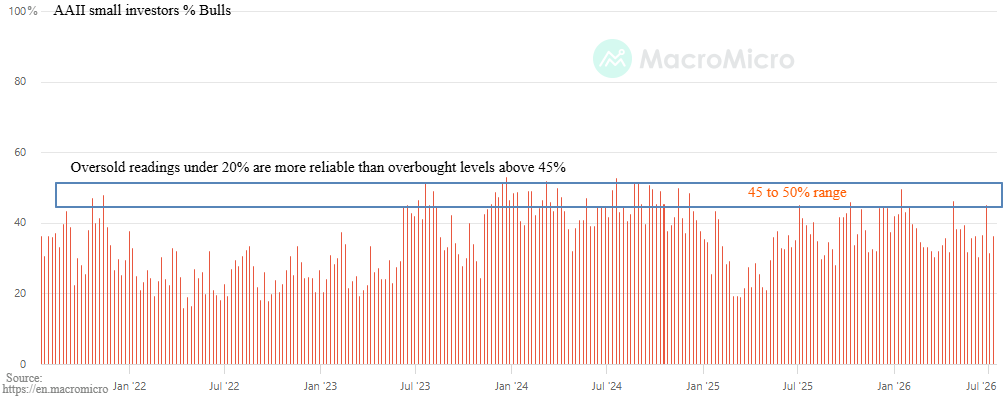
The AAII weekly survey shows 44.9% of individual investors bullish. We typically begin raising a yellow flag when bullish sentiment approaches 45–50%. Individual investors appear cautiously optimistic—not euphoric, but nearing the threshold where caution is warranted.
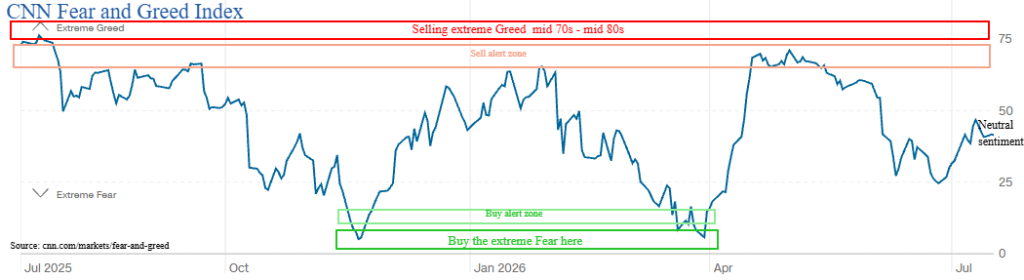
The CNN Fear & Greed Index just dropped to 41 today, squarely in neutral territory. Our concern historically rises when it enters the 65–80 range, signaling complacency. That has not yet occurred. With a neutral level today, we would note that technical sell signals in any indicator are less timely than oversold buy signals. Should this Fear index fall near single digits, it would firmly indicate a time to begin adding equity exposure to the portfolio.
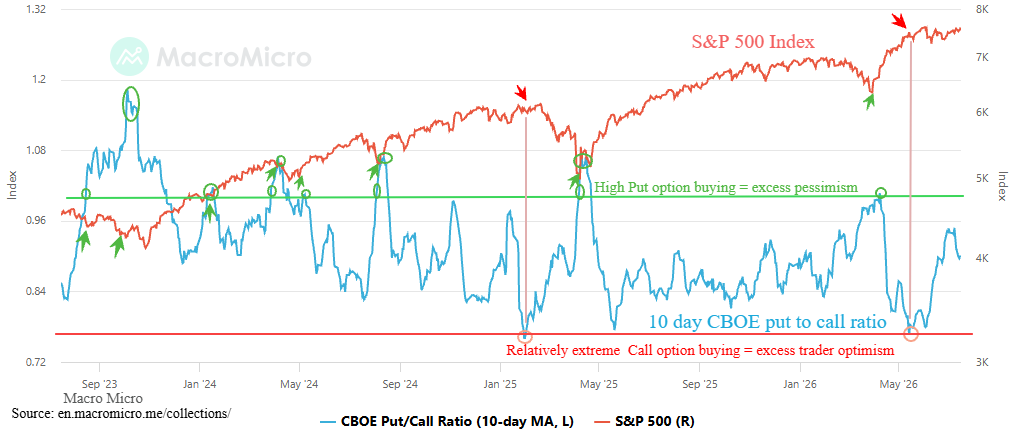
Two other indicators reinforce our cautious stance adopted in early June:
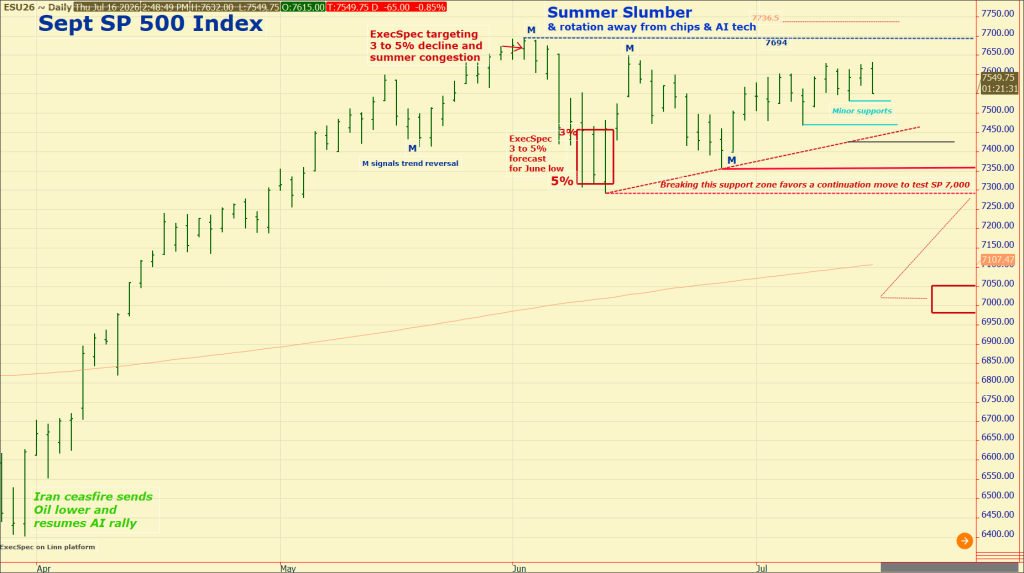
The CBOE 10-Day Put/Call Ratio hit optimistic extremes around May 14 and again near the June 2 peak, warning of overconfidence among option traders. Sentiment has since retreated toward neutral following the 6% pullback and consolidation in June–July. It remains unclear whether the correction has fully reset optimism or if further downside is needed.
The NAAIM Exposure Index showed leveraged professional managers tested just shy of the over-leveraged zone (99 to 105) on May 27 with a read of 98. The subsequent six-week consolidation has likely relieved much of that excess, with room to rise to an actual over-leveraged area should the S&P move to new highs again.
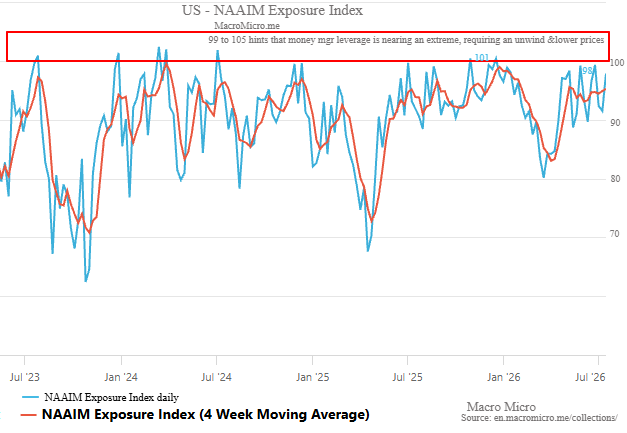
Collectively, these indicators support our central thesis for more than a month: not the start of a major bear market, but a period of summer congestion, labored advances, and selective profit-taking.
Technical Bottom Line
The technical evidence calls for modest caution, not pessimism. With the notable exception of the BofA Bull & Bear Indicator, few sentiment gauges are flashing red. Most remain close to neutral, suggesting investors have not yet reached the speculative extremes that often mark important market peaks. Our outlook is unchanged: the market is working through an overdue consolidation and leadership rotation before establishing its next sustainable trend.
Fundamentals Continue to Favor the Bulls
The underlying economy offers few signs of an imminent recession. Credit markets are calm, with corporate spreads historically tight. Consumer balance sheets, though less pristine than two years ago, still support healthy spending. Delinquencies remain low outside isolated pockets.Employment is resilient. The unemployment rate stands at 4.2%, with continuing claims confirming no meaningful slack in the labor market and 7.6 million job openings highlighting a persistent shortage of skilled workers. Wage growth of 3.6% remains supportive.Corporate earnings continue to impress, with Q2 expectations for 23–29% year-over-year EPS growth and 89% of companies beating estimates so far.Key Risks and UncertaintiesThe main downside triggers are not fundamental weakness but elevated valuations and sentiment. Notable risks include:
IPO Supply Pressure: A wave of new mega-cap offerings (SK Hynix, SpaceX, and potentially Anthropic targeting a trillion-dollar valuation later this year, followed by OpenAI) has already added over $100 billion in share float. This liquidity absorption could continue to weigh on existing stocks.
Political Uncertainty: Shifting congressional control and potential policy changes targeting the AI investment boom could create volatility, especially around the November elections.
AI Capital Spending Trajectory: The massive wave of investment in semiconductors, data centers, power, and automation remains a key differentiator from past cycles. However, users seeking cheaper AI tokens (including from China) could moderate spending growth and pressure margins longer term. For now, this appears more like a detour than a derailment.
Inflation and Energy: The sharp drop in core inflation to 2.6% is helpful, but oil prices have risen from ~$67 to $81 per barrel in recent weeks. A sustained move into the mid-to-upper $80s could revive CPI concerns, raise costs, and complicate the Fed’s path. We expect energy markets will eventually adjust around geopolitical risks, but near-term volatility remains a factor.
Outlook: Constructive with Selectivity
None of these risks changes our longer-term optimism. The AI genie is out of the bottle, and secular investment in artificial intelligence, data centers, power generation, automation, defense, and industrial infrastructure remains formidable. Earnings growth provides a solid foundation, even if valuations and sentiment have moved ahead. We continue to raise a yellow flag for the summer consolidation already underway. A correction of 9–10%+ in major benchmarks (and more in the chip sector) during 2026 would be neither surprising nor damaging to the longer-term bull market—it could even prove healthy. Markets occasionally need a controlled burn.The BofA indicator reinforces our caution and reminds us that expectations are elevated and the margin for disappointment has narrowed. It does not, however, signal that a major top has arrived. Bottom line: Navigate the bull market with greater selectivity, a somewhat larger cash reserve, and patience through this summer intermission. The fundamentals support optimism beyond the current consolidation.


Comments
Log in or sign up to join the conversation.