

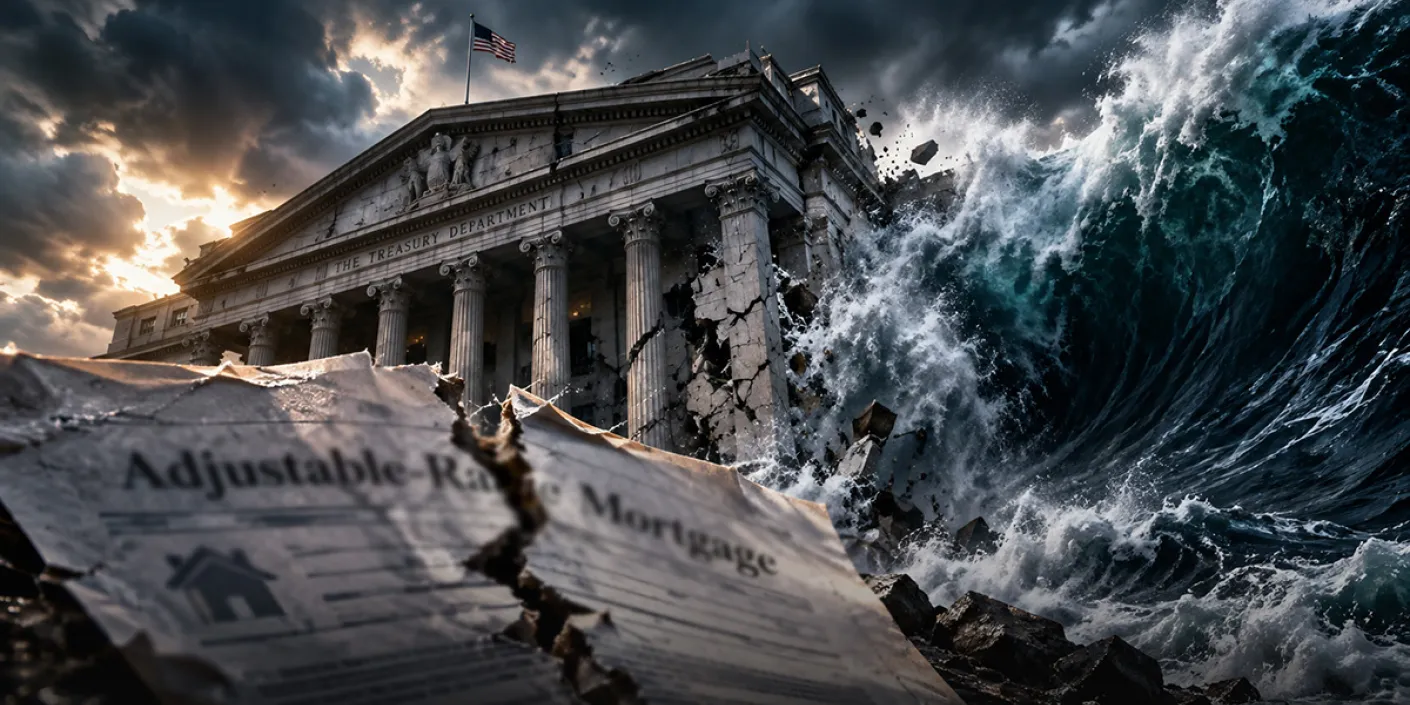
The Ghost of 2007
History does not repeat itself, but it often rhymes—and, right now, the global financial system is humming a familiar, ominous tune.
Nearly two decades ago, Wall Street and Washington presided over the buildup to the Great Financial Crisis. At its core, the 2007–2008 collapse was engineered around a fatal, widespread assumption: that money would remain cheap forever. Millions of homebuyers took out Adjustable-Rate Mortgages (ARMs) at rock-bottom rates. Nobody worried about what would happen when those teaser rates reset two or three years later. The universal consensus was simple: home prices only go up, the borrower could always refinance, and liquidity would never dry up.
When the Federal Reserve raised interest rates, the teaser rates expired. Monthly payments doubled or tripled, subprime borrowers defaulted en masse, and the entire collateralized mortgage pyramid collapsed into the lap of the Federal Reserve.
Today, we are witnessing the exact same movie. Only this time, the borrower isn’t a speculative subprime homebuyer in the Inland Empire or suburban Florida.
The subprime borrower is the United States Treasury.
Between 2008 and 2022, the Federal Reserve held interest rates pinned near zero (ZIRP) and monetized trillions in debt through Quantitative Easing (QE). During this fourteen-year period—and especially during the emergency fiscal blowout between 2016 and 2020—the federal government operated under the delusion that debt had no carrying cost.
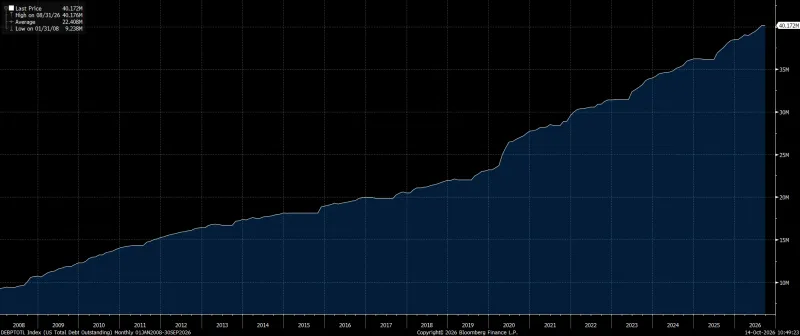
When borrowing is effectively free, debt discipline evaporates. The national debt exploded from roughly $9 trillion entering the 2008 crisis to over $40 trillion today.
Total US Debt (2008-2026)
Source: Bloomberg, Financial Sense Wealth Management
The ZIRP period handed the US Treasury a once-in-a-generation chance to lock in 30-, 50-, or even 100-year debt at just 1.5–2.5%, protecting the government from higher rates for generations to come. Austria and the UK seized the opportunity.
Instead, Washington did the exact opposite. Rather than terming out the debt, the Treasury became addicted to the shortest end of the curve—Treasury bills—to keep headline interest costs artificially depressed. They took out the sovereign equivalent of an Adjustable-Rate Mortgage.
That low-rate teaser period came to a screeching halt in 2022 when the Federal Reserve was forced to aggressively hike the Fed Funds rate to combat 40-year-high inflation.
The $10 Trillion Maturity Wall
The bill is now coming due. The United States faces an unprecedented maturity wall: approximately $10 trillion in short-term Treasury debt must be refinanced.
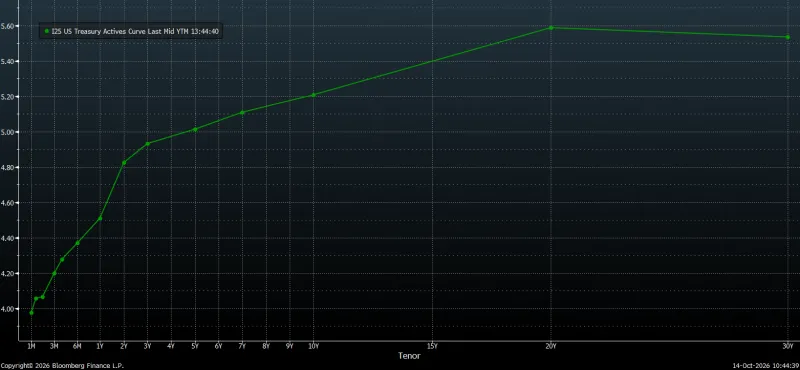
Much of this debt was issued when borrowing costs hovered between 0.25% and 1.5%. Today, as these notes and bills mature, they are being rolled over into a market where short- and intermediate-term yields range between 4.2% and 5.2%—rates that are three to four times higher.
US Treasury Yield Curve
Source: Bloomberg, Financial Sense Wealth Management
This is not new deficit spending; this is simply the cost to keep the existing debt running in place. It is the direct equivalent of an ARM resetting from 1% to 5.5% on an over-leveraged homeowner. The math turns vicious very quickly.
The Compounding Monster: Net Interest Expense
When interest rates rise on an ordinary debt load, fiscal policy tightens. When interest rates rise on a $40 trillion-plus debt mountain, net interest outlays transform into the single fastest-growing line item in the federal budget.
Annual net interest payments on the national debt have breached the $1 trillion threshold. For perspective, net interest expense now exceeds the entire national defense budget and is also larger than Medicare.
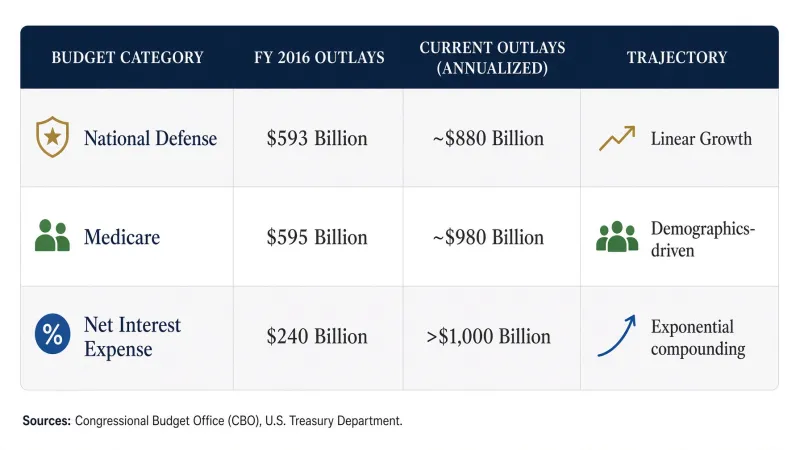
This creates an uncontrollable debt death-spiral: the Treasury must borrow more money just to pay the interest on the money it already borrowed. That additional borrowing generates yet more interest expense, requiring even larger auctions of short-term bills.
Where Have All the Buyers Gone?
In 2008, when mortgage-backed securities faced distress, market participants realized there were no bids for toxic subprime tranches. The Treasury market is now facing its own structural buyer deficit.
Historically, who absorbed the massive supply of US Treasuries?
The Federal Reserve through Quantitative Easing (now sidelined under Quantitative Tightening).
Foreign Central Banks, chief among them the Bank of Japan and the People's Bank of China.
Both traditional backstops have retreated:
China has systematically reduced its US Treasury holdings from over $1.3 trillion at its peak down to less than $750 billion, shifting reserves into physical gold, energy, and non-Western bilateral trade channels.
Japan, grappling with historic yen weakness, is constrained in its ability to accumulate foreign paper and has faced periodic pressure to liquidate Treasuries to defend its domestic currency.
Domestic Commercial Banks, sitting on hundreds of billions of dollars in unrealized losses from long-dated paper purchased at peak valuations in 2020–2021, have little regulatory appetite to absorb multi-trillion-dollar waves of new duration.
With the world's most stable, price-insensitive buyers exiting the stage, who’s stepped into the vacuum?
Unregulated Hedge Funds Running the Treasury "Basis Trade"
These funds exploit minuscule price discrepancies between cash Treasury bonds and Treasury futures contracts. Because the spread is often just a few basis points, they juice their returns by borrowing in the overnight repo market with leverage ratios often reaching 20-to-1 to 50-to-1.
This is no longer a niche strategy. As of the end of 2025, hedge funds held roughly $2 trillion in cash Treasuries—nearly triple the level from five years earlier—giving them a record 7% share of the entire marketable Treasury market.
Consider the systemic fragility: the bedrock sovereign debt market of the world’s reserve currency is no longer anchored primarily by sovereign reserves seeking a risk-free safe haven. It is increasingly dependent on leveraged hedge funds borrowing short in the overnight repo market to harvest basis points.
If repo rates spike—as they did in September 2019—or market volatility causes margin requirements to jump, these leveraged funds will be forced to dump Treasuries instantaneously.
The Inevitable Endgame: Auction Tails, YCC, and Dollar Debasement
When auction sizes expand relentlessly against a shrinking pool of real buyers, auctions begin to "tail"—meaning the yield at auction clears significantly higher than the pre-auction market price, indicating soft demand.
If primary dealers are forced to absorb supply they cannot resell, liquidity freezes. And in a sovereign bond market backing $40 trillion in public debt, a full Treasury auction failure is an outcome the financial system cannot survive.
Washington and the Federal Reserve are increasingly constrained by fiscal dominance—a situation in which the government’s large and growing debt load and ongoing deficits effectively limit what the central bank can do. Because higher interest rates raise the cost of servicing the national debt, the Fed has less room to fight inflation or tighten policy as aggressively as it otherwise might. With an unpayable sovereign debt wall looming, there are only three potential pathways out:
Austerity and Budget Surpluses: Politically dead on arrival. Neither party in Washington will cut entitlements or military spending, let alone balance the budget.
Outright Sovereign Default: Legally and financially unthinkable for a nation that issues its own fiat currency.
Financial Repression and Debt Monetization: The historic playbook of all over-indebted empires.
The playbook ahead is clear:
Yield Curve Control (YCC): When long-term rates rise to the point where they threaten federal solvency and crush the private economy, the Federal Reserve will be forced to cap yields on Treasury notes and bonds, just as it did between 1942 and 1951.
Uncapped Monetization: To enforce those yield caps, the Fed will have to stand ready as the buyer of last resort, expanding its balance sheet and monetizing whatever debt the private and foreign markets refuse to absorb.
The Sacrifice of the Currency: You can cap interest rates, or you can defend the purchasing power of the currency, but you cannot do both. By artificially suppressing yields below the true rate of inflation, the real purchasing power of the U.S. dollar will be sacrificed.
Preserving Capital in the Era of Fiscal Dominance
In 2008, the financial world learned that systemic risk cannot be destroyed; it can only be shifted from one balance sheet to another. Back then, Wall Street bailed itself out by dumping toxic private mortgage debt onto the public balance sheet.
Today, that risk has accumulated at the very apex of the global financial architecture—the U.S. Treasury. There is no higher balance sheet left to bail out Uncle Sam.
Wall Street’s standard playbook—the sacred 60/40 balanced portfolio and passive index funds—is designed for a disinflationary world that no longer exists. If you hold long-duration bond funds, you are holding paper certificates with no maturity date, sitting directly in the blast zone of rising yields and negative real returns. In an environment where the government’s explicit objective must be to keep interest rates pinned below the true rate of inflation—the classic post-WWII financial repression model—nominal bondholders are guaranteed to lose purchasing power year after year.
When financial assets face a secular winter, hard assets enter their summer. Surmounting this debt trap requires shifting out of paper promises and into tangible wealth that cannot be replicated at the push of a central bank button.
Given my outlook, I am taking a multi-pronged approach to positioning client portfolios, focused on the following:
Short-Duration Cash Flow Over Long-Term Paper: Keep fixed income in short-term individual paper or short-dated Treasury bills where capital rolls over before it can be burned by inflation. Focus the equity portion on cash-flow generators: essential companies with real pricing power, robust balance sheets, and growing dividends that can outpace the compounding cost of living.
The Monetary Bedrock with Precious Metals: Central banks can run the printing presses around the clock, but they cannot print silver and gold. Foreign central banks are already voting with their feet, aggressively accumulating gold reserves at the expense of U.S. Treasuries. Precious metals serve as unencumbered collateral with zero counterparty risk—an essential monetary hedge against currency debasement and sovereign balance sheet distress.
The Commodity Supercycle and Critical Resources: Decades of chronic underinvestment, restrictive regulations, and ESG capital starvation have left the global resource complex facing structural supply deficits. Demand for base metals, rare earths, uranium, and conventional energy continues to rise alongside global reindustrialization and infrastructure rebuilds. High-quality resource producers with proven reserves, expanding production profiles, and safe jurisdictions offer asymmetric protection.
The mathematics of a $10 trillion rollover wall cannot be negotiated away. The Federal Reserve and the Treasury will inevitably choose debt monetization, financial repression, and currency devaluation over outright sovereign default. Investors clinging to the assumptions of the last decade are repeating the mistakes of 2007. To protect purchasing power in the storm ahead, the capital preservation framework must pivot from paper claims to tangible reality.


Comments
Log in or sign up to join the conversation.