

Last week was rough for the market's most crowded trade. Google (GOOGL)/Alphabet had its worst single-day decline on record, Intel (INTC) had its worst crash since the 70s, and the Magnificent 7 and broader AI sector came under pressure. Now the financial media is asking whether the AI bubble is finally bursting.
Chris Puplava, Chief Investment Officer at Financial Sense Wealth Management, has been watching this setup develop since the summer. In his October 16 Smart Macro segment and companion article "All Booms End in a Bust – The AI Boom Is Likely No Different," he explained how credit markets were showing growing stress in AI-related companies while their stocks kept climbing—a concerning divergence that usually doesn’t end well.
In his latest conversation with Financial Sense Newshour, Chris explains what he saw, how it shaped the firm's positioning, and what he's watching now.
A Divergence That Couldn't Last
Chris's main concern wasn't valuation alone. It was that two markets were telling opposite stories.
Across the AI complex, including NVIDIA (NVDA), Micron (MU), Broadcom (AVGO), and the Mag 7, credit default swaps (CDS) kept rising to new highs. CDS are essentially the cost of insuring against a company defaulting on its debt. The stocks of those same companies kept rallying anyway.
"If you just looked at what the credit markets were saying [in terms of stress], you would expect every AI play to be at a 52-week low. Instead, we saw the complete opposite. They were at 52-week highs."
Over several months, the gap grew until the chart looked like what traders call "alligator jaws."
"Someone was wrong. Either the credit markets were wrong or the equity markets were wrong. And from what I've seen, the credit markets tend to be right."
Why Credit Tends to Lead
Chris's reasoning comes down to how each group of investors thinks:
Credit investors focus on getting repaid. Will the company be able to return the principal and the final interest payment when the bond matures? Answering that takes close work on balance sheets, cash flow, revenue, expenses, and margins.
Equity investors tend to look at shorter horizons. Will the company beat next quarter's estimates? How will the stock react to guidance?
When the two disagree, Chris has found that stocks are usually the ones that adjust.
"It's incredibly rare that I find that the credit markets were the ones that were wrong... It's almost always the equity markets play catch up to the downside whenever I see signs of stress in the credit markets."
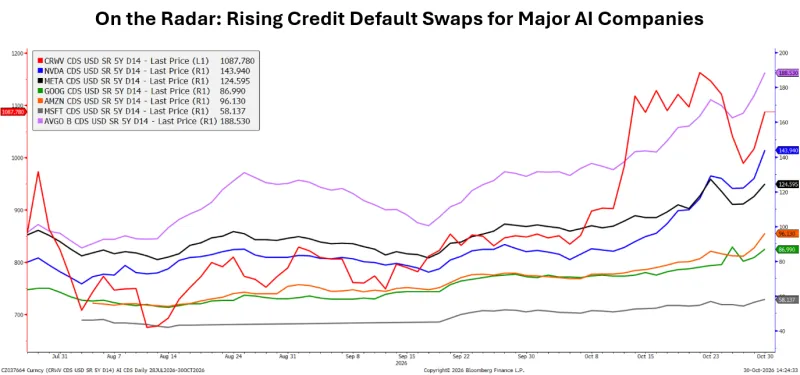
Source: Bloomberg, Financial Sense Wealth Management
Asymmetric Risk Into Earnings
Chris normally avoids trading ahead of earnings because any single report can go either way. This time, the credit signal led him to make an exception.
He saw the risk as asymmetric. With credit markets already pricing in stress, a disappointing report would likely hurt a stock much more than a strong report would help it. Based on that, the firm, which was already underweight technology relative to its benchmarks, sold Alphabet before its earnings release, which went on to have one of the largest single-day declines in its history.
Tech exposure has been reduced further since then. Chris says the firm is currently below its neutral risk level with above-average cash, mainly because of uncertainty around the midterm elections and possible escalation with Iran.
How Passive Investing Can Amplify the Downside
One of Chris's most useful points is about how today's market structure can make declines worse.
Because the S&P 500 is so concentrated, every $100 sold from an S&P 500 index fund means selling roughly $8 of Apple (AAPL), $8 of Microsoft (MSFT), and about $6 of Google, by Chris's estimate.
"Leverage works both ways. It works on the way up and it works on the way down. And that's the same with passive investing. All of these big mega caps, they benefit from passive investing when money flows in, but they also get hurt disproportionately when money flows out."
Passive inflows usually dominate the market. However, when that reverses and institutions, hedge funds, or retail investors start raising cash or rotating elsewhere, mega-cap tech takes a disproportionate share of the selling because of how concentrated the index is. Chris says last week gave us a taste of that.
Reading the Credit Markets: Chris's Framework
Chris says he learned to respect credit signals ahead of the 2008–2009 financial crisis, when credit markets were sending a very different message than stock prices or TV financial commentary.
He watches three main measures:
Credit spreads: the extra yield on riskier debt compared with Treasuries, or between rating tiers such as junk vs. investment grade, or distressed vs. investment grade.
Credit default swaps: the direct cost of insuring against default.
Total returns in the riskiest credit: leveraged loans, high yield, and distressed debt.
Where the Stress Is, and Whether It's Spreading
Chris also tracks credit stress by sector, because where it shows up matters as much as how big it is:
2008: Stress centered on financials and real estate, and it did become systemic.
2014–2016: Stress was concentrated in energy, as the shale bust and coal defaults hit highly leveraged companies. It never became systemic.
Today: "Believe it or not, it's in the tech companies."
The key question is whether the stress stays contained.
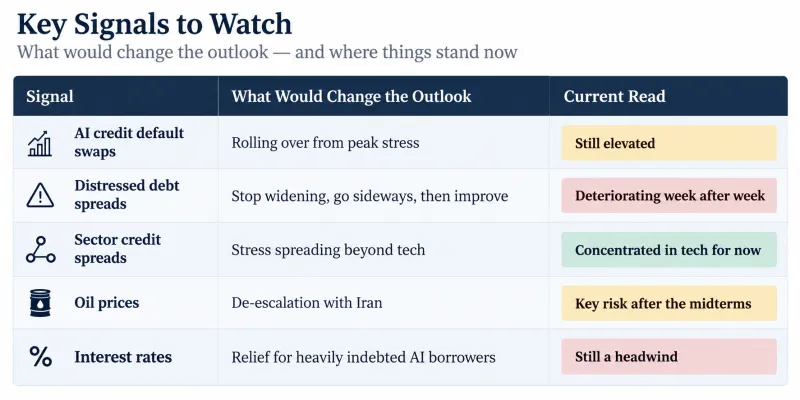
"If I start to see other sectors — industrials, healthcare, utilities, energy, materials, consumer discretionary — if I start to see those spreads for those sectors blow out, that would lead me to believe that this is not isolated and this could be actually indicative of potentially a recession."
Since AI capital spending has been propping up the economy, stress spreading from tech into other sectors would be an important warning sign. Chris boils his approach down to three questions: Is it isolated? Is it spreading? Is it improving?
What Would Signal a Turn
Chris describes credit markets as behaving "like an oil tanker." They move steadily in one direction and turn slowly, with much less noise than stocks. That's why he looks at week-over-week trends instead of daily moves.
So far, that trend hasn't improved:
"When I look at distressed debt, all year long, they've been worsening... Even when the stock market has a huge rally, I don't see a reversal in distressed debt credit spreads. It's just continued weakness all year long, every week... one-way street."
To him, that means this year's equity rallies have been "on weak footing." Before turning more constructive, he wants to see:
CDS rolling over from peak levels
Spreads that at least stop deteriorating and move sideways
Ideally, a sharp recovery in spreads showing that financial stress is easing
The Macro Backdrop: Financing Costs, Overseas Spending, and Oil
Higher rates are squeezing the AI build-out
AI capital spending on chips, data centers, and related construction now rivals past investment manias like railroads, canals, and the internet as a share of GDP. Much of it is funded with debt, which makes interest rates central to the story.
"If interest rates were 100 to 300 basis points lower and if we didn't have the Iran war, we might not actually be having this impact on the tech sector. I think the issue is all this financing being done at higher interest rates, it's squeezing margins and profits of some of these companies who are issuing all this debt and yet don't have the revenue to service it."
The wildcard: Iran and energy
Chris's biggest near-term concern is what happens after the midterms if the U.S. escalates with Iran.
"Do we see a spike in oil to $125, $150 a barrel? ... If we see oil prices spike even further, that could lead to the Federal Reserve feeling like they have to raise interest rates to combat inflation. And that could be a real economy killer if we have an energy shock and interest rate shock."
An energy shock, a rate shock, and a pullback in tech all at once could be, in his words, "a little bit too much to handle." Higher energy prices also feed back into the AI financing problem by keeping rates high.
Looking Ahead
Whether this week turns out to be the start of an AI bust or just some air coming out of an overheated trade, Chris's framework gives investors something concrete to watch: the credit markets. As long as stress stays contained to tech and spreads stabilize, the damage may stay limited to one corner of the market. If stress increases, spreads to other sectors, or an energy shock pushes rates higher, downside risks increase.


Comments
Log in or sign up to join the conversation.