


AI’s Crisis of Confidence
The artificial intelligence trade has undergone an abrupt change in sentiment. Earlier this year, technology companies were often rewarded for increasing capital expenditure budgets. More recently, large spending commitments have instead prompted questions about free cash flow, borrowing costs and the return on investment.
Credit investors have been particularly concerned about infrastructure companies that must fund GPU purchases and data-center construction before their contracted revenue is earned. The distinction matters: skepticism about financing is not the same thing as evidence that demand for computing has disappeared.
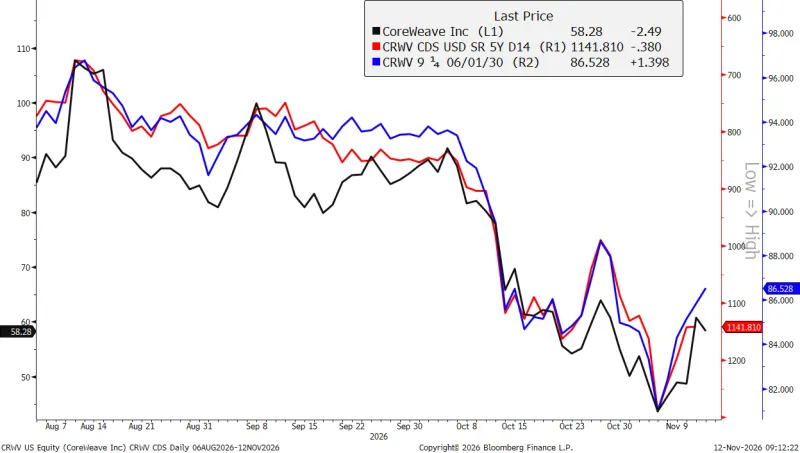
CoreWeave (CRWV) became a useful barometer of that debate. Its unsecured bonds traded at deeply elevated yields and its credit default swap (CDS) spreads widened sharply as investors assessed the risks of its debt-financed expansion. Then, ahead of its November 10 earnings report, portions of its credit market began to recover.
CoreWeave: Better Economics, Not Just Faster Growth
CoreWeave reported third-quarter revenue of $3.66 billion, up 168% from a year earlier, and revenue backlog of $132.5 billion. Adjusted EBITDA reached $2.26 billion. Its adjusted operating margin rose to 10%, compared with 1% in the first quarter; the corresponding GAAP operating margin was 6%. Management raised 2026 revenue guidance to $13.0–$13.3 billion.
For investors worried about a spending bubble, the most useful part of the call concerned how CoreWeave intends to pay for that growth. Its weighted-average cost of debt was 7.9%, down about 250 basis points year over year. Management expects approximately $9 billion in customer prepayments and deposits over the next three months, including funds tied to existing infrastructure rather than entirely new construction.
CoreWeave says more than 75% of committed capital expenditures through 2027 relate to investment-grade and enterprise customers. It does not plan to issue additional unsecured parent-level debt through 2027 at prevailing yields, relying instead on secured asset-level lending, contract-linked financing, prepayments and internally generated cash. It also expects EBITDA less interest, excluding prepayment benefits, to more than double in 2027. These are management expectations, not guaranteed outcomes.
The company is hardly slowing to a crawl: 2026 capital expenditure guidance is still $37 billion–$39 billion. But management says it has flexibility to keep 2027 spending broadly near 2026 levels while growing revenue and profitability. The message is no longer simply “build more.” It is “earn more on what we build.”
Credit Markets Are Beginning to Respond
According to the Bloomberg CDS, CoreWeave’s five-year spread reached roughly 1,278 basis points on November 5 and moved down toward 1,135 basis points by November 10, an approximately 11% decline. The accompanying bond chart also showed improving prices and lower yields before the earnings release. This was a pre-earnings improvement; it should not be described as the market’s reaction to management’s November 10 presentation.
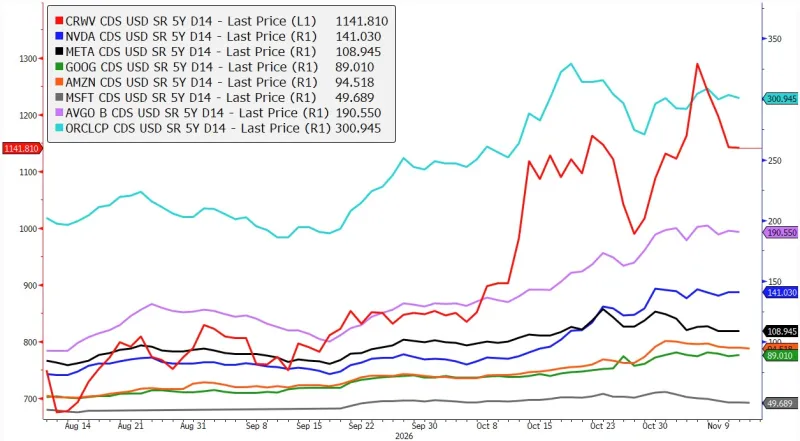
The distinction between its 7.9% weighted-average debt cost and much higher marginal yields on unsecured bonds is crucial. The former reflects its existing mix of financing; the latter indicates the cost of obtaining a particular type of new borrowing in stressed markets. CoreWeave’s stated avoidance of unsecured issuance is therefore economically meaningful.
Yet the balance sheet remains the central risk. CoreWeave reported a $709 million quarterly net loss, $846 million of net interest expense and approximately $46.9 billion of total debt at quarter-end. A growing backlog is not cash already collected, nor is adjusted EBITDA free cash flow.
To me, the first sign of renewed confidence is that operating performance and financing discipline are beginning to answer the questions raised by the credit market. The stronger confirmation would be a sustained narrowing of spreads, better bond pricing and successful financing transactions at less punitive terms.
Is AI Spending Really a Bubble?
There is a compelling bearish case: expensive infrastructure, rapidly changing GPU technology, substantial leverage and valuations that assume years of successful execution. The late-1990s telecom buildout reminds us that real technological demand can coexist with poor investment returns.
But the evidence for widespread physical overcapacity is less convincing today. CoreWeave says qualified demand through 2027 is approximately ten times its available capacity. Management reported price increases of about 25% in July and a further approximately 10% later in the quarter, with prices for some older GPUs increasing 30%–50% quarter over quarter. These are company-reported observations, not independent measures of all industry supply and demand.
Rising prices, customer commitments and strong renewals are inconsistent with a market already suffering broad excess capacity. They do not rule out a valuation bubble, future oversupply or individual financing failures. The key distinction is between demand for compute and the returns companies earn on the capital required to deliver it.
Agentic AI's Rapid Computing Demand
Early generative-AI interactions generally produced an answer to a user’s question. An AI agent can research, retrieve files, call tools, write software, check results and repeat the process. Each additional step generates model activity; complex workflows may consume many more tokens than a short chat.
Anthropic reports that its agents used about four times as many tokens as ordinary chats and its multi-agent research systems about fifteen times as many. That is vendor research from a specific implementation, so it should not be treated as an industry-wide multiplier.
Independent researchers offered further evidence in an April 2026 study, How Do AI Agents Spend Your Money? Analyzing and Predicting Token Consumption in Agentic Coding Tasks, by Longju Bai and colleagues from the University of Michigan, Stanford University, MIT, and other organizations. Analyzing coding workloads across eight frontier AI models, researchers found that agentic tasks consumed roughly 1,000 times as many tokens as conventional code-chat or reasoning workloads, with repeated input processing driving much of the cost. However, the tasks were not identical: the findings demonstrate how expensive longer autonomous workflows can become, not that agents require 1,000 times more GPU computing power to complete the same task. (Bai et al., April 2026)
There is also an offsetting force. In a November 2026 study, How Do AI Agents Waste Your Money?, Huimin Zeng and colleagues found that approximately 41%–46% of an AI agent's reasoning could be eliminated in experimental workflows while largely preserving task performance. Published November 4, 2026, the research demonstrates how improvements in agent design and software efficiency could reduce unnecessary token consumption without materially compromising results. (Zeng et al., 2026)
That is why the economic issue is aggregate use, not a fixed tokens-per-task multiplier. As AI becomes cheaper and better, new applications could become commercially viable, an echo of the Jevons paradox. Yet Epoch AI estimates that the hardware shipped through 2027 could support tens to hundreds of millions of concurrent frontier-model agents, while even partial utilization at current API-equivalent prices would imply trillions in annual spending. The industry must create sufficient customer value to support that capacity.
What the Shale Revolution Can Teach Us
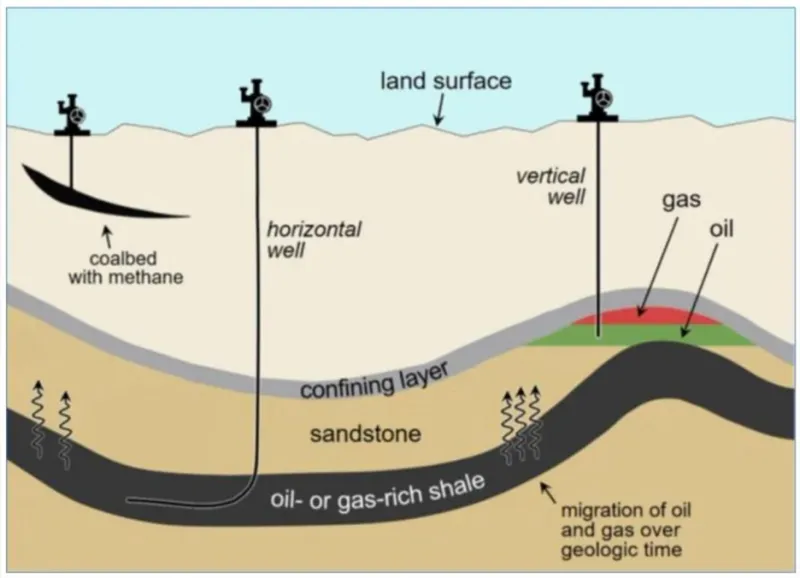
This debate reminds me of the early-2010s peak-oil discussion. Analysts looking at mature conventional fields questioned how production could keep pace with demand. Advances in horizontal drilling and hydraulic fracturing changed the economics of resources previously considered difficult or uneconomic to produce.
U.S. crude production averaged about 5.5 million barrels a day in 2010, more than 12 million in 2019, and a record 13.6 million in 2025. Technology profoundly changed the supply outlook.
The analogy is not exact. Shale innovation expanded oil supply; agentic AI may expand demand by creating entirely new categories of productive work. What links them is the danger of extrapolating current economics through a period of rapid technological change. A forecast built around today’s chatbot use may miss the compute required by tomorrow’s autonomous workflows. That does not prove every AI investment will be profitable.
Political Restrictions: Delays or Displacement?
The November elections have added uncertainty to the data-center construction pipeline. New governors in several states have supported pauses or tighter rules, and state and local officials can influence permits, power infrastructure and development schedules even when federal legislation faces a presidential veto. Bloomberg reported that roughly 40% of planned U.S. data-center capacity sits in states where incoming governors have called for restrictions or pauses. That is exposure to policy risk, not a verified cancellation rate.
There is another side to this calculation. Projects turned away from one jurisdiction may seek sites in another state with available power, land and permits. Loudoun County, Virginia, demonstrates why local officials compete for this business: its data centers generated approximately $1.2 billion in FY2026 property tax revenue, equivalent to 39% of the county’s overall budget, and the county cites more than 17,000 direct and indirect related jobs. Its residential real-estate tax rate fell from $1.145 per $100 of assessed value in 2016 to $0.805 in 2026, although lower rates have not meant lower bills for every homeowner.
Relocation is not frictionless. Electrical interconnection, transmission capacity and construction lead times can make a delayed project expensive to replace. CoreWeave says its near-term backlog is supported largely by permitted sites or facilities already under construction, limiting its expected 2027 exposure. Investors should watch actual permit decisions, megawatts delayed and revised capital budgets rather than assuming announced proposals will necessarily eliminate spending.
Two More Tests for the AI Trade
Nebius (NBIS) reports third-quarter results on Thursday, November 12. Its financing plan, infrastructure deployment, revenue conversion and margins will provide another test of whether strong AI demand can translate into durable operating economics.
Anthropic’s proposed IPO later this month offers a larger capital-markets test. Its November 10 preliminary prospectus describes 801.35 million new shares offered by the company, plus 23.65 million secondary shares, at an indicative $70–$78 range. These terms are preliminary and subject to change. Anthropic receives proceeds from its primary issuance, not from the secondary sale.
The headline valuation will attract attention, but what matters more for the infrastructure cycle is the amount of fresh capital raised, how much is provided by independent investors rather than strategic partners, and whether subsequent financing remains available on sustainable terms. A successful equity offering would be constructive; it would not by itself resolve the economics of all downstream data-center projects.
The Bottom Line
The AI investment cycle is moving from a period that rewarded capacity announcements to one that demands evidence of returns on capital. CoreWeave’s earnings offered an encouraging first response: rapid revenue growth, better operating margins, pricing power and a more detailed financing strategy. Its credit market had also begun to stabilize before the announcement.
The risks have not disappeared. Debt remains heavy, future construction may face regulatory delays, and agentic AI must generate revenue commensurate with the infrastructure needed to support it.
But I see an important difference between a correction driven by financing concerns and one caused by collapsing demand. The current evidence points more clearly to the former. The next confirmation must come from credit markets, Nebius, Anthropic and, ultimately, sustainable cash generation.



Comments
Log in or sign up to join the conversation.