


Rising Dollar and Rates Point to Risk-Off
The biggest near-term concern is the simultaneous rise in the dollar and interest rates—the same combination that preceded broad market declines in 2022.
“Whenever you see a combination of a rising dollar and rising rates, it’s not a good sign. That’s what we saw in 2022, which led to significant declines in stocks, bonds, and virtually everything outside of energy.”
After the early-2025 tariff-related selloff, the Bloomberg dollar index spent roughly a year and a half in a sideways range. It has now broken out of that range in a pattern that resembles a bull flag, raising the possibility of further dollar strength. A stronger dollar typically pressures commodities, emerging markets, and risk assets more broadly while increasing the burden on borrowers who finance in dollars.
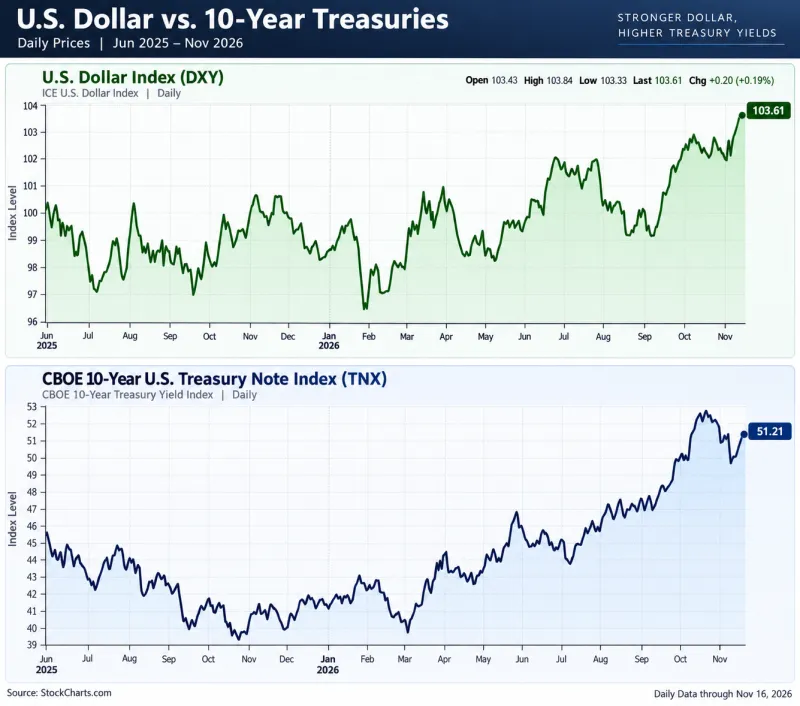
Interest rates have also risen sharply the past two weeks. After falling for most of October, rates have jumped again as markets price in a high probability of a Federal Reserve rate hike at the December 9 meeting and additional tightening thereafter, driven by sticky inflation and resilient employment data.
“The combination of rising rates and a rising dollar should, I think, tilt investors toward a risk-off stance right now—and not chase the recent bottom until we see a reversal there, because that combination is not favorable for stocks.”
Beneath the Surface, the Market Is Not Healthy
The S&P 500 initially bounced off its 200-day (longer-term) moving average, but Chris argues the underlying technical picture still remains weak. Technology already represents about 32 percent of the index; adding the major hyperscalers pushes the contribution of a handful of large companies above 40 percent. Outside that narrow leadership, most of the market is struggling.
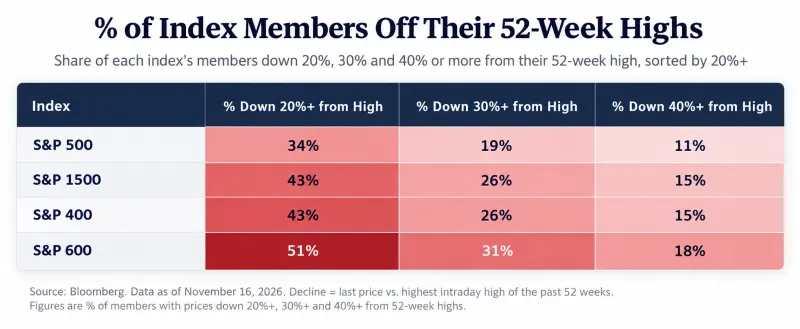
“In a bull market, you want to see a rising tide lift all boats… Currently… 34 percent of the S&P 500 is in a bear market… That’s not a healthy market.” [Note: updated to today's numbers shown in table below]
Source: Bloomberg, Financial Sense Wealth Management
Recent relative strength has been concentrated in defensive areas. In the latest week, healthcare led with 20 percent of its stocks hitting new 52-week highs, followed by consumer staples at 12 percent. New lows were more common in financials, industrials, consumer discretionary, and technology.
“As of today, when you look at the S&P, 34% of the S&P 500 is in a bear market. Looking at a 30% drawdown, 19% of the market is down 30% or more. So, there’s a lot of pain when a third of the market is in a bear market. That’s in large caps—which have been the strongest area. Looking at small caps, like the S&P 600, half—roughly 300 stocks—are in a bear market: 51%. A 30% drawdown? Now, roughly one-third of the S&P 600 is down that much. Looking at the whole market—small, medium, and large (the S&P 1500 Super Composite, which is the mid-cap 400, small-cap 600, and large-cap 500)—43% is in a bear market. A quarter is down 30% or more. That’s not a healthy market.” [Note: updated to today's numbers shown in table above]
Credit Stress in AI and Tech Remains Elevated
Chris has been drawing attention to rising credit default swaps—insurance against default—on the debt of major AI-related and hyperscale names since they began to spike in October of this year. As he noted October 16th (see AI Boom vs. Bust: Chris Puplava on Why the Credit Markets Are Worried), credit default swaps were moving aggressively higher on NVIDIA (NVDA) even while the stock was trading near all-time highs, alerting investors that risks were building beneath the surface for one of the largest AI tech stocks. Since then, the stock has declined by roughly 30%, and Chris says he is closely monitoring credit stress among the major tech companies to assess whether risks are stabilizing or deteriorating further.
Here’s what Chris had to say when we spoke with him in the most recent Smart Macro segment:
“There’s been some improvement over the last couple of weeks… However, we’re significantly above where we were a year ago… in general, the trend is up for credit default swaps on the hyperscalers and big neo-clouds.”
Chris does not yet see enough improvement to conclude that the peak in credit stress is behind us. He continues to treat elevated CDS as a reason for caution on the most crowded tech and AI names.
Positioning: Extra Cash and Short-Term Yield
Given rising rates and a stronger dollar, elevated credit stress, narrow leadership, weak breadth, and remaining uncertainties (including the situation with Iran and the path of Fed policy), Chris favors staying at or slightly below neutral risk exposure with above-average cash.
Short-term yields are attractive. T-bills offer over 4 percent, with six-month bills in the 4.25–4.5 percent range. One- to three-year corporates can yield around 6 percent. He is not interested in extending duration into long-term Treasuries, citing large federal deficits and the fact that government spending resembles a recessionary pace. In a risk-off environment without a clear recession signal, he prefers to collect short-term yields rather than reach for stock-like returns in long bonds.
“I’d rather be in short-term T-bills, rolling them over every couple months, and then, when there’s a good buying opportunity, take that matured cash back into the stock market… I’m really not interested in dramatically increasing duration absent a recession.”
The broader economy is still holding up, with jobs reasonably firm and no widespread credit deterioration that would point to an imminent sharp downturn. However, Chris sees vulnerability if the AI capital-spending engine slows meaningfully, as that has been a meaningful support for growth.
What Would Signal a Turn
The clearest improvement would be a reversal in the two main headwinds: the dollar rolling over and interest rates stabilizing or declining. Earlier in the year, when rates fell, credit spreads tightened and non-tech sectors improved. Until those conditions return, Chris views recent strength as more likely a relief bounce than the start of a sustained advance.
He also continues to watch whether credit stress stays concentrated in technology or begins to spread to other sectors, and whether the elevated share of stocks in bear markets begins to decline meaningfully.
Whether the current period resolves into a more extended sideways or corrective phase, or simply a pause before further gains, Chris’s framework centers on the dollar, rates, market breadth, and credit signals. As long as the dollar and rates remain rising and credit stress in AI-related names stays elevated, he favors caution, extra cash, and selective short-term yield rather than chasing rallies.



Comments
Log in or sign up to join the conversation.