

If you’ve been listening to our broadcast over the years, you know I often remind our listeners of an old rule of thumb: Wall Street is paid to sell you the next hot story, but math is the only thing that never lies.
Right now, the financial press is obsessed with the AI bust and the Fed’s next move. Will they raise rates a quarter or half a point in December? Will that be followed by further hikes in January and March? Currently, the futures market is forecasting a 97% quarter-point increase in December, a 70% quarter-point hike in January, and a 46% quarter-point rise in March. But the market is probably going to force a pivot.
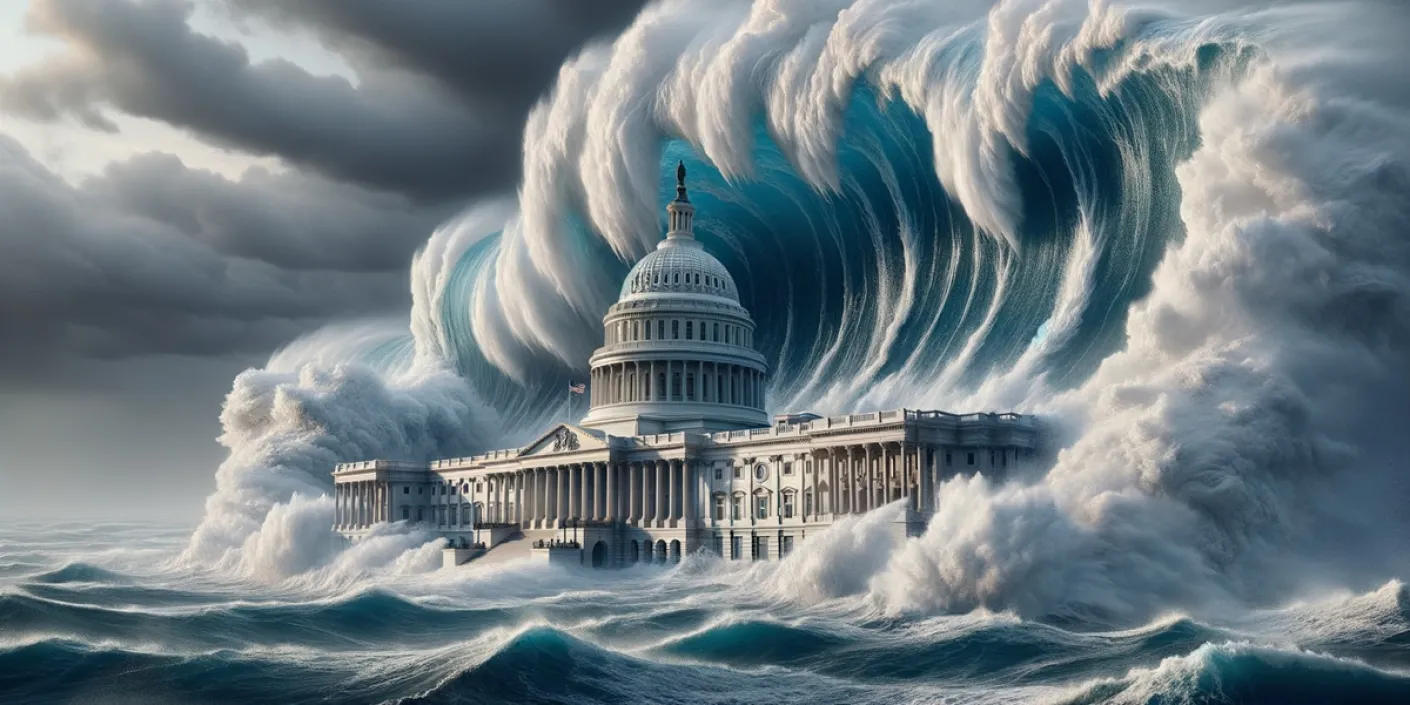
If you step back from the current headlines and look at the big picture, the more important story isn’t really about the Fed or even AI. It’s that the U.S. government is heading straight into a wall of debt refinancing in 2027—and the numbers simply no longer add up.
The 2027 Debt “Maturity Wall”
Imagine a family that went on a massive spending spree back in 2020. Fortunately for them, the bank offered a special introductory promotion: zero-percent interest for five years.
For five years, that family felt rich. They bought whatever they wanted, and their monthly credit card statement looked tiny because their interest rate was practically zero.
Then the promotion ends. The teaser rate expires, and the bank informs them that their borrowing rate is now adjusting to 22%.
Suddenly, even if they don’t buy another single thing, their monthly interest payment alone eats up half their paycheck.
Sound familiar? What happened to homeowners in the 2000s is precisely what is now happening to the U.S. government.
During the 2020–2021 pandemic crisis, the Treasury borrowed trillions of dollars at rock-bottom rates between 0.5% and 1.8%.
Now those 5-year and 7-year IOUs are coming due.
Through the rest of this year, over $1.1 trillion in older, low-rate debt has to be paid off and replaced with brand-new debt.
In 2027, the dam really breaks: approximately $3.4 trillion in medium- and long-term notes come due. When you include short-term Treasury bills, the government will have to roll over close to $9 trillion in a single year.
Here’s the catch: the Treasury can’t borrow at 1% anymore. Today, it must pay close to 5% or more.
For twenty-five years, whenever Uncle Sam rolled over old debt, it did so at lower rates. Monthly payments went down. Today, that dynamic has flipped. Refinancing that mountain of debt at today’s rates adds tens of billions of dollars every single year to the deficit purely through higher interest costs.
The Snowball Effect: Looking at the Real Numbers
In fiscal year 2026, total government spending topped $7.4 trillion. But look at where that money went: net interest on the national debt jumped over 11% to roughly $1.14 trillion. Net interest is now bigger than our entire national defense budget.
Entitlements are on autopilot: Social Security, Medicare, and Medicaid ate up another huge chunk of the budget.
According to the nonpartisan Congressional Budget Office (CBO), our total national debt is blowing past $40 trillion this year. By 2030, debt held by the public will cross 108% of GDP.
To put that into historical perspective: the highest debt level America ever reached was 106% of GDP in 1946, right after mobilizing the entire nation to fight and win World War II. We are on track to permanently shatter that wartime record in peacetime—with no world war, no national draft, and no emergency mobilization.
By 2036, the CBO projects interest payments alone will cross $2.1 trillion a year. At that point, Social Security, healthcare programs, and interest on the debt will consume virtually every single penny of federal taxes collected. Every other department—from the military to the FBI to national parks—will have to be put on the national credit card.
Why Washington Won’t Fix It
You might ask: won’t politicians in Washington just cut spending or raise taxes to fix this?
I’ve watched Washington for over forty years in my career. Neither party has the stomach for real fiscal discipline.
When you look at the major spending proposals on Capitol Hill—whether it’s expanded family tax credits, universal childcare subsidies, healthcare expansions, or housing grants—we are looking at another $3.6 to $4.4 trillion in gross spending programs over the next decade.
Even if you pass every proposed tax increase on corporations and high earners, it barely makes a dent against the compounding wave of interest and baby-boomer retirements. The structural annual deficit will still run at nearly 6% of GDP as far as the eye can see.
The Economy Today: A Tale of Two Consumers
Now let’s look at the economy. Are we about to fall into a deep recession tomorrow?
The economic indicators we watch—like the Conference Board’s Leading Economic Index (LEI)—are actually telling us that growth is holding up around 2%. The job market isn’t falling off a cliff.
Instead, we have a two-track, K-shaped economy.
The Strained Main Street Consumer: If you make an average paycheck, life feels expensive. Prices are up anywhere from 30% to 50% (or higher) since 2020. Credit card debt is at record highs, car loan delinquencies are climbing, and mortgage rates above 7% have frozen the housing market.
The Booming Industrial and AI Pipeline: On the other side of the tracks, money is pouring into artificial intelligence data centers, rebuilding our aging electrical power grid, domestic energy production, and military manufacturing.
This capital-spending boom is keeping the economy afloat. But it has a weak spot: it requires enormous amounts of cheap electricity, expensive equipment, and heavy borrowing. If interest rates stay high, those big corporate projects will eventually hit a wall, too.
The Big Question: When Does the Fed Blink?
Wall Street consensus says the Fed will start cutting rates by mid-2027 because inflation will magically drift down to its 2% target.
I don't buy that inflation story, and neither do many of the sharp macro thinkers we follow.
They point out that the Fed is trapped in a condition economists call Fiscal Dominance. In plain English: the government’s debt has grown so massive that the central bank can no longer control the steering wheel.
Think about the trap Fed Chairman Warsh is in.
If he keeps rates high to fight inflation, he bankrupts the Treasury by forcing them to refinance trillions of dollars at 5%, while crushing regional banks and corporate borrowers.
If he slashes rates, he pours gasoline on inflation, crude oil spikes higher, and consumer prices take off again.
Furthermore, Luke Gromen points out an incredible paradox: when debt is this high, high interest rates fuel inflation. Why? Because the federal government is paying out over $1.1 trillion in cash interest directly into the financial system, putting fresh purchasing power right back into circulation!
So, what happens next? Grant Williams describes it as a forced capitulation. The Fed won’t cut rates because they “won” the inflation fight. No, they will cut rates because the Treasury market will force them to.
We’ve seen this movie before. In the late 1940s, after World War II, the U.S. government had a 106% debt-to-GDP problem. Did they raise interest rates to 10% to fight inflation? Absolutely not.
The Fed stepped in and capped interest rates at 2.5%, while inflation ran at 6%, 8%, or even 10%.
That is called Financial Repression. The government intentionally holds interest rates below the rate of inflation, slowly eroding the purchasing power of cash and bonds to shrink the debt in real terms. It’s a hidden tax on every saver in America.
Your Survival Guide: How to Invest for What Lies Ahead
So, how do you protect yourself when the game is rigged to erode paper money?
For decades, the standard advice was the “60/40 portfolio”—put 60% of your money in stocks and 40% in government bonds, then sit back and retire. In an era of fiscal dominance, that strategy is broken. Long-term government bonds yielding less than the real cost of living are guaranteed to lose purchasing power.
The Financial Playbook My Firm Is Following for Clients
Own Businesses with Real Cash Flow, Not Promises
In a high-rate world, companies that don’t make money today are toxic. Move money away from debt-heavy, speculative tech stocks trading at nosebleed valuations. Focus on Defensive Value: Healthcare, Consumer Staples, Utilities. These are companies that sell everyday necessities, generate hard cash today, and pay reliable dividends.Overweight Energy and Master Resources
Energy is the lifeblood of everything we do. Between geopolitical strife in the Middle East and the massive electric power demanded by new AI data centers, global energy supplies are tight. Owning oil, gas, and power infrastructure gives your portfolio an ironclad inflation hedge.Demand Clean Balance Sheets
Avoid companies drowning in junk debt. When that 2027 refinancing wall hits corporate America, weaker businesses will see their profit margins crushed by higher interest costs. Stick with companies with little to no debt and ample cash reserves.Don’t Panic into 100% Cash
A lot of frightened investors throw their hands in the air and move everything into cash. That’s a mistake. While cash pays a decent nominal return today, financial repression guarantees that inflation will outrun cash over time. Plus, with corporate share buybacks running hot and short-sellers heavily short, markets can stage violent rallies when you least expect it.Hold Real, Tangible Assets: Gold
If history teaches us one undeniable lesson, it is this: whenever governments find themselves with too much debt, they always choose to debase the currency. They have done it from ancient Rome to 18th-century France to post-WWII America.
Physical gold is nobody’s liability. It cannot be printed by a central bank, and it cannot be defaulted on by a politician. In an age of financial repression, gold remains the ultimate monetary anchor.
The Bottom Line
You don’t need to fear the future, but you do need to understand the rules of the game we are playing.
The 2026–2027 debt wall is a mathematical certainty. Washington cannot borrow trillions of dollars forever without consequences, and the Federal Reserve will eventually be forced to choose between defending its currency or bailing out the Treasury.
Keep your head clear, tune out the daily market cheerleaders, avoid debt-choked companies, and anchor your wealth in tangible, cash-flowing assets.
Until next time, stay disciplined, stay safe, and always keep your eye on the Big Picture.



Comments
Log in or sign up to join the conversation.