

Last week, in a move buried by headlines about inflation, new leadership at the Federal Reserve, and the war with Iran, the U.S. Department of Energy ordered Unit 4 of the Wagner Generating Station, outside Baltimore, to keep running through the summer. That might sound like a small piece of bureaucratic housekeeping, but it’s a flashing warning light for energy demand.
Wagner 4 is a 397-megawatt oil-fired unit built in 1972 that’s already been scheduled for retirement. Maryland air-quality rules cap it at 438 operating hours a year. The new order lets PJM, the largest grid operator in the U.S., keep that plant running past that cap, on demand, from now through August 19.
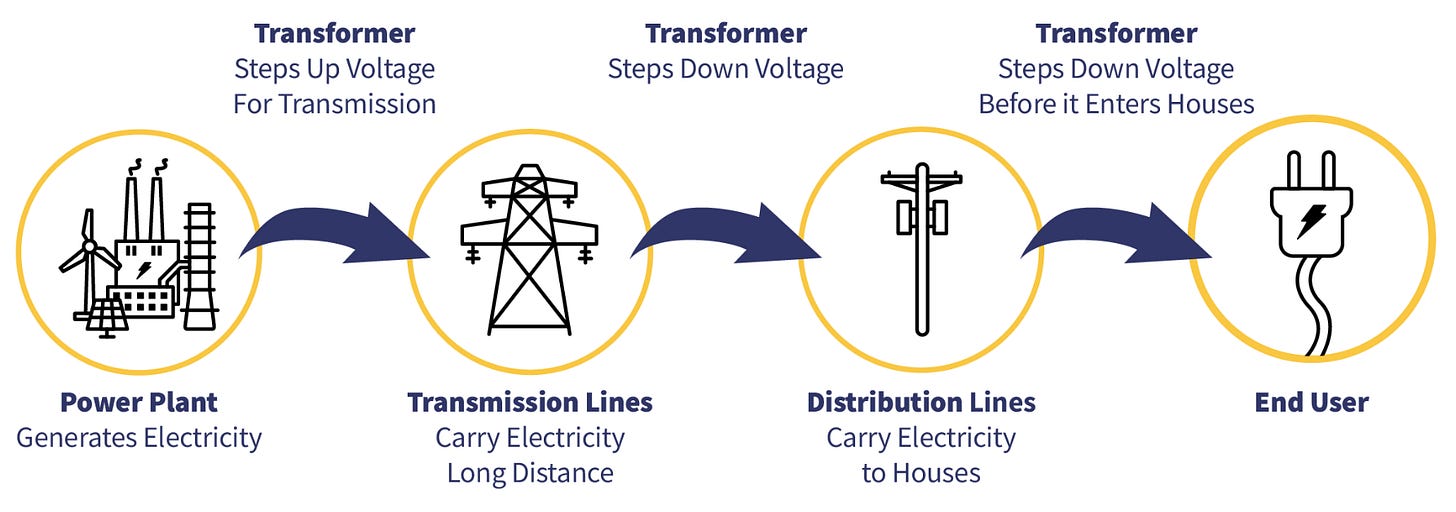
PJM filed the request on May 21. Energy Secretary Chris Wright signed the order the next day, saying energy shortfalls for the 65 million Americans the PJM grid serves are unacceptable. Formally known as PJM Interconnection, the regional transmission organization covers thirteen states and Washington, DC. It is important because it coordinates the flow of electricity from power generators (the companies producing energy) through a grid of transmission lines to local utilities, who then distribute the energy to consumers, ranging from residential customers to large businesses.
This is the third emergency order for the Wagner plant in under a year. The first came in July 2025, a second carried it through the winter, and this one covers the summer ahead. Wagner is one of several Talen Energy (Nasdaq: TLN) units that were set to close in 2025 and instead had their retirement pushed to 2029 under a reliability agreement approved by federal regulators.
Wagner is not alone. Since early 2025, the U.S. Department of Energy has used its emergency authority under Section 202(c) of the Federal Power Act to keep expensive and less efficient coal and oil units running well past their retirement dates in Michigan, Washington, Indiana, Colorado, Pennsylvania, and Maryland. Each order lasts about 90 days, and several have already been renewed more than once – placing greater cost pressures on utilities, consumers and future operating plans.
The thing is, PJM previously warned that its “system could see a capacity shortage” as early as this year. Already, with a brutally cold winter that stretched the demands on the regional grid, transmission line congestion threatened the potential for rolling blackouts. And the growing threat of an unreliable grid is not occurring in isolation or as a one-off event. In 2024 alone, U.S. energy consumers experienced double the number of blackout hours than they did the previous decade, largely driven by natural disasters.
The Plants That Were Supposed to Close
Power companies schedule a plant’s shutdown years in advance, in coordination with state and federal regulators, typically because the operations have grown old, expensive to run, or too dirty to keep within environmental rules. Many of the plants in question are coal units built in the 1960s and 70s, before the age of the internet and technologies that enabled plants to be more efficient, more reliable and more resilient to increased load demands. Those shutdowns are now being reversed one by one.
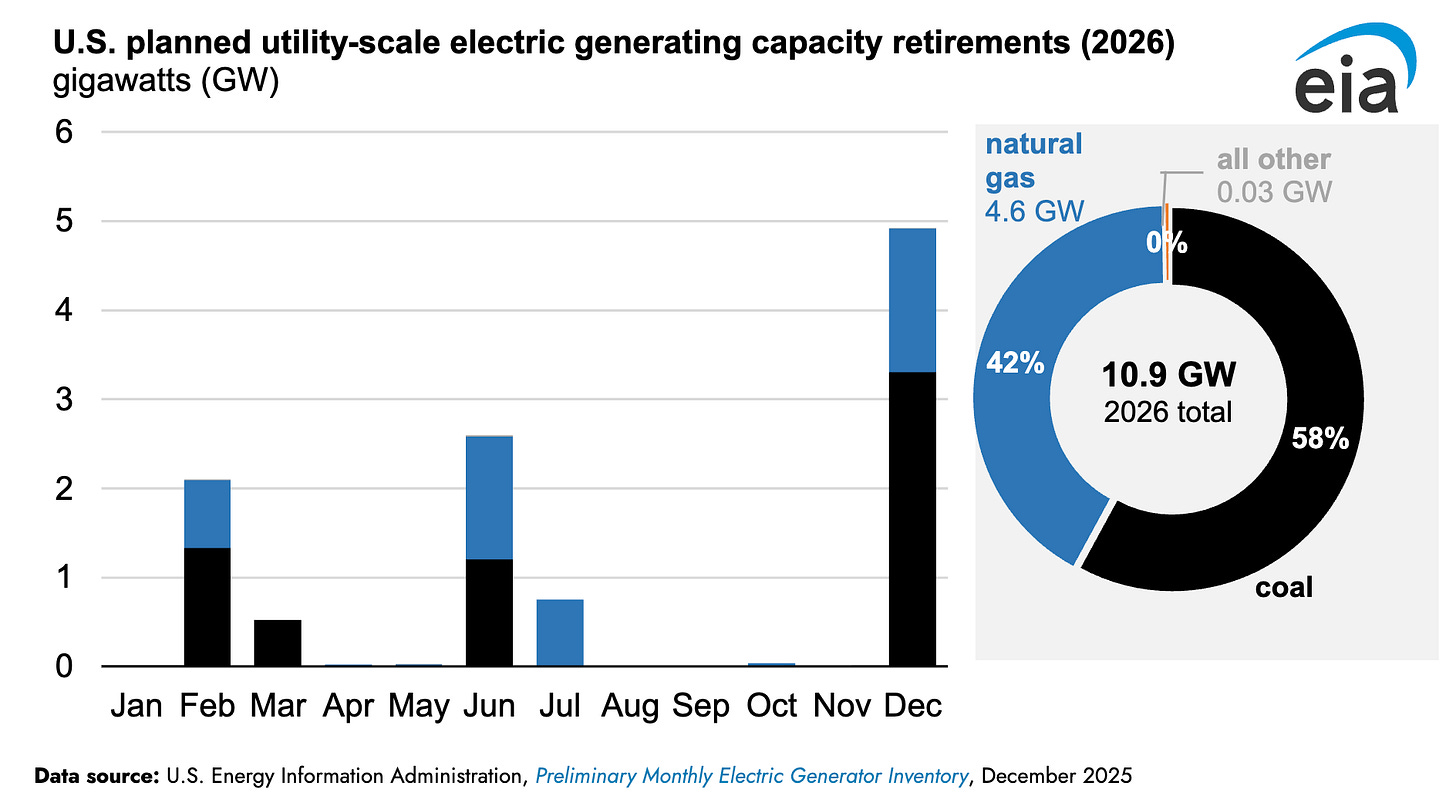
Since May 2025, the Department of Energy has issued more than 40 emergency orders under Section 202(c) of the Federal Power Act, keeping at least 4.4 gigawatts of coal capacity running past the dates it was meant to close.
The list is specific and offers details into the moment and the trends in the U.S. and beyond. The 1,560-megawatt J.H. Campbell coal plant in West Olive, Michigan, was scheduled to close at the end of May 2025, yet it is still operating under a federal order. TransAlta’s 730-megawatt Centralia plant in Washington, the R.M. Schahfer coal units in Wheatfield, Indiana, and Unit 1 of the Craig Station plant in Colorado were all set to retire by the end of 2025, yet, following the national trend, were ordered to stay available instead.
In 2025 as a whole, power companies had lined up 12.3 gigawatts of capacity to be shut down for good, yet only 4.6 gigawatts actually went dark, the smallest amount retired in any year since 2008. The rest stayed online because the regional grid could not afford to lose it without facing added strain on the grid or the threat of outages.
The Wagner order runs through August 19, placing it directly over the peak summer heat, the weeks of July and August when vital air-conditioning demand across the mid-Atlantic is highest, and the grid has the least room to handle a problem. PJM is shoring up its supply now because that test is only weeks away.
On May 4, the North American Electric Reliability Corporation (NERC) issued a Level 3 alert, its most serious category, on the risk data centers pose to the grid. Its latest long-term assessment projects the steepest growth in peak demand since it began tracking the figure in 1995, and rates 13 of 23 North American regions at elevated or high risk of shortfalls.
The demand projections are what break the old planning math. NERC now expects U.S. summer peak demand to grow by 224 gigawatts over the next decade, against a 132-gigawatt projection just a year earlier. Winter peak demand is projected to grow even faster. These are the highest growth rates NERC has recorded since it began the assessment in 1995.
Demand Came Back, Supply Did Not
U.S. electricity demand was flat for 20 years. It is now climbing again, driven by data centers and artificial intelligence’s constant demands along with the return of domestic manufacturing or onshoring and the electrification of heating and transportation.
PJM expects to add 5 to 7 gigawatts of data center load every year from 2027 through 2032, against only 2 to 3 gigawatts of new supply. The wait to connect a finished project to the PJM grid has stretched from under two years in 2008 to more than eight years now.
And while solar and wind can add capacity quickly, they can’t do that on demand. The war in Iran added even greater complexity to the matter by cutting into the fuel supply chains behind conventional energy generation.
Today, what the grid lacks is reliable and resilient energy, or what the industry calls “firm power,” that can run around the clock regardless of weather. Wagner 4 burns oil and costs far more per megawatt-hour than almost anything else on the system, which is why Maryland holds it to 438 hours a year. Yet it is running anyway because PJM has nothing else to call upon.
Meanwhile, mounting energy costs are already shifting to households, who are largely covering the burden. PJM’s independent market monitor found that customers across the region are paying roughly $13.6 billion more in a single delivery year, much of it for upgrades to handle new data center load.
What Firm Power Is About to Be Worth
The reality is that not all energy is created equal. That’s because some power plants can run whenever the grid needs them, while others cannot. A gas plant, a nuclear reactor, a hydro dam, or a geothermal plant can be switched on and typically held at full output on demand. A solar farm or a wind farm only produces energy when the sun is out or the wind is blowing. The first kind is what the grid calls firm power, and it is exactly what is in short supply.
The grid operator’s independent market monitor, called Monitoring Analytics, reported in March that, “large data center load additions have already had a significant and irreversible impact that will be paid through May of 2028 and will have additional significant impacts on other customers as a result of higher transmission costs, energy market prices and higher capacity market prices.”
That higher capacity market pricing, which is the price that PJM pays generators, is set to remain at elevated levels, just to keep that power available.
That price has climbed to its legal ceiling in three straight auctions. The next auction is scheduled for June 2026, and it will set capacity payments for the 2028-2029 period. A temporary cap held the last few results down. Without it, the most recent auction would have cleared near $530 per megawatt-day.
This trend and its impacts are quietly grabbing the attention of strategic investors. That’s because the companies that own reliable and resilient energy generation are about to find out what it is really worth, in public, on a pre-determined date.


Comments
Log in or sign up to join the conversation.