

Wall Street Recovery Helps FTSE Stabilise as China Data Hit Miners
London recovered from early weakness on Wednesday, with the FTSE 100 regaining marginal positive sentiment in line with a steadier tone on Wall Street. Additional U.S. inflation colour and Federal Reserve rhetoric continued to support hopes that U.S. rate pressure may ease, helping global equities stabilise after a cautious start. The move was modest rather than convincing. Investors remained wary as Middle East tensions continued to escalate and China’s latest GDP data disappointed. The result was a market that edged away from its lows but still lacked strong conviction. The main drag came from miners. China’s economy expanded 4.3% year-on-year in the second quarter, according to the National Bureau of Statistics, marking the slowest pace of growth in about three years. The figure reinforced concerns that Chinese demand remains weak, particularly for industrial metals and raw materials. That weighed on London’s commodity complex. Fresnillo fell 3%, Antofagasta dropped 2.1%, and Endeavour Mining lost 2%. The weakness in miners reflected both slower Chinese growth and broader caution around global demand. For the FTSE 100, this matters because miners often provide an important offset when domestic UK sectors are under pressure. On Wednesday, that offset was missing.
Telecoms also weakened after recent deal-driven strength. Vodafone (VOD) fell 2.3%, while BT (BT.A) slipped nearly 2%. Vodafone had rallied sharply after UAE telecom group e& announced plans to sell its stake to the family investment vehicle of Xavier Niel, but Wednesday’s decline looked like a pause after that repricing. Investors are still interested in the strategic angle, but the stock is no longer being carried by the initial deal excitement alone. IAG remained under pressure from the oil and geopolitical backdrop. With Middle East tensions still high and crude prices elevated, airlines face a combination of fuel-cost risk, possible route disruption, and weaker consumer confidence. That remains a challenge even as takeover activity in easyJet has kept parts of the sector in focus.
There were pockets of strength. ICG climbed 3%, while Barratt Redrow gained about 2.5%. Imperial Brands, Burberry, Persimmon, St. James’s Place and NatWest (NWG) rose between 1% and 1.8%. The gains in housebuilders were notable, particularly given the still-fragile domestic data backdrop. Investors appear to be looking toward eventual rate relief if weaker growth and demand destruction become the dominant macro story.
That interpretation fits the broader rates debate. The burden of policy risk has shifted increasingly toward GDP rather than inflation alone. The Bank of England’s “active hold” is therefore becoming the path of least resistance. The MPC can keep policy unchanged while using communication to nudge financial conditions tighter through market expectations, without actually raising the Bank Rate. This approach buys time. The Bank is effectively trying to allow modelled disinflationary forces to pull inflation back toward target while avoiding an additional policy move that could intensify the growth slowdown. In a fragile economy, signalling can do some of the work of tightening without adding the full shock of another rate increase. That matters because a “hike and hold” strategy looks increasingly costly. If the MPC were to hike again and keep rates elevated, it would likely need to deliver disproportionately dovish compensation later. Put simply, what the Bank takes from the economy today through tighter policy, it may have to give back tomorrow — and potentially more than it took. The longer a hike is sustained, the greater the required speed and depth of future easing. That is because higher rates would compound the hit from weak productivity, subdued capital formation, soft consumer demand, a fragile housing market, and renewed energy-price pressure. A prolonged additional hike could lower the future inflation path by damaging demand more than it improves inflation credibility.
This is why the Middle East oil shock is not straightforwardly hawkish for UK rates. Higher energy prices lift near-term inflation, but the UK’s vulnerability is mainly through the demand channel. As a net energy importer, the UK suffers when oil rises because households and firms face a real-income squeeze. If the shock persists, the medium-term effect could be lower growth and eventually lower inflation. That creates a dovish risk for 2027 even if markets initially price more near-term inflation risk. The U.S. inflation backdrop helped sentiment on Wednesday because it eased some of the global rate pressure. Softer U.S. inflation data earlier in the week, combined with Fed rhetoric that did not challenge dovish hopes, allowed bond yields to stabilise and supported equities. For the FTSE, that helped offset some of the weakness from China and geopolitics.
But the UK’s domestic story remains soft. Recent BRC retail sales data showed like-for-like sales growth slowing to 1.7% in June, the weakest since February and below expectations. Construction remains deeply contractionary, services activity has slipped below 50, and housing indicators are only tentatively improving. The market is therefore sensitive to any sign that policy is becoming too restrictive for the growth backdrop.
Politics remains close to the surface. The Labour leadership nomination window closes on Thursday. Andy Burnham remains on course for an unopposed path to the leadership, with markets expecting him to become Labour leader on 17 July and prime minister on 20 July if no challenger emerges. The market has largely priced the leadership transition, but the Chancellor appointment and fiscal agenda remain key. That fiscal agenda is constrained by the OBR’s long-term debt warnings and by elevated gilt yields. The incoming government may have to balance public investment, defence spending, productivity policy and tax compliance without triggering renewed gilt-market stress. The HMRC tax gap, recently estimated at £59.2 billion, remains an important potential revenue source if better enforcement can collect tax already owed rather than raising headline rates.
Finish Line: The FTSE 100 recovered from early weakness and regained marginal positive sentiment as Wall Street steadied on softer U.S. inflation signals and dovish Fed hopes. But the tone remained sluggish, with miners hit by China’s slowest GDP growth in about three years and telecoms giving back recent gains. Housebuilders, ICG, NatWest and selected consumer names rose as investors leaned into the idea that weak growth may eventually force a more dovish BoE path. The key policy message is increasingly clear: an “active hold” is easier to justify than a hike, because any extra tightening today would likely require faster and deeper easing tomorrow.
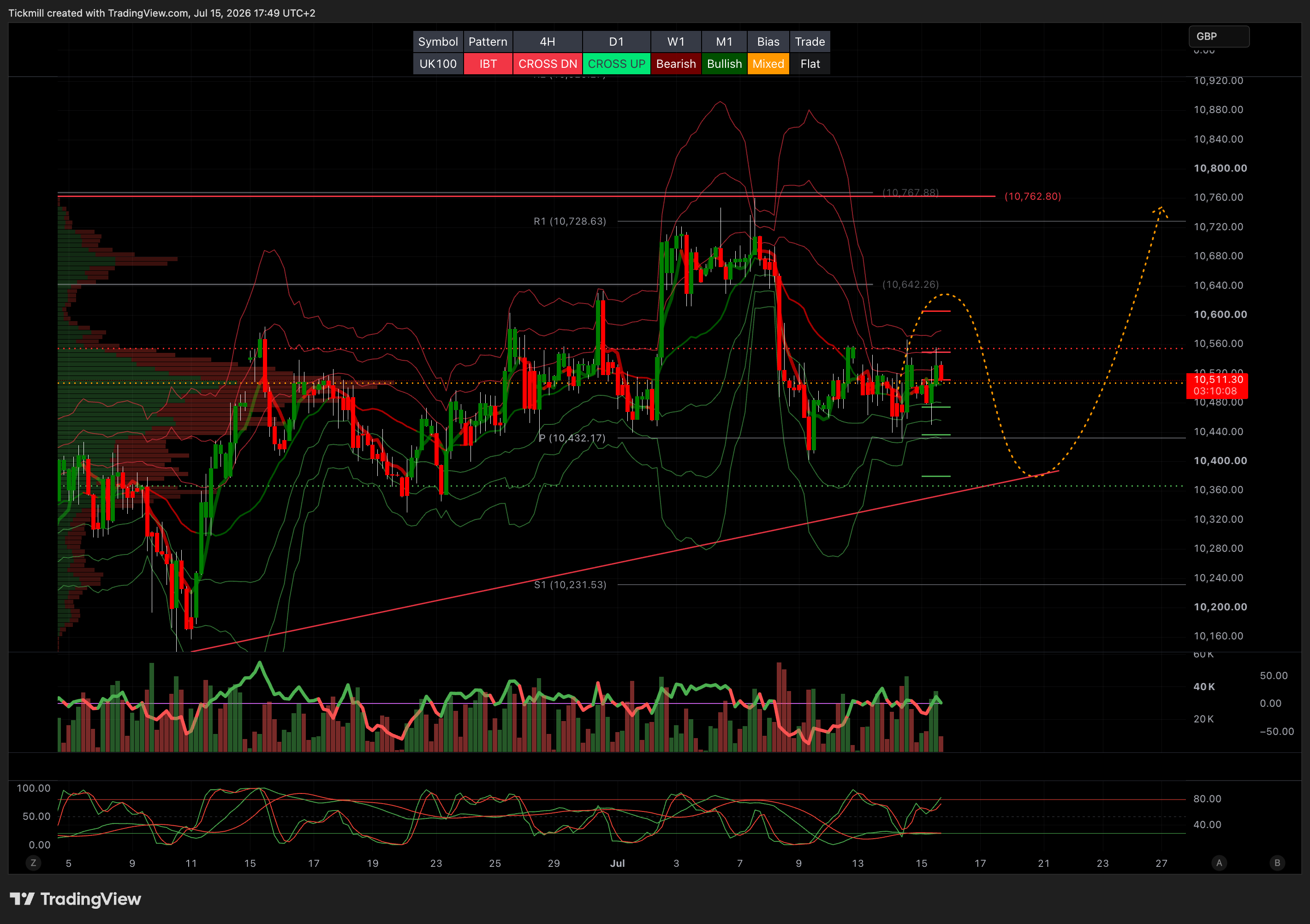
TECHNICAL & TRADE VIEW – FTSE100
Daily VWAP Bearish
Weekly VWAP Bearish
Above 10300 Target 11000
Below 10100 Target 9469

Comments
Log in or sign up to join the conversation.