

Miners Lift FTSE as Hormuz Deal Hopes Stir Global Risk Appetite
London moved modestly higher on Tuesday, with the FTSE 100 supported by strong gains in miners as global risk appetite improved on fresh hopes that the Strait of Hormuz could reopen to traffic and that the U.S. and Iran may be moving toward a deal. The gains were not broad-based, however, as weakness in Smith & Nephew, HSBC, consumer names and selected financials kept the index’s advance contained.
The geopolitical focus remained the Strait of Hormuz. U.S. Treasury Secretary Scott Bessent said on CNBC that the waterway could be close to reopening, echoing comments from President Donald Trump a day earlier. The remarks lifted global sentiment, with the Dow and S&P 500 reaching all-time highs after investors priced in a lower risk of a prolonged disruption to one of the world’s most important energy routes.
For London, the immediate market response was more nuanced. On Monday, falling oil prices had weighed on BP (BP) and Shell (SHEL) but helped housebuilders and rate-sensitive stocks as gilt yields declined. On Tuesday, the prospect of a reopening of Hormuz supported broader risk appetite while also helping miners, which benefited from stronger global growth sentiment and a more constructive tone toward industrial commodities.
The mining sector led the FTSE higher. Antofagasta rose 4.5%, Glencore gained 4%, Anglo American climbed 3.2%, Rio Tinto (RIO) advanced 2.75%, Endeavour Mining added 2.2%, and Fresnillo rose 1.1%. The move showed that investors were willing to move back into resources as the market shifted from a pure war-premium trade toward a more optimistic global-demand interpretation of de-escalation.
Copper-linked names were especially well placed to benefit. If the Strait reopens and energy disruption risk falls, investors can begin to focus less on inflation damage and more on the possibility that global manufacturing and trade conditions stabilise. That is helpful for industrial metals, particularly after recent UK manufacturing data showed expansion continuing but slowing to a four-month low.
BP gained more than 1.5% after more than doubling its second-quarter replacement cost profit. The result helped offset the pressure from recent oil-price volatility. Energy shares have been caught between two opposing forces: lower crude prices reduce earnings expectations, but strong cash generation, earnings beats and the possibility of ongoing geopolitical risk keep the sector from being fully abandoned.
The BP move followed Shell’s recent profit strength and showed that investors are still willing to reward oil majors when operational delivery and earnings resilience are clear. Even if Brent remains below the recent highs, the sector’s balance sheets, shareholder returns and cash-flow profiles remain central to the FTSE’s support base.
Travis Perkins was the standout domestic stock, soaring 16% after reporting strong interim results. The move added to the recent recovery in housing and building-related names, which benefited Monday from falling gilt yields and renewed expectations that lower energy prices will reduce inflation pressure. Stronger results from Travis Perkins gave investors a company-specific reason to extend that trade.
The rally in Travis Perkins also helped support the broader view that parts of the UK domestic economy are holding up better than feared. Housebuilders and construction-linked stocks have been highly sensitive to bond yields, mortgage affordability and consumer confidence. If oil stays lower and the Bank of England remains on hold, the sector could continue to attract selective buying.
Halma surged 3.2%, while BAE Systems, Aberdeen Group, AstraZeneca (AZN), Babcock International, Croda, Rentokil Initial (RTO), Polar Capital Technology Trust, ICG and Rolls-Royce gained between 1.3% and 2.5%. AstraZeneca’s rise offered some relief after Monday’s sharp fall on reports of possible merger discussions with Bristol Myers Squibb (BMY). Rolls-Royce continued to hold investor interest after its recent guidance upgrade, while defence names remained supported by persistent geopolitical uncertainty despite hopes of a Hormuz reopening.
BAE Systems and Babcock’s gains underline an important point: markets are not assuming that Middle East risks have disappeared. A reopening of the Strait of Hormuz would be an important de-escalation step, but the region remains unstable, and defence spending expectations remain structurally supported. That keeps defence contractors attractive even during risk-on sessions.
The main FTSE 100 faller was Smith & Nephew, which dropped 5.6% after cutting its full-year revenue growth forecast, citing weaker demand for hip and knee implants in the United States. The downgrade hit confidence in the medical products group because it pointed to demand weakness in a key market and raised questions about growth momentum for the rest of the year.
HSBC fell 1.7% despite reporting better-than-expected second-quarter results, raising its cost-savings target and announcing a new share buyback. For the six months to June 30, HSBC reported net income of $14.626 billion, or $0.85 per share, compared with $11.510 billion, or $0.65 per share, a year earlier. The negative share reaction suggested investors had already priced in a strong result or were focused on cost, revenue mix, margin sustainability or outlook details.
HSBC’s decline contrasted with recent strength in Standard Chartered, Lloyds and NatWest (NWG), all of which had been rewarded for earnings beats, capital returns and upgraded guidance. The difference reinforces the market’s selective approach to banks. Share buybacks are supportive, but investors still scrutinise whether earnings momentum is sustainable and whether cost targets are credible.
Coca-Cola Europacific Partners (CCEP) shed nearly 4%, while JD Sports, Pearson, IAG, Prudential (PRU), Persimmon, Metlen Energy & Metals, Haleon (HLN), Marks & Spencer, NatWest, Next, Unilever and Diageo fell between 1% and 2.5%. The weakness across retailers, staples and travel names showed that Tuesday’s rally was narrow and mining-led rather than a broad risk-on move across the FTSE.
IAG’s decline was notable because a reopening of Hormuz and lower energy risk should, in theory, help airlines through lower fuel-cost pressure. The drop suggests investors may have been taking profits after recent gains or focusing on demand, disruption and cost risks beyond crude alone. Persimmon’s weakness also showed some giveback after the previous session’s strong housebuilder rally.
Keller Group drifted about 1.3% lower despite posting strong results for the first half of 2026. As with HSBC, the move showed that positive earnings alone were not always enough if expectations had already risen or if investors saw limited upside to guidance. After July’s record-setting run, the market is becoming more demanding.
The Bank of England backdrop remains supportive but watchful. Last week’s decision to hold Bank Rate at 3.75% came with three hawkish dissents, but Governor Bailey stressed that investors should not leave thinking the Bank was edging toward a hike. The central message remains that domestic disinflation is offsetting external energy pressure, giving policymakers time to monitor second-round effects.
A reopening of the Strait of Hormuz would help that view by reducing the risk of a sustained energy shock. Lower or more stable oil prices would ease pressure on headline inflation, household energy bills, transport costs and wage bargaining. But the BoE will still watch indicators such as the breadth of price changes and wage-setting behaviour before becoming more confident that the shock has not become embedded.
The domestic growth backdrop remains mixed. Monday’s S&P Global UK Manufacturing PMI eased to 51.9 in July from 52.5, marking a four-month low but still showing expansion for a ninth consecutive month. That suggests the economy is still growing, but with less momentum. A decline in geopolitical disruption would be helpful, but it does not remove all pressure from manufacturers, retailers or consumers.
For Prime Minister Andy Burnham’s government, the potential reopening of Hormuz and recent oil-price retreat provide some breathing room for the cost-of-living agenda. Lower energy prices reduce the urgency of further household support and help the fiscal arithmetic. But investors will continue to watch whether targeted relief measures remain credible and whether growth-sensitive sectors show enough resilience without additional stimulus.
Finish Line: The FTSE 100 edged higher as miners rallied on hopes that the U.S. and Iran could reach a deal to reopen the Strait of Hormuz. Antofagasta rose 4.5%, Glencore gained 4%, and Anglo American, Rio Tinto and Endeavour also advanced. BP climbed after more than doubling second-quarter replacement cost profit, while Travis Perkins surged 16% on strong interim results. Smith & Nephew dropped 5.6% after cutting revenue growth guidance, and HSBC fell despite better-than-expected results, higher cost-saving targets and a new buyback. The market’s message was selective: Hormuz optimism helps global risk appetite and miners, but after July’s record run, investors are still punishing guidance cuts and questioning results where good news is already priced in.
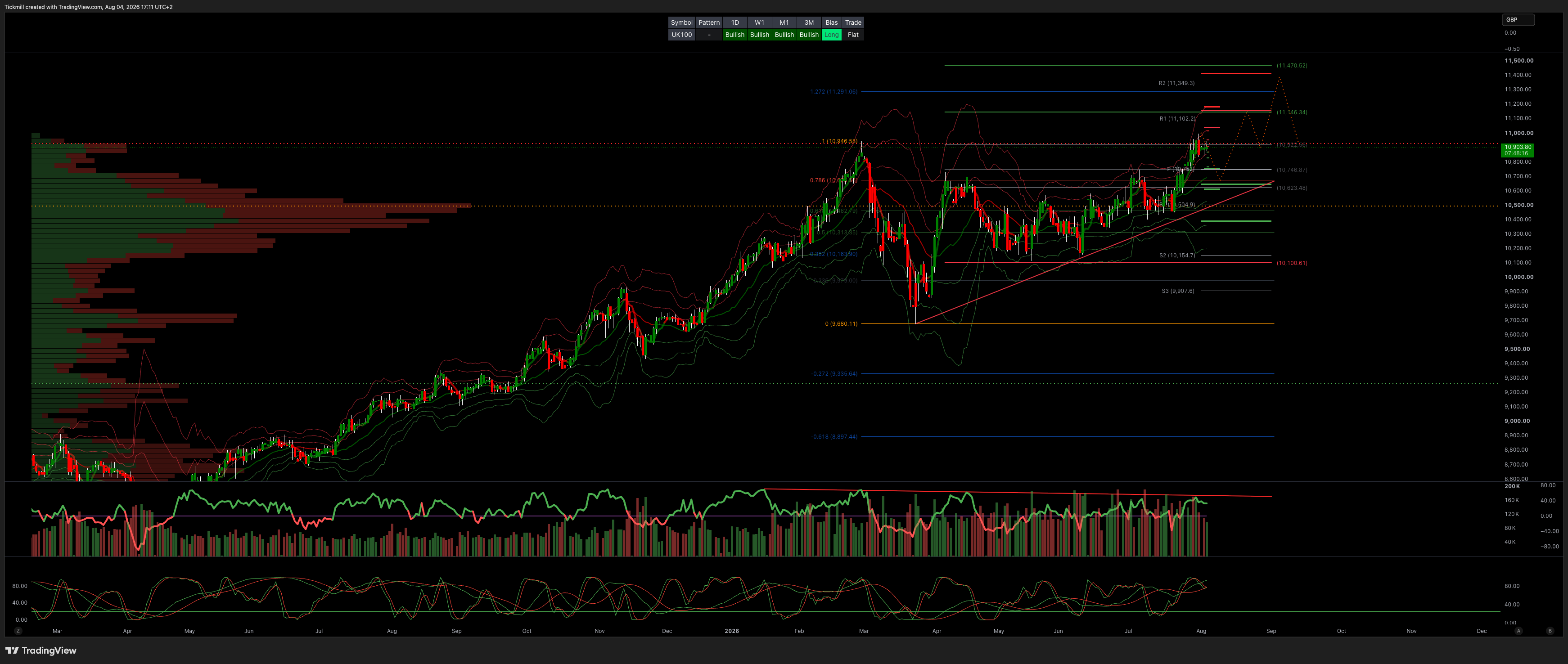
TECHNICAL & TRADE VIEW – FTSE100
Daily VWAP Bullish
Weekly VWAP Bullish
Above 10700 Target 11150
Below 10400 Target 9500
Comments
Log in or sign up to join the conversation.