


Global equities extended gains into Asia while Treasuries rose after softer US labour-market data reduced pressure on the Federal Reserve to keep raising rates. MSCI’s Asia-Pacific index gained around 1% following a tech-led rally on Wall Street, while Japan’s Nikkei 225 climbed about 2%. The market tone has improved because the data finally gave investors something they had been waiting for: evidence that the labour market may be cooling without an immediate growth scare.
Treasury yields eased modestly, with the US 10-year yield falling around 1 bp to 5.26%. That is hardly a major rally given the weakness in payrolls, but it does show some stabilisation after the recent bond-market damage. Yields remain historically high, and the long end is still carrying concerns about inflation persistence, public spending, Treasury supply and corporate borrowing linked to AI investment. Still, the immediate pressure for another Fed hike has faded.
Friday’s September payrolls report was soft on the headline. Nonfarm payrolls rose just 29k versus the 90k consensus. Revisions were also lower, subtracting 60k over the previous two months, although August’s 133k gain still looks reasonably solid. The details were less alarming than the headline suggests. Government employment fell 17k, and healthcare added only 17k, which explained a meaningful part of the miss. Most other sectors were broadly within recent ranges rather than showing a sharp deterioration.
The unemployment rate rose to 4.2% from 4.1%, but that was driven by another increase in labour-force participation. Participation rose to 61.8% from 61.6% and is now up from the 61.4% low touched in July. That makes the unemployment increase less clearly negative. A higher participation rate can be read in two ways: households may need more income because costs have risen, or improved opportunities may be pulling workers back into the labour market as growth remains resilient.
The wage data were more clearly supportive for the Fed. Headline average hourly earnings slowed to 3.0% y/y from 3.1%, implying very limited real wage growth. The Atlanta Fed wage tracker still shows some pockets of demand, particularly a jump in pay for job switchers, and hours worked have improved this year. But the broader wage signal is no longer flashing the same inflation warning as it did earlier in the cycle.
When framed alongside last week’s downward revisions to PCE inflation, the payrolls report is likely to tilt the FOMC toward an October pause. That reinforces the recent tone from voting Fed speakers. The data do not necessarily justify cuts, but they reduce the urgency to hike again, especially against a backdrop of uncertainty around Iran, energy markets and rates-market volatility.
Markets are now pricing less than a 20% chance of an October Fed hike. That looks reasonable. The Fed can argue that financial conditions have already tightened materially through higher bond yields, even if equities have held up better than expected. Policymakers will not want to overreact to one payrolls report, but the combination of softer jobs, softer wages and a cooler revised inflation profile makes another immediate hike harder to justify.
Equities have responded positively, but the move is still fragile. US stock futures gave back earlier gains, with S&P 500 futures slipping around 0.1% and Nasdaq 100 futures little changed. The market is relieved that the Fed may pause, but not fully convinced that the growth backdrop is risk-free. The best outcome for equities remains a controlled labour-market cooling that lowers rate pressure without damaging earnings.
Oil prices slipped, with Brent falling around 0.5% to roughly $101.75/bbl after Saudi Arabia cut prices for its benchmark crude to Asia as supply flows increased. The decline helps the disinflation narrative at the margin, but Brent above $100 still remains uncomfortable for central banks. Lower oil reduces near-term headline pressure; high oil still threatens expectations, transport costs and household purchasing power if sustained.
The Euro weakened to its lowest level against the Dollar since May 2025 as political uncertainty in Spain added to broader concerns over Europe’s fiscal outlook. The currency fell as much as 0.8% to around $1.1161. German bond futures rose, while French debt underperformed, showing that investors remain alert to fragmentation and fiscal-risk dynamics across the region.
Europe’s political and fiscal backdrop is becoming a more prominent market concern. France had already been under pressure due to questions over fiscal credibility and political stability. Spain now adds another layer of uncertainty. The issue is not yet systemic, but it is enough to weigh on the Euro and keep investors cautious toward European sovereign spreads. In an environment of elevated global yields, fiscal tolerance is lower.
European equities were set for a modestly higher open, helped by the global risk rebound, but investors remain wary of stress in regional government bond markets. A Fed pause helps global sentiment, yet it does not solve Europe’s domestic fiscal problems. If sovereign spreads continue to widen, equity gains may struggle to broaden beyond the most globally exposed and defensive sectors.
The Dollar remains supported despite the softer US payrolls print. That may appear counterintuitive, but relative dynamics matter. US yields are still high, the Fed is not close to cutting, and Europe’s political risk is weighing on the Euro. The greenback can soften if US data weaken sharply, but a moderate cooling in the US labour market combined with European fiscal stress still leaves the Dollar in a strong position.
This week brings a quieter early-month data calendar. The main focal point today will be final services and composite PMI reports, which should offer more granular colour across the Eurozone. Investors will look for any evidence that the rise in energy prices during September affected firms’ costs, margins or pricing intentions. The flash estimates suggested limited impact, but the final details may provide more nuance.
The US ISM services report is also due today and will be important after the payrolls miss. A softer ISM services reading would reinforce the view that the Fed can pause in October. A strong reading, especially with firm prices paid, would complicate the market’s dovish interpretation of payrolls. Services remain central to the inflation debate because they are more labour-intensive and more closely tied to wage dynamics.
In Europe, Eurozone retail sales and German factory orders are due Tuesday, followed by German industrial production on Wednesday. These releases will help assess whether Europe’s weak growth pulse is stabilising or deteriorating further. The ECB minutes are released Thursday and will be scrutinised for how policymakers are balancing energy-driven inflation risk against weaker activity and rising sovereign-market stress.
In the UK, Thursday is the key day. The REC jobs report has improved recently and will be watched for evidence that labour-market cooling has stalled. The RICS survey should show a slowdown in housing activity, reflecting higher mortgage costs and broader financial tightening. The BoE credit conditions survey will be especially relevant given renewed attention on credit markets, bank lending standards and the pass-through from higher yields to the real economy.
For the US, the FOMC minutes on Wednesday are the main event. They will flesh out the thinking behind the September rate hike and allow markets to assess the prospects for a follow-up move. However, the cooler PCE profile and payrolls miss since that meeting should have tempered much of the anxiety around another near-term increase. Other US releases include consumer credit on Wednesday, then weekly jobless claims and wholesale inventories on Thursday.
Elsewhere, Japan wage data and Swedish inflation on Wednesday are worth tracking, while Canada’s monthly labour-market report on Friday will be the key non-US labour release. Japan’s wage data matter for the BoJ’s normalisation path, while Swedish inflation will shape expectations for whether the Riksbank follows through on its signal of a possible year-end hike.
The speaker calendar is busier than the data calendar. From the ECB, Schnabel and Lane speak today, Cipollone on Tuesday, Lane again Thursday and Wunsch on Friday. Markets will be listening for how much concern there is about sovereign spreads, fiscal risk and energy-driven inflation. From the BoE, Mann speaks Tuesday, followed by Pill, Bailey and Lombardelli on Thursday. Their remarks will be important for November hike pricing, especially if UK labour and credit data point to resilience.
From the Fed, Williams speaks Tuesday, Logan Wednesday, Musalem Thursday and Collins Friday. The key question is whether officials lean into the payrolls miss and cooler PCE revisions as reasons to pause, or whether they stress that inflation risks remain too high to declare victory. A coordinated tone of patience would support bonds and equities. A reminder that one weak payrolls print is not enough could limit the relief rally.
Macro to Micro, markets have been given a window to stabilise. Softer payrolls, slower wage growth and lower PCE revisions reduce the urgency for another Fed hike, while cheaper oil helps at the margin. But this is not a clean dovish pivot. Yields remain high, Brent is still above $100, the Dollar is firm and Europe’s political and fiscal risks are intensifying. For traders, today’s ISM services report, the US 10-year around 5.26%, Brent near $102, the Euro’s slide and this week’s central-bank speakers will determine whether the post-payrolls relief can extend or quickly fade.
Overnight Headlines
Fed May Skip October But Pull Rate Hike Trigger In December
BoJ’s Deputy Chief Flags AI’s Possible Impact On Neutral Rate
Euro Falls To 17-Month Low On Region’s Fiscal And Political Risks
Wall Street Tries To Live With 5% Yields As Market Cracks Grow
Middle East Oil Exports Exceed Pre-War Levels But Tanker Attacks Increase
OPEC+ Agrees To Keep Oil Output Targets Steady In November
Iraq Shifts Oil Strategy By Arranging Tanker To Move Past Hormuz
Yemen Launches Operations To Seize All Areas From Iran-Backed Houthis
Russia Strikes Kyiv As Germany’s Chancellor Merz Visits
Merz Unveils Fresh Military Aid In Kyiv: Germany Not Intimidated
UK Expected To Impose Tariffs On Chinese Electric Cars
ECB Advances Digital Euro, Tokenised Settlement, Instant-Payment Links
Global Pension Funds Cut US Equities Over AI Concentration Risk
Schneider Electric Nears Deal To Buy Software Group PTC For $20B
Revolut Rises To Become Europe’s $115B Big Bank Rival
FX Options Expiries For 10am New York Cut
(1BLN+ represents larger expiries and is more magnetic when trading within the daily ATR.)
EUR/USD: 1.1400 (EU3.65b), 1.1550 (EU2.95b), 1.1700 (EU2.33b)
USD/JPY: 156.00 ($1.55b), 155.70 ($998.6m), 155.00 ($953.2m)
USD/BRL: 5.5000 ($567.3m), 5.1500 ($560m), 5.0000 ($450m)
AUD/USD: 0.7025 (AUD302.7m)
USD/CAD: 1.4200 ($532.3m)
USD/MXN: 17.44 ($314.6m), 16.72 ($300m)
USD/CNY : 6.7400 ($497.5m), 6.7060 ($350m)
GBP/USD: 1.3150 (GBP308.9m)
CFTC Positions as of 1/10/26
Bitcoin net long position is 2,465 contracts
Swiss franc posts net short position of -24,617 contracts
British pound net short position is -91,075 contracts
Euro net short position is -63,256 contracts
Japanese yen net long position is 55,440 contracts
Speculators increase CBOT US 5-year Treasury futures net short position by 114,848 contracts to 995,701
Speculators increase CBOT US 10-year Treasury futures net short position by 88,863 contracts to 900,615
Speculators trim CBOT US 2-year Treasury futures net short position by 115,041 contracts to 792,024
Speculators trim CBOT US UltraBond Treasury futures net short position by 10,289 contracts to 326,436
Speculators increase CBOT US Treasury bonds futures net short position by 31,070 contracts to 186,875
Equity fund managers cut S&P 500 CME net long position by 33,658 contracts to 901,255
Equity fund speculators increase S&P 500 CME net short position by 575 contracts to 355,697
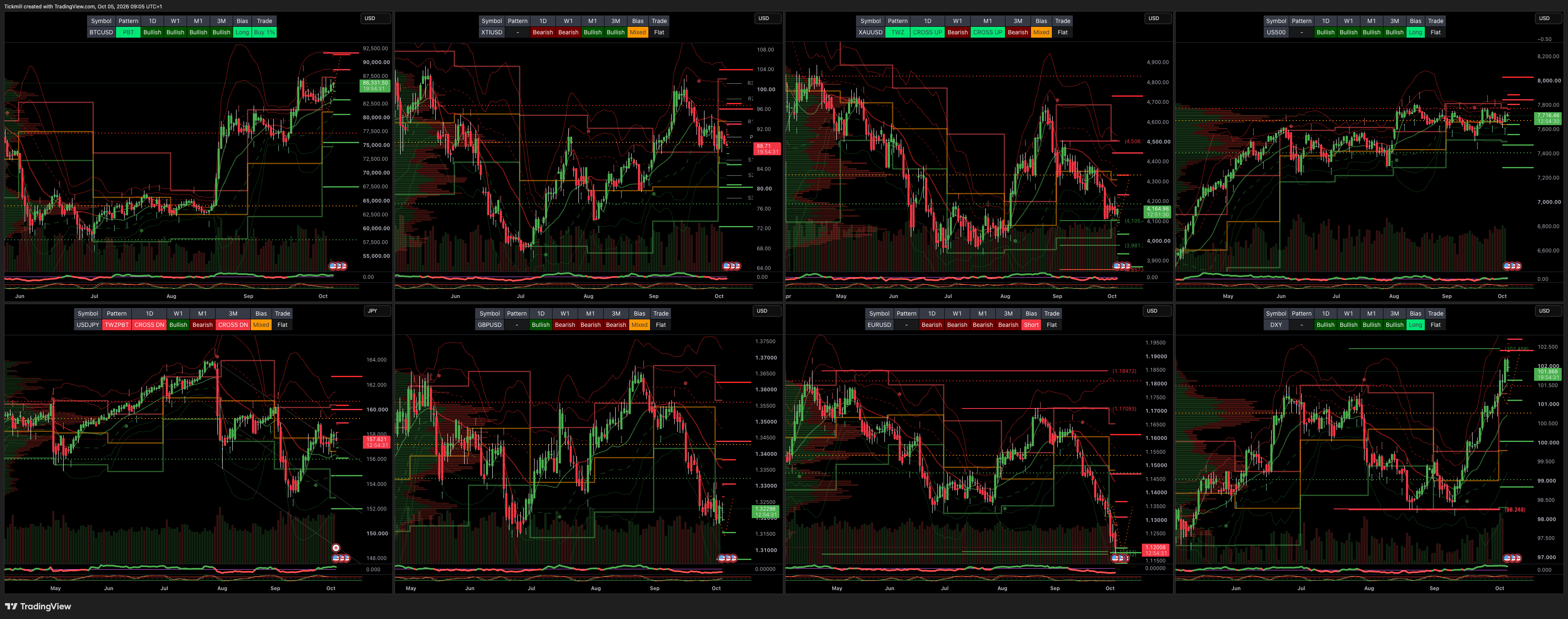
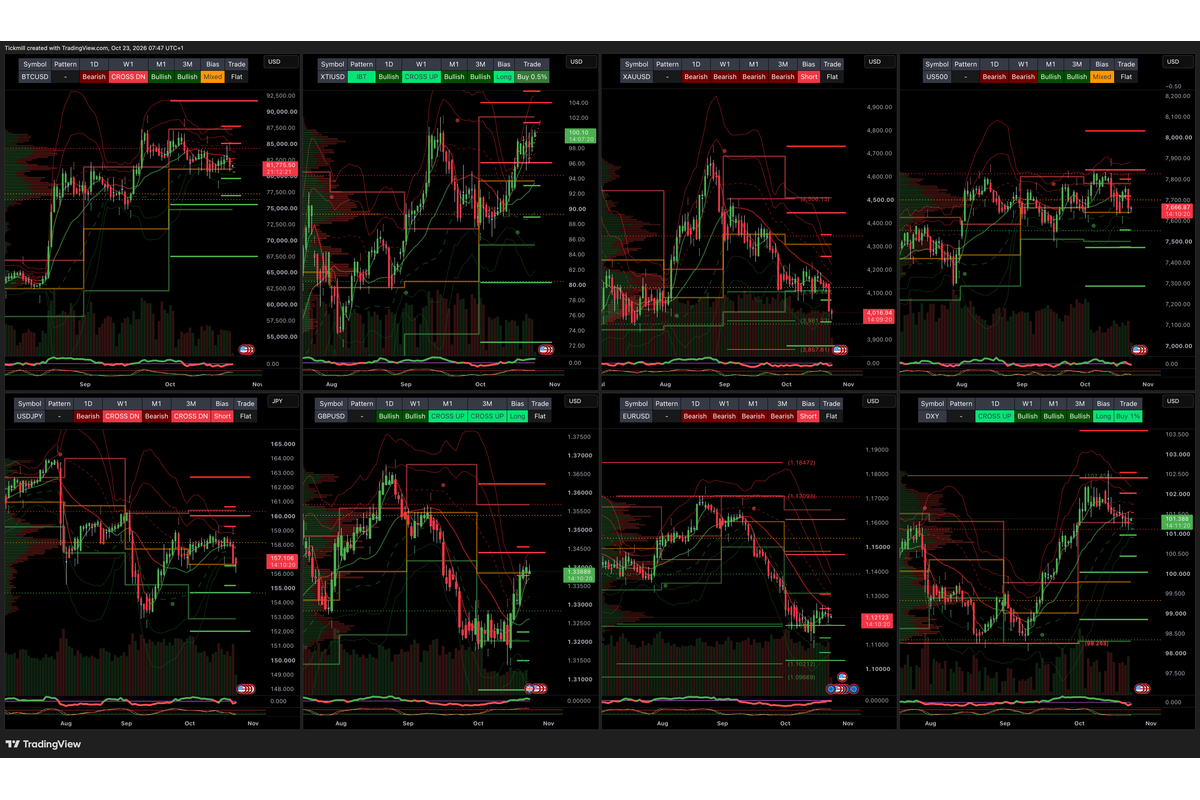
Technical & Trade Views


Comments
Log in or sign up to join the conversation.