

Oil Rebound Revives Inflation Worries as FTSE Trades Mixed
London’s FTSE 100 turned in a mixed performance on Tuesday as a rebound in oil prices revived inflation concerns and kept investors cautious ahead of crucial U.S. inflation data later in the week. Energy stocks rose with crude, but weakness in insurers, asset managers, consumer names, and selected industrials prevented the broader market from gaining clear traction.
The main macro driver was the renewed tension around the Strait of Hormuz. Hopes for a reopening faded after U.S. President Donald Trump said he had instructed American representatives to include compensation demands from Iran in any future negotiations. That complicated the diplomatic path and raised the risk that the crucial waterway remains restricted for longer.
Oil prices responded quickly. Brent crude futures climbed back above $90 a barrel, gaining nearly 3%, as investors rebuilt a geopolitical risk premium. The move reversed some of the recent optimism that had followed speculation about a possible U.S.-Iran deal and a reopening of Hormuz.
For the FTSE, higher oil once again produced a familiar split. BP rose 1.85%, and Shell (SHEL) gained 1.6%, helping support the index through their heavy weighting. But the broader market was less comfortable. Rising crude prices increase inflation risks, complicate the Bank of England outlook, pressure consumer spending, and raise input costs for companies outside the energy sector.
This is the core tension that has defined UK markets since the Middle East escalation began. Energy strength can mechanically support the FTSE 100 because of BP and Shell’s size, but the same oil move can hurt the domestic economy, reduce real incomes, and delay any easing in monetary conditions. Tuesday’s mixed performance reflected exactly that trade-off.
Investors were also reluctant to take large positions before the upcoming U.S. inflation report. The data will matter for global rate expectations, U.S. Treasury yields, the dollar and cross-market risk appetite. After a period in which central banks have tried to look through some energy volatility, another firm inflation reading would raise concern that policy may need to stay restrictive for longer.
In the UK, the Bank of England remains in watch-and-hold mode. Bank Rate is still expected to remain at 3.75%, and Governor Bailey recently pushed back against the idea that the Bank is edging toward a hike despite a 6-3 vote split at the last meeting. But the renewed rise in oil prices and Monday’s stronger pay signals from the KPMG/REC jobs report mean the MPC cannot become complacent.
The jobs report showed permanent staff appointments stabilising after a 45-month downturn and temporary billings growing at the fastest pace in three years. That was encouraging for labour demand. But starting salary inflation reached a six-month high, and temporary wage growth hit a 26-month high. When that is combined with Brent above $90, the risk of second-round effects becomes more relevant.
That backdrop weighed on rate-sensitive and financial names. Legal & General fell 4.2%, M&G dropped 3.4%, Standard Life lost 2.6%, and Prudential (PRU) declined 2.3%. Aviva (AV) also slipped, while Hiscox was weaker. The declines across insurers and asset managers suggested investors were reassessing the sector’s sensitivity to bond markets, market volatility and consumer financial conditions.
Spirax Group was the sharpest industrial mover, dropping more than 10% before recovering some lost ground. The stock was still down about 6% later in the session even though the thermal energy and fluid technology firm reiterated guidance for mid-single-digit organic revenue growth and margin expansion after improved first-half results. The reaction suggested expectations had been high and that investors wanted more than a simple reaffirmation of guidance.
The market has repeatedly shown this earnings season that “good enough” is not always enough. Companies delivering clear beats, upgraded guidance, buybacks or cost-saving plans have been rewarded sharply, as seen with WPP, Diageo, Serco, Travis Perkins and Plus500. But companies that merely confirm expectations, or where guidance lacks upside, can still be sold.
Consumer-facing stocks were also under pressure. Tesco, JD Sports, Sainsbury, Coca-Cola HBC (CCH) and other names fell between 1% and 1.5%. The weakness followed new retail sales data from the British Retail Consortium showing UK like-for-like retail sales rose 1% year-on-year in July, below expectations for a 1.5% gain and down from 1.7% in June. It was the softest growth since February.
The retail data reinforced concerns that consumers remain under pressure despite some easing in headline inflation earlier in the summer. Higher oil prices threaten to reverse part of that relief by raising transport and energy-related costs. If wage growth improves but prices reaccelerate through fuel and essentials, real spending power may remain squeezed.
InterContinental Hotels Group (IHG) slid 1.4% after room revenue growth, a key performance measure, slowed in the second quarter. The decline pointed to more caution around travel and leisure names, especially as investors reassess consumer resilience and discretionary spending. Although travel demand has held up in many areas, slowing revenue growth makes valuation support harder.
International Workplace Group tumbled 4% after weak results. The office-space provider reported a pre-tax loss of $20 million, compared with a pre-tax profit of $12 million a year earlier. The update highlighted ongoing challenges in flexible office demand, costs and profitability, and investors punished the swing back into loss.
Among the gainers, IG Group rose 1.5%, continuing to rebuild after earlier pressure tied to its proposed Underdog acquisition. Lion Finance, Scottish Mortgage, BT, Auto Trader and Airtel Africa posted moderate gains. BT’s move stood out because telecoms had been weak in recent sessions, while Scottish Mortgage benefited from a degree of support for growth-oriented assets despite the cautious broader tone.
Auto Trader’s gain suggested investors were still willing to buy selective digital and platform names, while Airtel Africa’s rise provided some emerging-market telecom support. However, these moves were not strong enough to shift the overall market mood, which remained cautious and inflation-sensitive.
The broader story is that the FTSE has moved from late-July record momentum into an August consolidation phase. The index is not breaking down, but the drivers have become more conflicted. Oil strength helps energy majors but hurts inflation-sensitive sectors. Hormuz diplomacy can lift risk appetite but pressure energy. Earnings beats still matter, but the bar has risen. Domestic data are stabilising, but not strong enough to remove growth concerns.
For Prime Minister Andy Burnham’s government, the renewed rise in oil complicates the early policy agenda. Measures aimed at easing household energy bills and supporting consumer-facing sectors become more relevant if crude remains elevated, but fiscal credibility remains important. Investors will continue to watch whether any further support is targeted enough to avoid adding to inflation pressure or gilt-market concerns.
Finish Line: The FTSE 100 traded mixed as Brent crude climbed back above $90, gaining nearly 3%, after President Trump’s compensation demands from Iran complicated talks to reopen the Strait of Hormuz. BP rose 1.85%, and Shell gained 1.6%, but higher oil revived inflation worries and weighed on insurers, asset managers, retailers and selected industrials. Spirax fell sharply despite reaffirming guidance, Legal & General and M&G dropped, and retail names weakened after BRC like-for-like sales rose just 1% in July, the slowest growth since February. With U.S. inflation data due later this week and UK wage indicators firming, investors remained cautious. The market’s message was clear: energy can lift the index, but oil above $90 makes the inflation and rates outlook harder for everyone else.
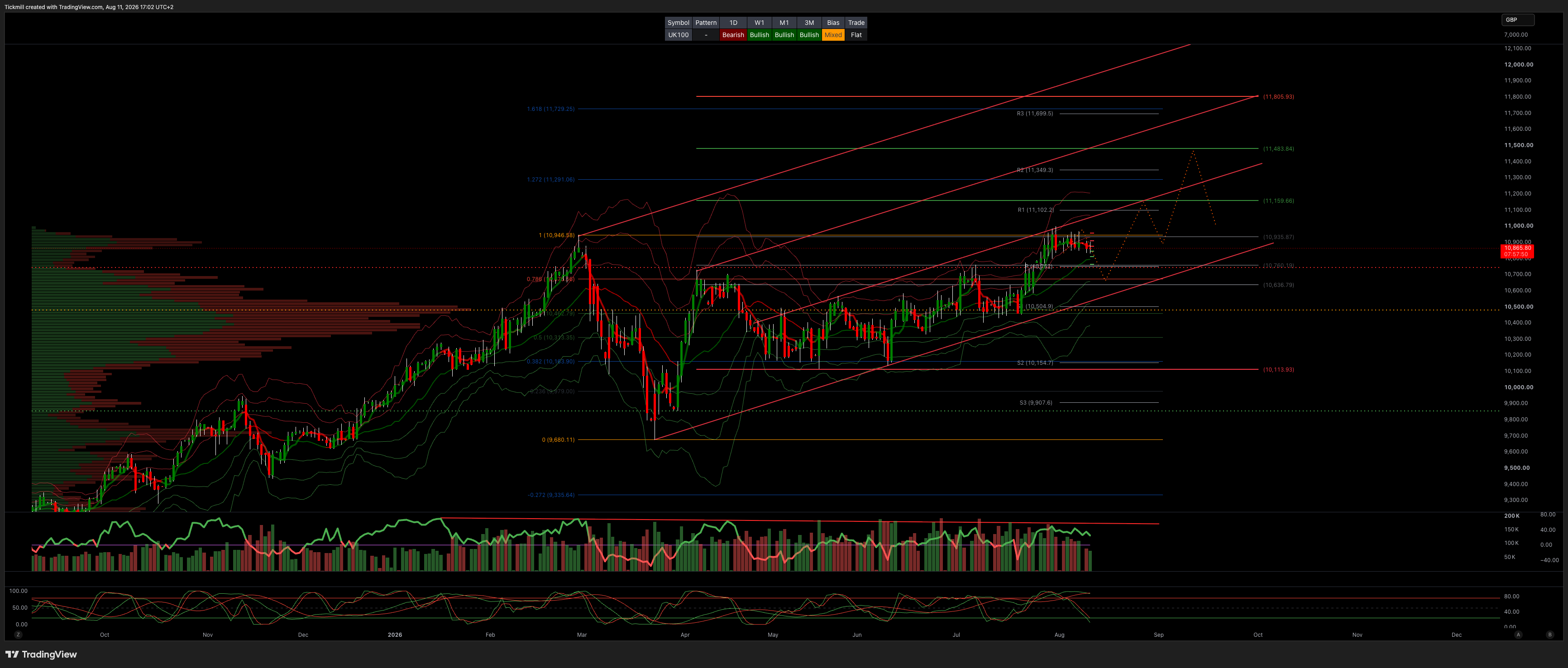
TECHNICAL & TRADE VIEW – FTSE100
Daily VWAP Bearish
Weekly VWAP Bullish
Above 10700 Target 11150
Below 10400 Target 9500
Comments
Log in or sign up to join the conversation.