


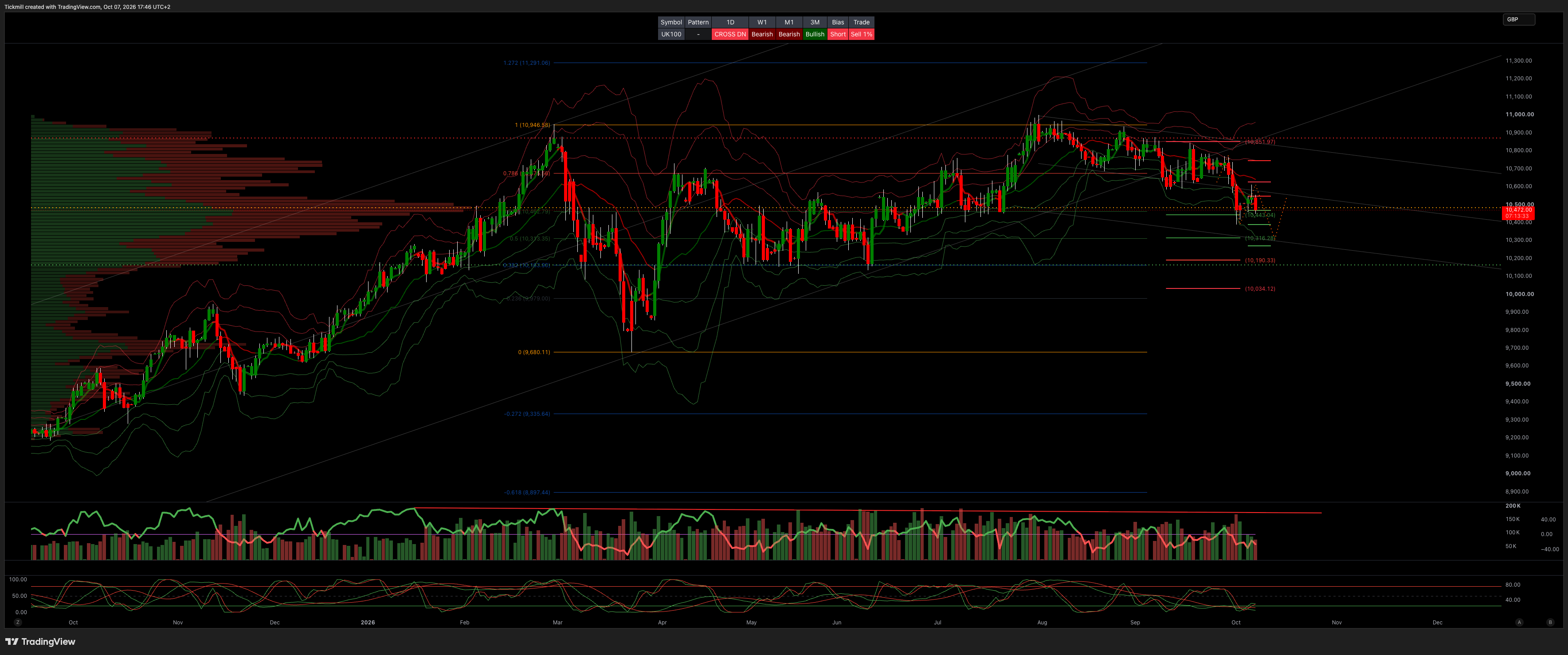
The U.K. stock market’s benchmark FTSE 100 slipped into negative territory on Wednesday, weighed down by climbing crude oil prices and surging benchmark bond yields. Heavy selling across major banking, financial, and utility counters offset localised strength in retail and energy majors, as geopolitical escalation in the Middle East kept broad risk appetite strictly constrained ahead of key Federal Reserve policy minutes.
Financials and utilities bore the brunt of the session's losses. Rate-sensitive banking heavyweights declined sharply, led by Standard Chartered and HSBC Holdings dropping 3.6% and 3.2%, respectively, alongside losses across Barclays (-2.2%), Lloyds Banking Group (-2.0%), and NatWest Group (NWG) (-1.9%). Water utility Pennon Group plummeted 17% after announcing a £550 million rights issue and a 30% dividend cut. Widespread selling hit utility peers Severn Trent (-3.0%), United Utilities, and National Grid, as well as blue-chip names Informa, Prudential (PRU), Investec, Antofagasta, Weir Group, IG Group, Halma, Lion Finance, Whitbread, Aviva (AV), and Burberry Group.
Conversely, consumer discretionary, household staples, and energy majors offered defensive shelter. JD Sports Fashion gained 3.2% to top the top-flight risers, with steady buying also seen across Marks & Spencer, Reckitt Benckiser, Haleon (HLN), J Sainsbury, BT Group, and Compass Group, which all gained between 1.5% and 2.0%. Energy majors Shell (SHEL) (+1.0%) and BP (BP) moved higher as crude recovered, with Shell benefiting from an upgraded Q3 integrated gas production outlook. British American Tobacco advanced after entering a buyback agreement with Merrill Lynch International, while Vodafone Group (VOD), AutoTrader Group, Experian, Computacenter, Airtel Africa, Smith & Nephew, Tesco (TSCO), Howden Joinery, and Tritax Big Box REIT also traded up.
Macro concerns were driven by energy markets and fixed-income volatility. Front-month Brent crude futures rose 1.2% to $101.80 a barrel following reports from the U.K. Maritime Trade Operations of nine tanker attacks in the Strait of Hormuz and Persian Gulf this month, alongside Houthi drone and missile claims targeting Saudi infrastructure. Escalating energy supply fears pushed the U.K. 10-year Gilt yield up to 5.475%.
On the domestic economic front, Lloyds Banking Group reported that U.K. house prices were flat month-on-month in September following two consecutive monthly drops (-0.3% in August, -0.1% in July), while remaining flat on an annual basis. Lloyds Mortgages Director Andrew Asaam noted property price resilience despite elevated mortgage rates driven by shifting Base Rate expectations.
Finish Line: U.K. equities succumbed to persistent macro headwinds as surging crude oil above $101 and climbing Gilt yields triggered a sharp pullback across banking and utility heavyweights. While consumer staples, retail, and energy producers provided partial insulation, broad market sentiment remains pinned on global interest rate trajectories and Middle East security risks.
TECHNICAL & TRADE VIEW


Comments
Log in or sign up to join the conversation.