

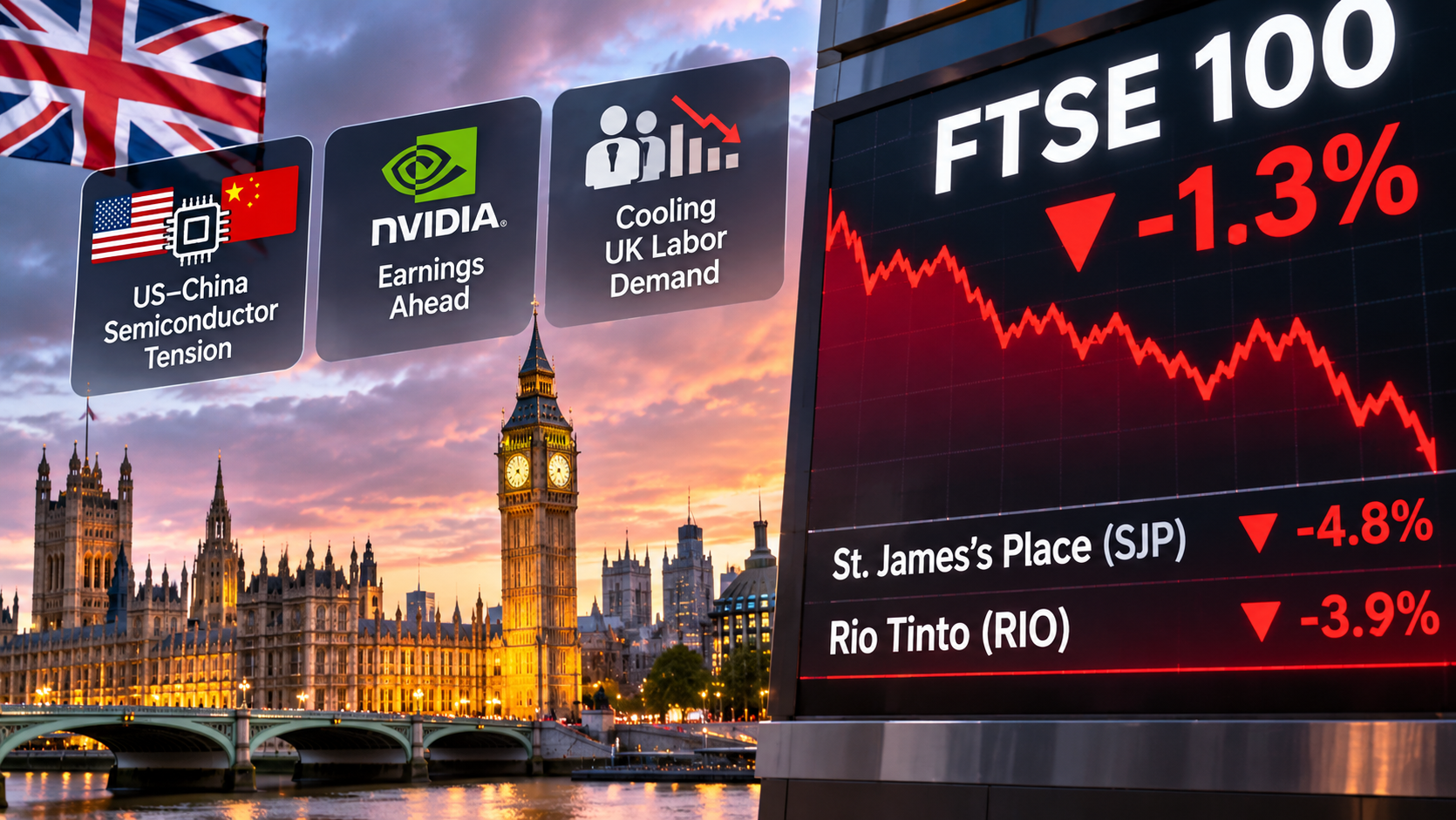
London's benchmark FTSE 100 tumbled more than 1.3% on Tuesday as global risk appetite deteriorated ahead of high-stakes geopolitical and corporate catalysts. Sentiment was battered by reports that the United States plans to tighten restrictions on China's access to advanced artificial intelligence chips, prompting sharp pushback from Beijing and casting a shadow over Thursday's scheduled summit between U.S. President Donald Trump and Chinese President Xi Jinping in Shenzhen. Caution ahead of Nvidia's (NVDA) upcoming quarterly earnings and domestic labour market cross-currents further kept buyers on the sidelines.
Broad-based selling swept through financial, mining, defence, and technology-linked blue chips. Wealth manager St. James's Place led top-flight decliners with a 2.7% drop, while steep losses of 1.6% to 2.5% hit BAE Systems, Airtel Africa, Burberry Group, WPP (WPP), Babcock International, Weir Group, Polar Capital Technology Trust, AutoTrader Group, Howden Joinery Group, and GSK. Resource producers also lost ground alongside softer copper prices, with Antofagasta, Rio Tinto (RIO), Anglo American Plc, Glencore, and Endeavour Mining shedding between 1.1% and 2.0%. Notable downside pressure extended across Standard Chartered, National Grid, Kingfisher, The Sage Group, Marks & Spencer, Severn Trent, Barratt Redrow, AstraZeneca, ConvaTec Group, and Informa.
Bucking the wider market downturn, only a handful of trading, service, and defensive counters managed to advance. Online trading platform IG Group Holdings climbed 1.7% to lead blue-chip risers amid heightened market volatility, while pest control specialist Rentokil Initial (RTO) and industrial supplier Diploma gained 1.2% and 1.1%, respectively. Modest upside was also logged across BT Group (BT.A), Ithaca Energy, Whitbread, JD Sports Fashion, and British Land.
Geopolitical and national security headlines added to the cautious tone across trading desks. China's Foreign Ministry condemned the proposed U.S. export restrictions as "economic coercion and long-arm jurisdiction", warning of retaliatory measures to protect its interests ahead of the Shenzhen summit. Separately, market participants monitored reports that the U.S. National Security Agency's classified internal network (NSA Net) suffered an unexplained outage, prompting staggered staff arrivals while investigators ruled out immediate signs of a cyberattack.
On the domestic macroeconomic front, official data from the Office for National Statistics (ONS) presented a mixed picture of U.K. labour market dynamics for the Bank of England. The ILO unemployment rate unexpectedly ticked down to 4.6% in the third quarter from 4.7% previously (defying forecasts for an unchanged reading). However, underlying demand showed clear signs of cooling: payroll employees fell by 34,000 in October to 30.2 million, and job vacancies declined by 22,000 in the August–October period—the sharpest quarterly drop since mid-2025. Meanwhile, average regular earnings excluding bonuses moderated slightly to 3.5% year-on-year in Q3 from 3.7% in the prior period.
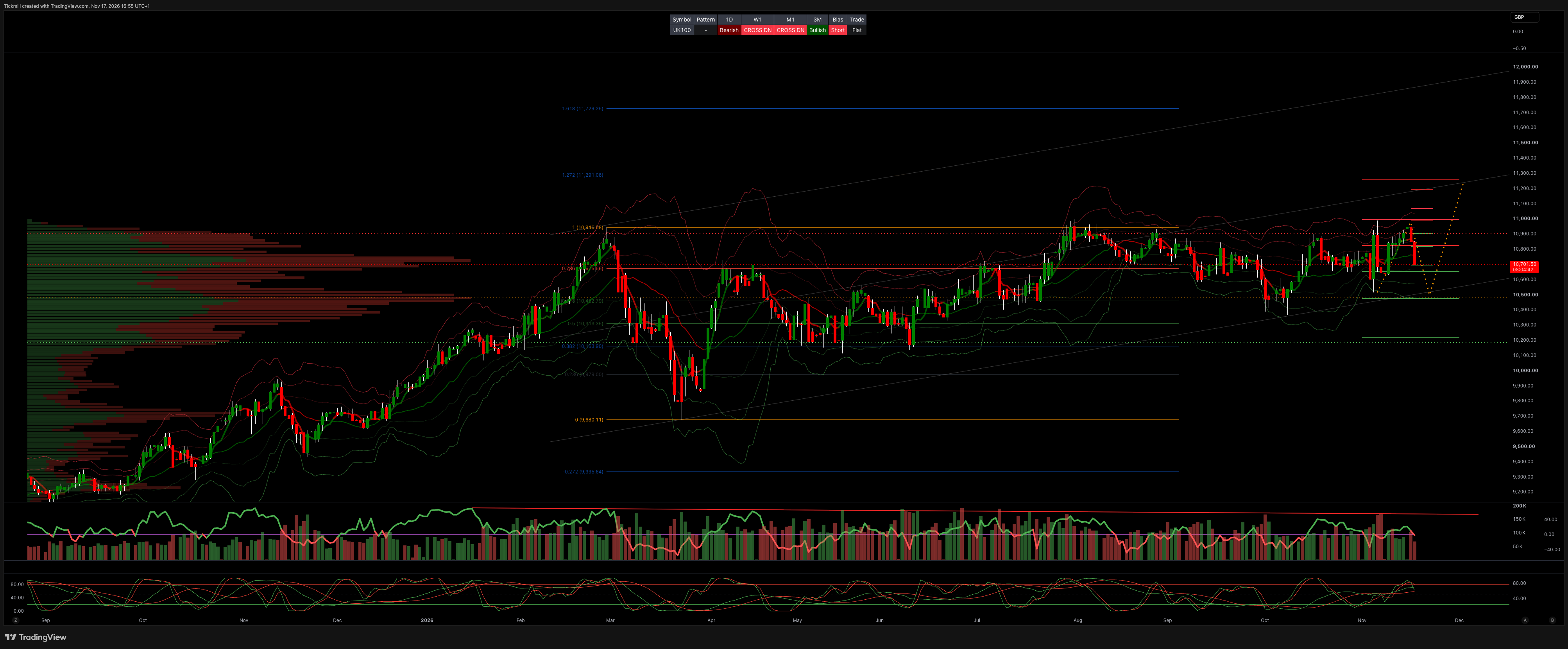
Finish Line: U.K. equities suffered a broad-based pullback as escalating U.S.-China semiconductor friction and pre-Nvidia earnings jitters outweighed signs of moderating domestic wage growth. With geopolitical risks flaring ahead of Thursday's Shenzhen summit and tomorrow's critical October U.K. CPI print looming, the FTSE 100 surrendered its early-week gains to slip back below the 10,800 threshold.



Comments
Log in or sign up to join the conversation.