

Starmer Resigns, Markets Shrug, Banks and Miners Rally
London opened the week higher despite a major political headline, as investors treated Prime Minister Keir Starmer’s resignation plan as more of a managed transition than a market shock. The FTSE 100 gained about 1%, helped by strong moves in miners, banks and financials, while sterling and gilts showed only limited stress. Starmer said he intends to resign, clearing the way for a new leader by September. That would put Britain on course for its seventh prime minister since the Brexit vote in 2016, underlining the persistence of UK political churn. Yet the market reaction was muted. The pound slipped only slightly toward $1.32, while the 10-year gilt yield held around 4.85%. The domestically focused FTSE 250 was weaker, falling 0.6% to a one-week low, but there was no broader disorderly repricing. That tells us something important. Investors had already begun to price the risk of a leadership challenge after Andy Burnham’s momentum last week. Starmer’s announcement removed some uncertainty around the process, even if it opened a new phase of political risk. The key question is not the resignation itself; it is whether the next leader sticks to the current fiscal framework, who becomes chancellor, and how much room the new administration seeks for borrowing, redistribution or tax reform.
For now, the market is giving the UK the benefit of the doubt. If Burnham, the apparent frontrunner, signals respect for the fiscal rules, the gilt market can probably absorb the transition. If the autumn leadership process points toward looser fiscal policy or a more confrontational stance with bond investors, the UK risk premium could rise quickly. Equities, however, leaned into global risk appetite. The FTSE 100’s gain was driven by the same sectors that benefit from a weaker pound, firmer commodities and higher-for-longer rates. Miners were strong, with Fresnillo up 2.7%, while Metlen Energy & Metals, Endeavour Mining and Antofagasta also advanced. The bid in mining reflected both commodity support and the defensive appeal of hard-asset exposure in a politically uncertain environment.
Banks and financials were also major contributors. Lloyds, Barclays and Standard Chartered gained between 2% and 2.5%, while NatWest (NWG), Legal & General, Aviva (AV), HSBC, 3i Group, Standard Life and Admiral also moved notably higher. The sector continues to benefit from elevated gilt yields and a Bank of England that is not yet ready to ease. Political instability is usually a headwind for domestic lenders, but today the market focused more on margin support and the absence of a gilt-market shock. Cyclicals and travel names joined the rally. IAG, Whitbread, Auto Trader, Barratt Redrow, Marks & Spencer, Scottish Mortgage and InterContinental Hotels (IHG) all gained ground. The move suggested investors were not treating the resignation as an immediate consumer or business-confidence shock, at least not yet.
There were clear losers. Babcock International fell more than 5% after reporting lower full-year profit despite higher revenue. Profit before tax dropped to £283.7 million from £329.1 million, while earnings per share fell to 41.3p from 48.0p. After a strong run in defence names, the update gave investors a reason to take profits. Burberry lost about 2.9%, extending weakness in luxury and consumer discretionary names. Mondi, Spirax, Vodafone (VOD), JD Sports, BT, BAE Systems, Diageo, Berkeley, IMI and Weir also fell between 1% and 1.7%. The weakness in Burberry, Diageo and JD Sports reflected ongoing pressure on consumer-facing global brands, while telecoms remained unloved.
The policy backdrop remains delicate. Last week’s Bank of England hold at 3.75% with a 7–2 split reduced the immediate risk of a UK rate hike, but it did not open the door to near-term easing. Inflation remains above target, gilt yields are elevated, and the political transition now raises questions about fiscal credibility. The market can tolerate leadership change; it is less tolerant of unfunded fiscal ambition. The U.S.-Iran situation also remains in the background. Investors continue to track whether peace efforts resume or whether supply-risk pricing returns to oil. For the FTSE, the impact cuts both ways: higher oil supports BP and Shell (SHEL) but can revive inflation concerns, while lower oil helps consumers and margins but weakens the index’s energy ballast.
Finish Line: Starmer’s resignation was a historic political moment, but not a market rupture. The pound dipped, gilts held steady, and the FTSE 100 rose about 1% as miners and banks rallied. The real test now moves to the autumn: the next leader, the next chancellor and the fiscal rules. If Burnham or another successor keeps policy orthodox, markets may continue to shrug. If the transition points toward higher borrowing or wealth-tax experimentation, gilt yields — not equities — will be the first warning light.
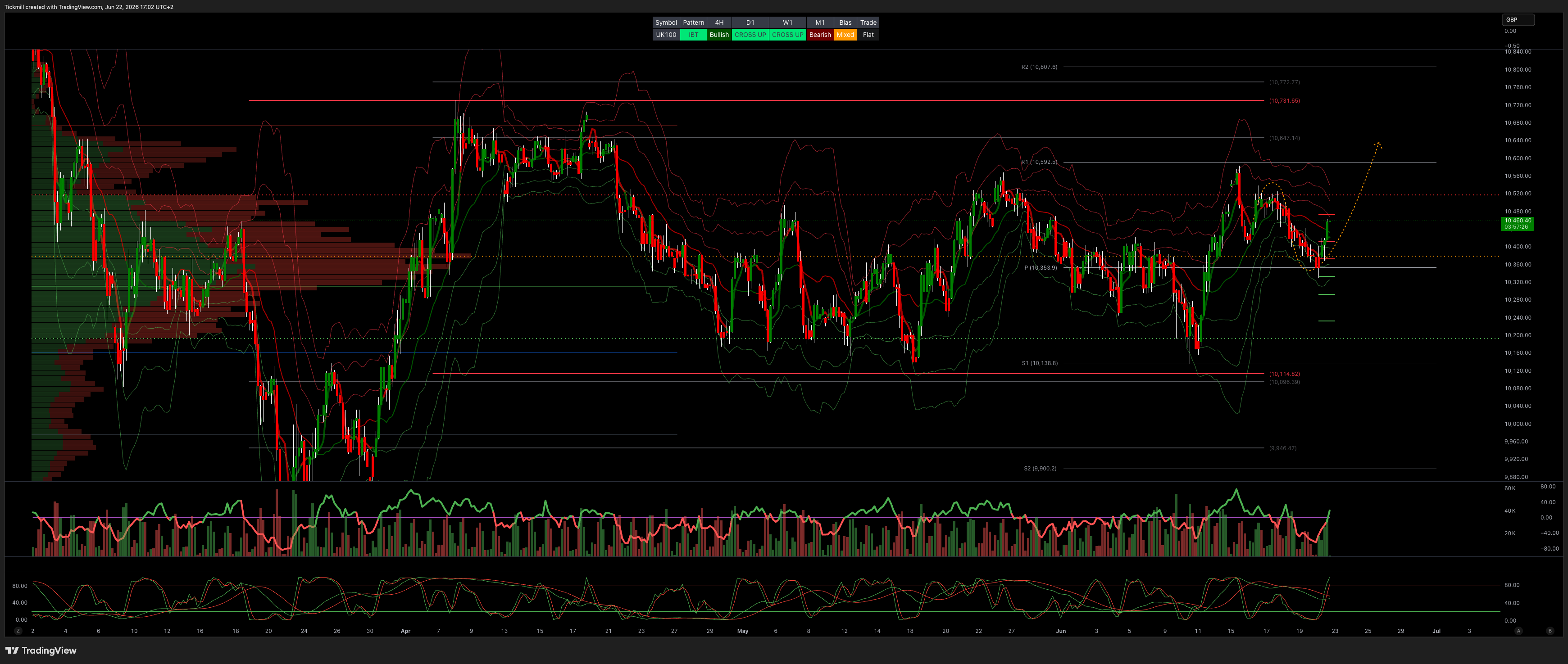
TECHNICAL & TRADE VIEW – FTSE100
Daily VWAP Bearish>Bullish
Weekly VWAP Bearish>Bullish
Above 10350 Target 11000
Below 10100 Target 9469
Comments
Log in or sign up to join the conversation.