

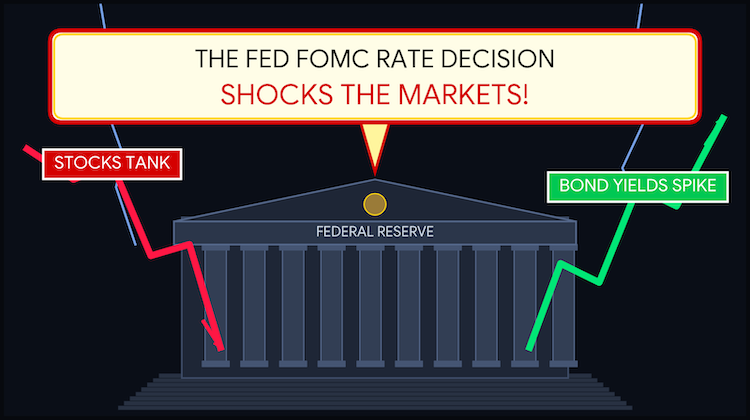
The Fed rate decision had 9 Governors voting to hold rates steady while 3 voted for a rate hike. The market reaction was swift and harsh, as the 30-year Treasury bond yield soared to 19-year highs.
Summary
It’s 2 PM on Fed meeting release day…At that time, I put CNBC on my office TV to find out what top-line interest rate decision the Fed has made. Yesterday, however, I was on a train coming back to Long Island from NYC and missed it.
There’s a reason why I would be intensely interested, as a rate hike, drop, or maintaining the status quo can have a direct impact on my real estate market-related business.
But often more importantly than the decision itself is the press conference given by the Fed Chair at 2:30, where they read a statement and then take questions. That is very often where the real news is made.
In any event, when I got back to my office, the DJIA was down close to 1,000 points along with similar percentage drops in the other stock market indices, and the 10-year and 30-year Treasury bond yields were spiking (post-PCE release this morning, stock markets are bouncing). The 10-year yield reached a level not seen for well over a year, and the 30-year Treasury yield hit a level not seen for 19-years!
So it was a significant decision, and the following article examines various sectors of the economy and how they may be impacted by the macroeconomic environment (that is extremely dynamic), or how certain indicators will actually impact that environment in the case of crude oil and inflation.
The Fed Decision, Interest Rates, Inflation, Crude Oil, Real Estate and the Economy
The Fed Rate Decision
The Federal Reserve voted 9-3 to hold the federal funds rate steady at 3.50% to 3.75%, which is the fifth consecutive meeting with no change
The three dissenting regional presidents — Beth Hammack of Cleveland, Neel Kashkari of Minneapolis, and Lorie Logan of Dallas, voted to raise rates, indicating that there is significant disagreement within the FOMC about it’s mandate of controlling inflation
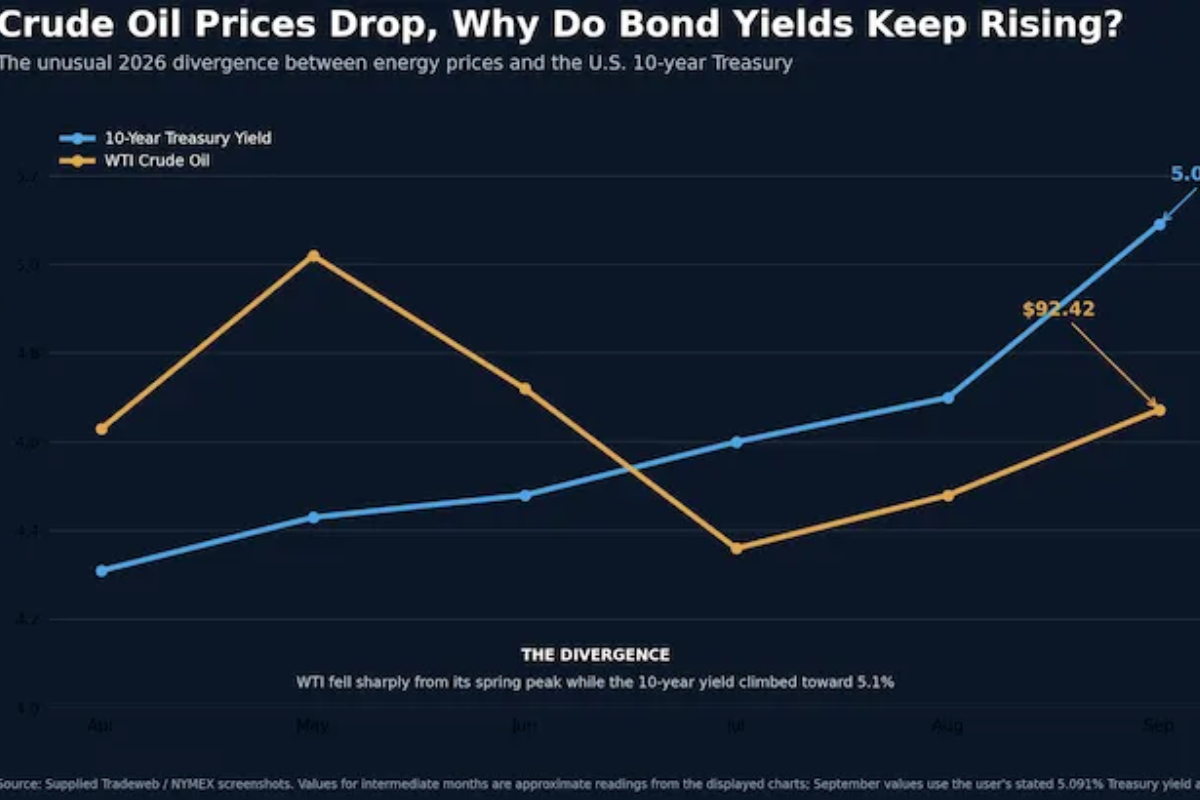
The 10-year Treasury yield rose as high as 4.70% following Warsh’s press conference. The ‘smart money’ in the bond market issued its verdict on the Fed both immediately and negatively!
At the end of the day the Dow was down over 1,100 points, the S&P 500 was down 112 points, and the NASDAQ was down 430 points.
The statement also dropped forward guidance entirely leaving markets guessing about September
Warsh will speak at Jackson Hole, August 27-29, which is an event where Fed chairs have been known to signal major policy pivots
Inflation Is Still Running Hot
Headline PCE inflation has risen from 2.8% in January to 4.1% in May 2026, which was a three-year high, although this morning’s June PCE release showed a YOY PCE inflation rate of 3.7%, better than the 3.8% estimate.
The Iran conflict heated up once again, and WTI crude is back above $80/barrel.
An interesting statistic shows that a 10% increase in oil prices will raise headline PCE inflation by 0.2pp and core inflation by 0.04pp.
If the Strait of Hormuz were ever to close for an extended period of time and crude prices elevated even higher, PCE could move above 5%
For those of us involved in real estate, residential construction input prices are running 6.2% higher than a year ago. In a world that desperately needs housing, these higher costs are moving us in the wrong direction!
Crude Oil Prices Are The Great Unknown
At the beginning of the Iran war, WTI crude peaked with a high of $119.47/barrel, pushing the price of gas at the pump well over $4. That price pulled back as WTI crude fell back into the $70+ range, but last weekend in New York I paid over $4 again.
Pressure is building once again as Iran resumed sending missiles and drones at targets all over the Middle East, hitting Egypt for the first time.
It appears that the price of crude oil will be one of the most important factors affecting inflation for the foreseeable future, and that will impact the Fed, midterm elections, consumer spending and confidence, mortgage rates, Treasury yields, and the real estate market.
How Does It All Impact Mortgage Rates And Interest Rates
The 10-year Treasury yield is now at 4.67%, the highest level in more than a year. At the same time, short-term yields fell, which may indicate that there are fears about a slowing economy, or it’s simply a flight to quality.
30-year fixed mortgage rates are now running in the 6.75% range, far away from the 2023 peak over 8%, but still a significant problem for affordability.
As we have discussed in many prior articles, the 30-year Treasury above 5.2% signals that investors lending for three decades want higher compensation due to concern over long-term inflation, the level of US government debt, consistent and growing budget deficits, and dysfunction in Washington.
What’s The Impact On The Residential Real Estate Market?
Mortgage rates approaching 7% present a significant affordability issue, particularly for first-time homebuyers.
2026 appears to be the second consecutive year of declines for single-family home building. As we see in New York City, where many thousands of apartments are being held off the market, lack of inventory and high demand lead to higher and higher prices.
The lock-in effect, as mortgage rates move higher, will get even worse until some holding these low rates simply throw in the towel and move. Otherwise, homeowners sitting on 3% and 4% mortgages really have no rational incentive to sell into a high 6% mortgage rate environment, a situation that also impacts supply.
Imagine this…Nassau County’s median home price of $852,000 financed with a 7% mortgage will cost approximately $5,675 a month assuming a 20% down payment. Borrowers would need a gross household income of roughly $230,000 just to qualify.
Buyers who can buy will buy, but everyone who can wait is waiting. I face the exact issue of holding my house, or making a lateral price move somewhere else.
Builder import costs rising over 6% are yet one more factor huring confidence and limiting supply.
With the NAHB Housing Market Index at 35 (50 = neutral) builders are not particularly confident, a surprise, as having known builders for quite some time, they are typically always optimistic. Anecdotally, walking the dog around the neighborhood, I see many houses that have been bought as knockdowns months ago, just sitting behind a chain link fence.
IMPACT ON COMMERCIAL REAL ESTATE
The 10-year at 4.657% means cap rates are being compressed as the spread between CRE yields and the risk-free Treasury rate narrows. For those unfamiliar, ‘Treasury debt represents the risk-free rate for borrowers around the world, inserted into formulas like the Capital Asset Pricing Model (CAPM) learned in business school’.
The refinancing Wall — Billions in commercial mortgages originated at 3-4% during 2019-2022 now need to be refinanced with much higher mortgage rates. For many borrowers, the math behind underwriting a CRE loan at these mortgage rate levels simply won’t work.
The refinancing wall is accelerating — every month of elevated rates adds more properties to the distress pipeline, particularly in office and downtown retail markets already weakened by remote work and crime
Rising construction costs, of course, impact CRE too, with development challenged at current interest rate and materials cost levels.
Do you have the proverbial ‘dry powder’? For long-term investors with money to invest, the current environment in many CRE sectors is creating genuine acquisition opportunities.
Impact On The Economy
The FOMC’s own statement acknowledged: “Economic activity is expanding at a solid pace despite elevated uncertainty that owes, in part, to the conflict in the Middle East. Productivity growth and capital investment are strong. Job gains have kept pace with the workforce”. What does that mean exactly? Is there trouble ahead for the economy?
At the start of 2026, the consensus from economic experts was that there would be rate cuts this year. Not that economists and forecasters are typically wrong, but they certainly were this time.
Over the years, seeing dissenting votes on a Fed rate decision was more the exception than the rule. Expect that situation to remain, unless one rate direction or the other somehow becomes crystal clear.
Consumer confidence is not particularly strong given higher gas prices, higher grocery prices, higher mortgage rates, and stock market volatility. Confident people transact (i.e., buy or sell a house), while less than confident people will sit back with a wait-and-see attitude.
Got stagflation? Growth holding steady or dropping, while inflation is high. Stagflation is the hardest economic environment for the Fed to deal with!
So Where Do We Stand, And Where Do We Go From Here?
A divided Fed holding rates while inflation rises, 10-year Treasury yields approaching 5%, oil price volatility driven by geopolitical events entirely outside the Fed’s control, and a real estate market that was already strained seems to have produced the most challenging macroeconomic environment for real estate since 2008.
Unlike 2008, however, the economy is not collapsing. Earnings are mostly strong, unemployment is low, and productivity through AI is strong. we are most certainly not currently experiencing a financial crisis. Instead, we face elevated costs, limited supply of real estate, and lower levels of transactions.
What will turn this situation around? Very hard to say!
Here’s an interesting interpretation from a market analyst about yesterday’s Fed decision…Amidst all the ambiguity, one thing is clear: the trajectory of prices, not the labor market, will determine which policy scenario prevails in the short run. For now, the labor market is playing second fiddle, while inflation has first chair.”
In a confusing economic time, that statement may describe the future as well as any.
Comments
Log in or sign up to join the conversation.