The End Of A Legendary Mortgage Monopoly

Fair Isaac Corp faces a structural shift as the FHFA ends its mortgage credit scoring monopoly.

Source: DepositPhotos

When a business owns a government mandated toll bridge, investors naturally assign it a premium valuation. Fair Isaac Corporation (FICO) benefited from something close to that setup in the mortgage market for years. But the Federal Housing Finance Agency has now directed Fannie Mae (FNMA) and Freddie Mac (FMCC) to open rival credit scoring model VantageScore 4.0 to all approved lenders, widening a bypass that was already under construction. The question is no longer whether competition will be allowed. It is how quickly lenders will adopt the alternative, and how much pricing power FICO can keep.

Main Note

The sudden loss of absolute pricing power

Fair Isaac Corp (FICO) Quote

Verdict: A regulatory change has put one of FICO’s most valuable competitive protections under pressure. Lenders now have a wider opening to choose a rival score, which could weaken pricing power and take business away. But permission to switch is not the same as an immediate loss of revenue. The investment question is how quickly lenders move and how much profit FICO can defend.

What happened

On September 3, the Federal Housing Finance Agency directed Fannie Mae and Freddie Mac to expand VantageScore 4.0 access to all approved lenders rather than a limited pilot group. The change opens the door to using the rival score instead of Classic FICO on eligible mortgages sold to the two companies. That is a meaningful competitive opening, but lenders still have to meet the applicable underwriting, insurance and loan delivery requirements.

The price gap is real, but these numbers are for individual scores, not the full mortgage credit report. Equifax advertises VantageScore 4.0 at $1 per score through 2027, compared with FICO’s $10 flat fee option. FICO also offers lower upfront score fees through its direct licensing program, with additional charges when a loan closes. The rival is cheaper on that headline comparison, but lenders still need to compare the whole bill.

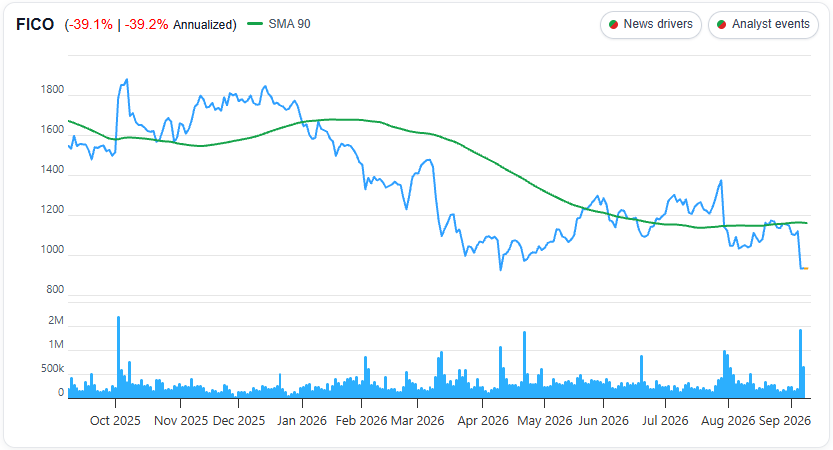
Fair Isaac Corp (FICO) 1 Yr Chart

Fair Isaac Corp (FICO) 1 Yr Chart

Why it matters

FICO’s Scores division reported a 91% operating margin in the June quarter, before certain companywide expenses. That division includes more than mortgage scoring, but mortgages are hardly a side business: mortgage origination generated about $282 million of FICO’s $674 million in quarterly revenue. Losing score volume or cutting prices could take a substantial bite out of profit. The unanswered question is how much business moves, and what FICO has to charge to keep the rest.

What changed in the thesis

Investors previously treated this business as an untouchable utility with absolute pricing leverage. Now they must model a highly competitive duopoly. This structural shift usually forces earnings multiples to compress to reflect the new regulatory reality, even if the underlying business remains highly profitable.

What the market may be missing

The panic over mortgage scoring might be overshadowing a real transition elsewhere in the business. In the June quarter, FICO Platform annual recurring revenue grew 62%, with a 148% net revenue retention rate. But part of that growth came from moving existing customers off older FICO products. Excluding those moves, platform growth was in the mid 30% range, while annual recurring revenue across the entire software business rose 10%. That is a promising second engine, not yet a replacement for the mortgage cash machine.

Valuation and expectations

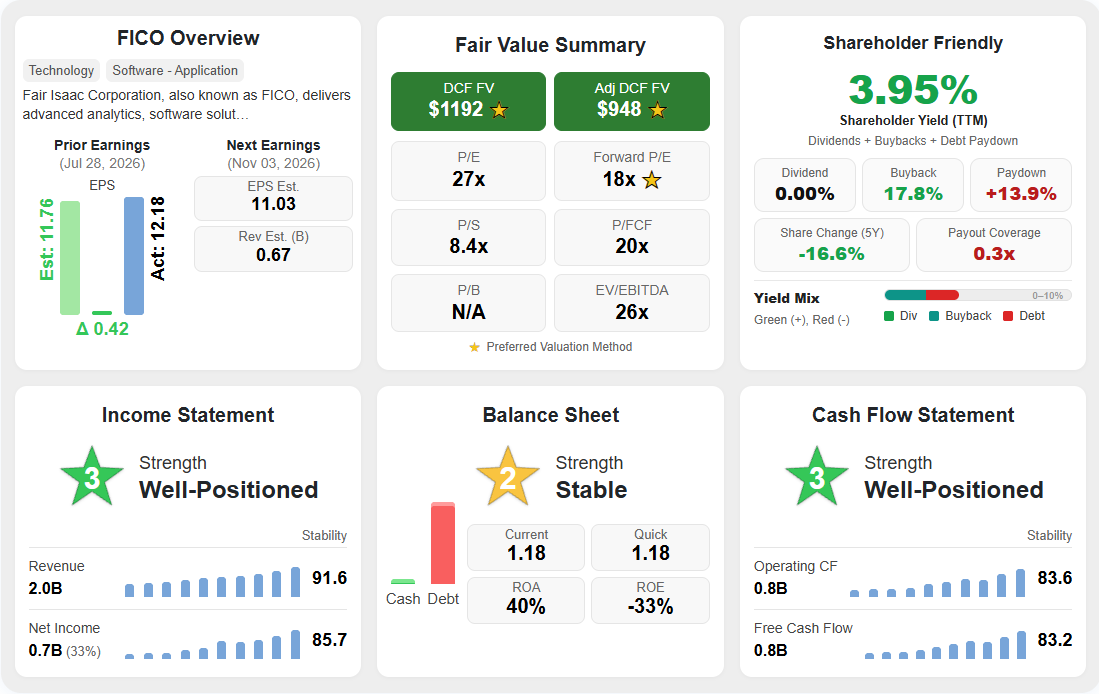
At Tuesday’s $933.30 close, shares traded at roughly 27 times trailing reported earnings, or about 22 times management’s fiscal 2026 adjusted earnings guidance of $42.43 per share. Those are different measuring sticks, not a range for the same earnings figure. FICO also borrowed $1.5 billion in June to fund accelerated share repurchases. If competitive pressure weakens future cash flow, that borrowing will leave less room for error. A lower share price does not automatically make the stock cheap when the earnings outlook is also less certain.

Fair Isaac Corp (FICO) Scores

Fair Isaac Corp (FICO) Scores

Bottom line

FICO can no longer lean as heavily on being the required choice. But its defense is broader than lender inertia. The company has established customer relationships, its newer FICO 10T model and a direct licensing program designed to change how lenders buy its scores. None of that guarantees protection from a cheaper rival. It does mean this is a competition over price, performance and implementation, not simply a bet that banks refuse to change.

Pre Market Pulse

  • Shares stabilized around $934 on Tuesday after a 17% plunge late last week.

  • Regulators continued their aggressive public rhetoric against credit bureau pricing heading into the Wednesday session.

  • The broader software sector offered no lift, with key software exchange traded funds falling roughly 2% in recent trading.

Why it matters this morning

Tuesday brought a pause rather than a convincing recovery. FICO finished almost unchanged after Friday’s sharp decline, but one quiet session does not establish a floor. The next useful evidence will be actual lender adoption, pricing decisions and management’s assessment of the effect on future earnings.

Peer Read Through

Equifax (EFX)

Shares fell roughly 8% late last week as regulators threatened to reduce the mandatory three bureau credit pull to a two bureau system.

TransUnion (TRU)

The credit data provider fell roughly 8% alongside its peers on the exact same regulatory threat to bundle pricing.

Experian

The third major credit bureau involved saw its London traded shares fall roughly 5% as it faces identical pressure to lower consumer costs.

Group takeaway

While these three companies jointly own the new rival scoring model, they are facing their own severe regulatory headwinds. The entire credit reporting oligopoly is under pressure from regulators determined to cut costs across the housing ecosystem.

What to Watch

  • Actual lender adoption of VantageScore 4.0, alongside FICO’s mortgage score prices and volumes.

  • Published changes to the number of credit bureau reports required, rather than regulatory comments alone.

  • Fiscal fourth quarter results, expected in early November, with the reporting date still awaiting company confirmation.

  • Pricing changes and adoption of FICO’s direct licensing program, including whether it helps defend profitable business.

Bottom line

Fourth quarter results, expected in early November, should provide a clearer view of management’s outlook. But investors do not have to wait until then to watch lender adoption and pricing. For long term investors, the question is not simply how far the stock has fallen. It is how much durable earning power remains, and whether today’s price leaves enough room for the risks.

STOCKS IN THIS ARTICLE

Also Mentions:

Comments