

The reality is MPT has been used more as a marketing tool for the financial services industry to market investment advice under the guise of an advanced approach developed from a Nobel prize winning theory the tenets of which provides portfolios with less risk without the loss of returns.
“Buy and Hold” and Strategic Asset Allocation (SAA) practitioners attribute their approach to MPT.
The reality is the Markowitz paper, Portfolio Selection, led with: "The process of selecting a portfolio may be divided into two stages. The first stage starts with observation and experience and ends with beliefs about the future performances of available securities. The second stage starts with the relevant beliefs about future performances and ends with the choice of the portfolio. This paper is concerned with the second stage."
But a static "buy and hold" strategy isn't what Dr. Markowitz proposed.
Markowitz envisioned an active strategy with a forecast.
This is stage one that Markowitz referred to, and it occurs before MPT is applied to one's holdings.
Since 1900, there have been 85 twenty-year periods; the first was from 1900 to 1919, and there are eighty-four double-decade time spans from that point. At the point when divided into two groups, those above the average and those below the average, the top group averages returns of 10.5% and the bottom group 5.1%. The average of each one of those scenarios shows the long-term average return before exchange costs and taxes of 7.8%.
Although the future performance of the stock market can't be anticipated with assurance or accuracy, through observation and experience, we have the option to, at any rate, refine return expectations.
One trademark that is self-evident for the two groups is the beginning valuation of stocks, by using a cyclically adjusted price-to-earnings ratio such as Shiller’s CAPE10.
You can see this in the following chart from Crestmont Research, a high CAPE results in below-average future stock returns.
(Click on image to enlarge)
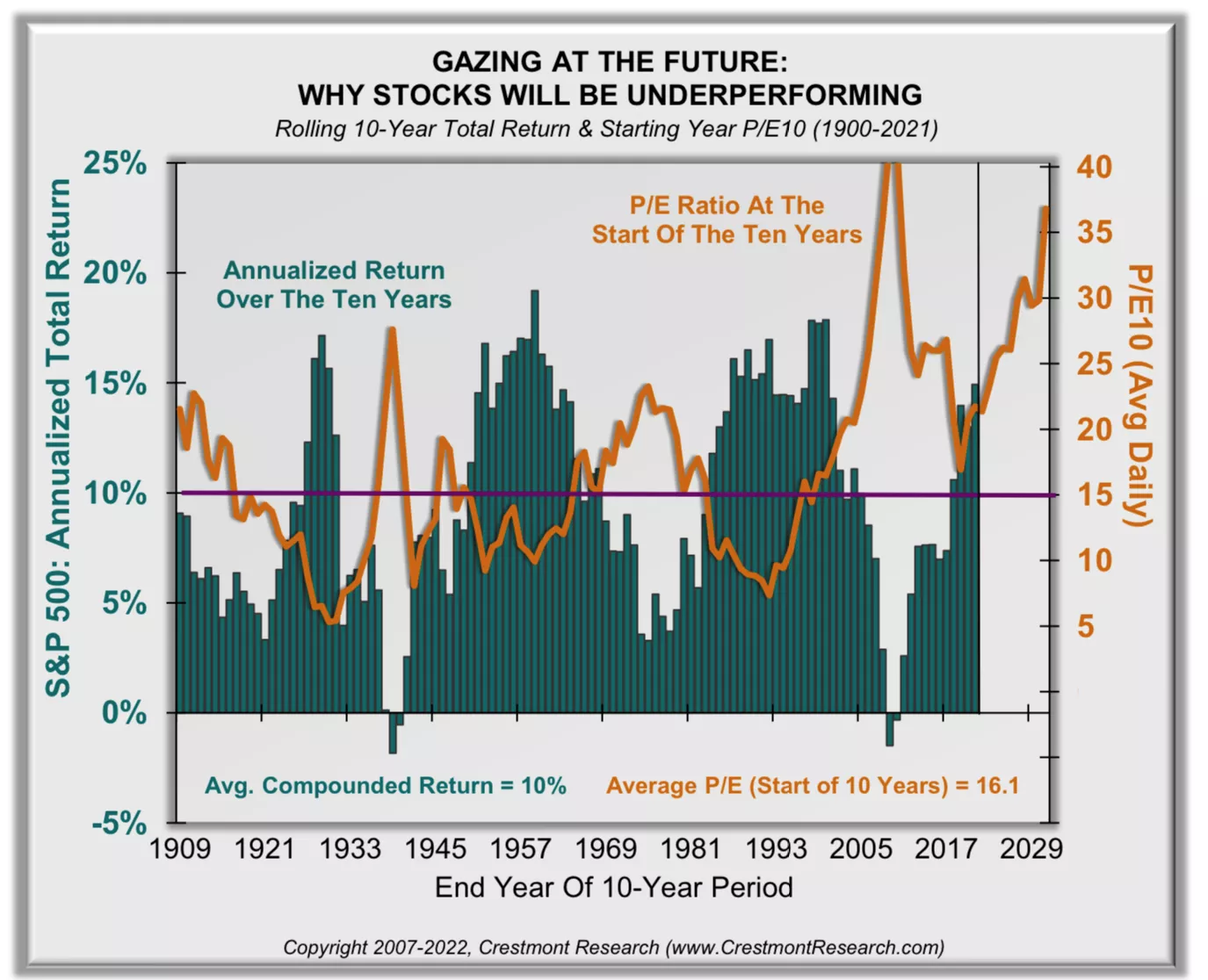
As Markowitz underscores, we must use "observation and experience" to create "beliefs about future performances."
Considering current market valuations are extreme, they ought to incorporate a below-average return assumption.
Correlation as a factor presents difficulties for the advice provided by an investment or robo advisor, just as it introduces potential liability.
In the paper, Post-crisis Perspective on Diversification for Risk Management, from the Edhec-Risk Institute, the findings reveal that since the financial crisis of 2008, improving risk management practices has been a hotly debated issue. They conclude that the solution can be found in active asset allocation approaches. They state, “dynamic asset allocation techniques deal efficiently with general loss constraints because they preserve access to the upside."
The utilization of strategic asset allocation optimization software based on MPT is inescapable in the investment advisory industry. The reality remains that given SAA's use of 80-100 year average returns, static risk, and correlations, the inability to perform a post-execution examination dependent on the client investor's portfolio returns leaves the advisor exposed to potential liability.
Contingent upon irregularity between the first projections and the post projections, perhaps an advisor's activities are fraudulent.
Correlations among asset classes, similar to returns and risk estimations, are not static in the real world markets. In fact, research has shown that correlations (and volatility/risk) increase and the diversification benefits of the SAA strategy fail during periods of market instability.
In their paper, When Diversification Fails, authors and T. Rowe Price portfolio managers, Sébastien Page, CFA, and Robert A. Panariello, CFA state “one of the most vexing problems in investment management is that diversification seems to disappear when investors need it most. We surmise that many investors still do not fully appreciate the impact of extreme correlations on portfolio efficiency — in particular, on exposure to loss."
They conclude:
“investors should not use them (correlations) in risk models, at least not without adding other tools, such as downside risk measures and scenario analyses. To enhance risk management beyond naive diversification, investors should re-optimize portfolios with a focus on downside risk, consider dynamic strategies, and depending on aversion to losses, evaluate the value of downside protection as an alternative to asset class diversification."
In their 2009 paper, The Myth of Diversification, Chua, Kritzman, and Page reported critical "undesirable correlation asymmetries" for an expansive scope of asset classes. In addition to the fact that correlations increased in a downturn, they additionally diminished on the upside. This asymmetry is something contrary to what investors need.
Markowitz's guidelines require that asset allocation recommendations ought to respond to changes in the economy and the market.
All things considered, the industry has advanced the "buy-and-hold" approach with the use of SAA and hung their hat on another mistaken understanding of an acclaimed asset allocation study.
In 1986, the Gary P. Brinson, L. Randolph Hood and Gilbert L. Beebower (BHB) study, "Determinants of Portfolio Performance,” was published in the Financial Analysts Journal.
The BHB study considered the variability of returns' of 91 pension plans across stocks, bonds, and cash.
The study found that the asset allocation policy represented around 93.6% of the fluctuation of the plans' returns. The BHB study concentrated on the variability of returns, yet the industry over and over has distorted the discoveries of the BHB study to mean that the BHB study shows that asset allocation represents 93.6% of an investor's returns. Advisors have used this distortion religiously to promote buy and hold and SAA.
Conclusion-
The intentions of Modern Portfolio Theory are clear, a modern investment approach used by the investment advisor and robo advisor must consider present market conditions. At a minimum, the strategic asset allocations should not be based on historical asset class average returns, risk, and correlations over an 80-100 period. They should be based on current market conditions, for example, current bond yields and stock valuations.
More By This Author:
Expect Equities To Improve Before The Economy In 2023
The Strategic Asset Allocation Dilemma
Yield Spread Translates Into Greater Than 50% Chance Of Recession


Comments
Log in or sign up to join the conversation.