

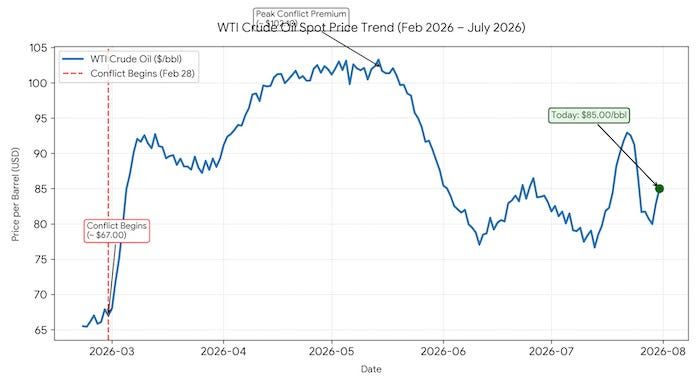
March 9th, the price of WTI crude hit an intraday price of $119.47/barrel. It stayed over $100/barrel before dropping after repeated attempts at a ceasefire. With tensions still hot, why are we at $85?
Why Ask Why?
As a bond and equity trader in a prior life, one thing you learn is that when a situation seems to be trending in the opposite way you believe it should, don’t fight the tape!
A perfect example is a stock that reported bad news and, after opening lower, begins to meander towards unchanged. Understanding that we are not smarter than the market, that can be the perfect opportunity to go long the stock.
In any event, with tensions in the Middle East not abating and in some ways actually escalating, my curiosity centered this morning on why crude oil prices are remaining somewhat subdued in the face of continued Iranian drone and ballistic missile launches.
You might be wondering why I would care about crude oil prices, and the answer is that beyond my national security interests, there is also a focus on interest rates, mortgage rates, inflation, the real estate market, and the economy. Energy costs and inflation are, of course, central to all of these things.
So, doing some digging through Claude, I discovered some of the reasons why we are where we are. I asked Claude the following question:
The conflict in the Middle East seems to have the potential for expanding and bringing in other countries like Saudi Arabia into the fighting. And yet, crude oil prices have leveled off in the high $70 to low $80/barrel range. Doing a deep dive around the internet, is there a reason why crude is not reacting with a move higher, or is it that traders believe the issue will be resolved?
 |
A Common Phrase Describing Crude Oil…Demand Destruction!
Reasons why, for the time being, crude prices are somewhat stable well below the initial panic highs…
REASON 1 — The Demand Collapse Is Staggering and Largely Unreported
Since the conflict began in late February, the world has lost roughly 11.1 million barrels per day of oil supply, or roughly 10% of global demand. That loss has drawn down global inventories to record lows, according to a team of JPMorgan strategists led by Natasha Kaneva. Yet, even as the Houthis have begun targeting vessels in the Red Sea, futures have remained far below their wartime peaks.
The reason: demand has collapsed almost as dramatically as supply. The biggest surprise was China, the world’s largest oil importer, which had slashed crude imports to the lowest in nearly a decade by June. China’s economy is slowing, its manufacturing sector is contracting, and its domestic fuel exports were curbed — dramatically reducing the world’s single largest source of marginal demand at the exact moment supply was disrupted
A recovery in world oil demand is underway, with consumption set to rise from its May nadir on seasonal trends. Annual contractions ease from 4.8 mb/d in Q2 2026 to 1.7 mb/d in Q3 2026. The demand contraction is enormous — 4.8 million barrels per day in Q2 — effectively offsetting much of the supply disruption
REASON 2 — Saudi Arabia Found an Alternative Route and Flooded the Market
This is perhaps the single most important factor. Saudi Arabia, the biggest Gulf oil exporter, sharply increased shipments from its Red Sea Yanbu port, helping to offset the loss of barrels via the Strait of Hormuz. Rather than being paralyzed by Hormuz closure, the Saudis pivoted to their Red Sea port infrastructure with remarkable speed
Saudi Arabia is simultaneously engaging in what traders are calling a potential price war — slashing its official selling prices to Asian customers and racing to maintain market share even at lower prices
OPEC+ approved another production target increase starting in August. “It is increasingly looking like the Gulf producers are gearing up for a price war,” said Robert Yawger, director of energy futures at Mizuho. “They are selling into a falling market, offering little hope of an imminent price recovery.”
The brutal irony: Saudi Arabia is simultaneously being threatened by Houthi maritime embargoes tied to Iran — and yet is pumping more oil to defend market share against Iran and keep prices from spiking in ways that would damage its long-term customers
REASON 3 — Strategic Petroleum Reserves Were Released
The G7 countries, led by the United States, moved quickly to release strategic petroleum reserves when prices spiked above $100 — providing a meaningful supply cushion that capped the price rally at levels well below what analysts initially feared
Prices retreated from intraday highs following news the U.S. and other G7 countries were considering tapping strategic petroleum reserves. The mere signal of SPR releases was enough to suppress the ceiling on oil prices
The U.S. Navy escort program for tankers through the Strait of Hormuz, combined with Treasury Secretary Scott Bessent’s insurance program to support shipping through the waterway, reduced the practical impact of Hormuz disruption below what raw shipping statistics suggested
REASON 4 — Hormuz Traffic Has Partially Resumed and Markets Are Pricing That Reality
Hormuz shipments briefly restarted in June, easing concerns about crude availability, but dropped again in July as the fighting resumed. The on-again, off-again nature of Hormuz traffic has created a market that prices probabilities rather than worst-case scenarios
Global oil supply rebounded by a sharp 4.1 mb/d to 98.8 mb/d in June, as a resumption of flows through the Strait of Hormuz underpinned a partial recovery in Gulf production.
Iran set to boost sales after a temporary reprieve from US sanctions drove down prices of physical crude oil cargoes around the world. Markets are pricing in the possibility of Iranian supply returning, not just the current disruption
REASON 5 — Traders Are Pricing Peace Probability, Not War Certainty
A pause in fighting between the United States and Iran has given oil traders hope that a diplomatic resolution could restart the flow of oil traffic out of the Middle East. Oil prices tumbled 8% Monday, on pace for crude’s biggest single-day decline since May 25. The “news” that oil markets are trading on is thin at best: The Trump administration paused plans to escalate the war. And a lack of fighting this weekend suggested that maybe the two countries could return to the negotiating table.
The oil market has repeatedly demonstrated that it will sell first and ask questions later whenever any diplomatic signal emerges — regardless of how thin or unverified that signal is
This behavior reflects the fundamental structure of oil trading: the downside from an unexpected peace deal is far larger than the upside from an unexpected escalation, so traders structurally lean toward positioning for de-escalation
REASON 6 — Non-OPEC Supply Has Surged to Fill the Gap
U.S. shale production has remained at near-record levels, with American producers capitalizing on elevated prices to drill aggressively — partially offsetting Middle East supply losses with Western Hemisphere production that has no Hormuz exposure
The IEA July 2026 Oil Market Report confirms: If transit volumes improve, oil supply will expand by 7.5 mb/d next year — the market is already pricing in a supply recovery scenario that reduces the urgency of current price spikes
Russia’s production, while sanctioned, has continued flowing through alternative channels to willing buyers — adding additional supply that the official figures understate
REASON 7 — The Recession Risk Premium Is Suppressing Demand Expectations
The Commonwealth Bank of Australia said that recent decline in oil prices reflects easing concerns over an immediate escalation between the U.S. and Iran, but cautioned that risks to global energy supplies remain elevated.
Elevated oil prices themselves destroy demand — by raising costs for consumers and businesses, they slow economic growth and reduce the very demand that supports prices. This self-correcting mechanism has been visible throughout 2026: every spike toward $110-$120 triggered demand destruction that pulled prices back
Global manufacturing PMIs have been contracting across Europe, China, and parts of the U.S. — signaling slower industrial activity and lower fuel consumption even before any additional supply disruption
REASON 8 — Saudi Arabia’s Naval Coalition Proposal Calmed Markets
Most recently — just yesterday: Oil prices fell Thursday after Saudi Arabia proposed a naval coalition to protect key trade routes as ships come under attack from Iran and its allies in the Red Sea and Strait of Hormuz. The Saudi Defense Ministry said more than 40 countries attended a meeting to discuss “strengthening maritime defense cooperation and unifying efforts to protect the security of maritime passages.”
The signal that 40+ countries are willing to defend maritime routes — rather than allow Iran and the Houthis to control them — is profoundly bearish for oil prices, as it reduces the perceived probability of a sustained Hormuz closure
Where We Go From Here
Paying close attention to daily events and how they are impacting macroeconomic conditions, or have the potential to impact those conditions, all of the reasons above as to why crude prices are remaining at current prices are valid.
However, the situation in the Middle East is incredibly dynamic, basically one action away from erupting further. Giving peace a chance is, of course, the preferable alternative, but if one thing remains crystal clear, it’s that you need two willing and somewhat trustworthy partners at the negotiating table.
Obviously, in dealing with Iran, we may not have that type of partner at the table.
So, bottom line, it appears to these eyes that extraordinary pressure seems to be building in the Middle East, and any new and significant escalation could spike oil back past $100/barrel.
But because surprises can happen, perhaps peace will break out, sending crude back to pre-conflict levels.
We will just have to wait and see.

Comments
Log in or sign up to join the conversation.