


On Friday, the framework agreement is set to be signed in Switzerland by the U.S. and Iran. This will mark the start of a 60-day period during which technical negotiations are intended to lead to a lasting solution. Not all details of the agreement are known yet, but what has already been leaked is likely to at least significantly undermine the hoped-for belief in a lasting peace. Israel does not accept the agreement, which means that the problem in Lebanon is far from resolved. For Iran, however, this point is of great significance. It therefore remains to be seen whether the Strait of Hormuz will indeed be fully and unrestrictedly reopened. The risk that the final chapter of this conflict has not yet been written thus seems quite real. The stock market’s reaction to the progress of the peace talks was correspondingly cautious—rather subdued.
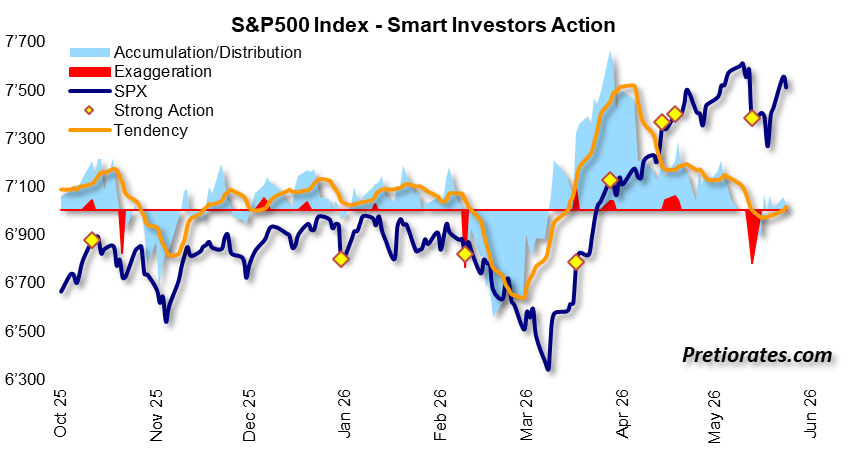
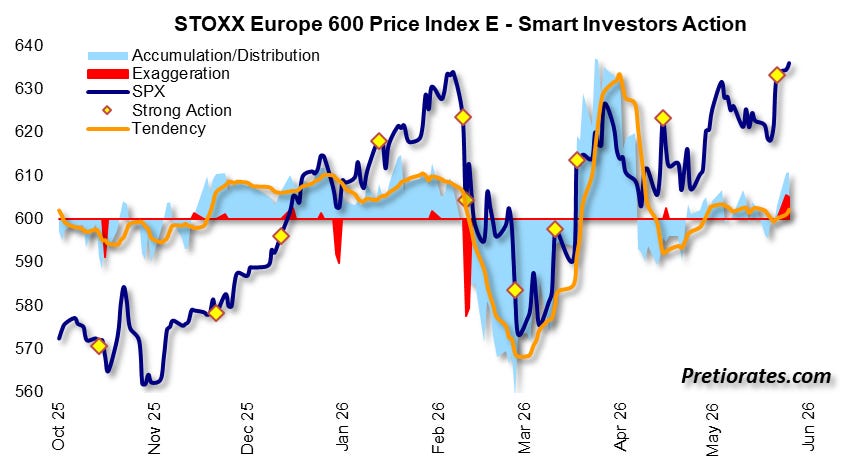
The “Smart Investors Action” indicator uses the light blue area to show whether large investors—who typically act patiently and rather inconspicuously in the background—are accumulating or selling shares. These are always long-term investments, as is typical for this type of investor. It is striking that the sell-off at the beginning of the month was excessively strong, triggering a red area—a so-called “exaggeration.” Such exaggerations are almost always met with equally strong counter-movements. During the rally of the past few days, however, it is noticeable that the Smart Investors Action no longer indicated accumulation. The large investors therefore seem to have used the rising stock prices to take profits rather than to buy aggressively.
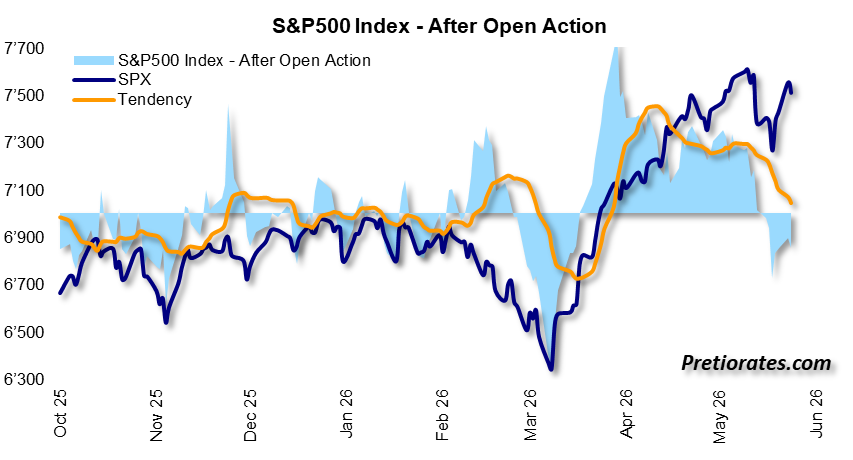
The same picture emerges in professional trading, as depicted by the After Open Action indicator. Here, too, it appears that the rising stock prices of the past few days have been used primarily to sell off investments. In other words: The pros haven’t necessarily used the bullish market to cozy up to it, but rather to exit through the side door.
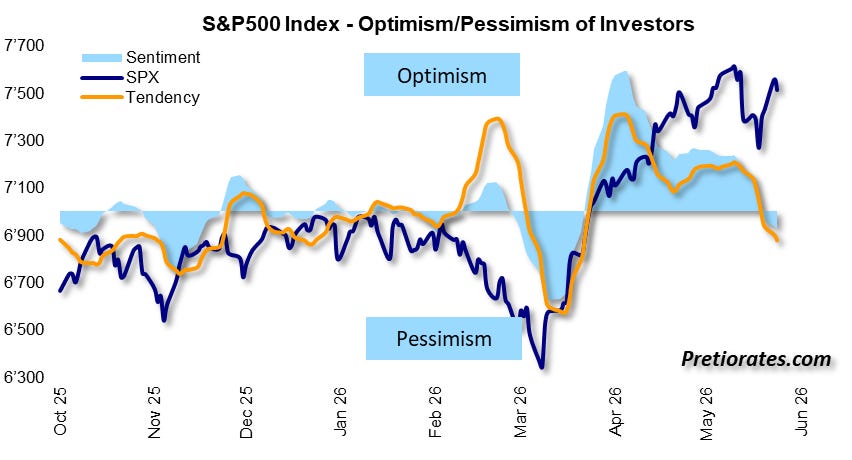
For the first time since late March—when we turned bullish on the U.S. stock market again due to the rising sentiment indicator, which compares optimism and pessimism—that indicator has now fallen back into the pessimistic zone. From this point on, the overall market therefore needs fundamentally positive news if further gains are to be achieved. A positive mood alone is no longer enough; the market wants to see solid arguments again.
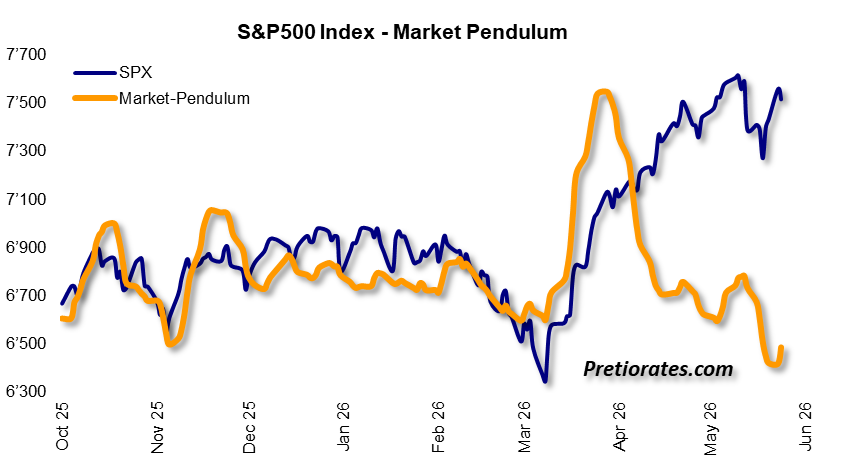
In the short term, the Market Pendulum still seems to indicate that the positive underlying tone is likely to persist somewhat. It can therefore be assumed that the index will not suddenly lose momentum, but will rather consolidate at a higher level, possibly accompanied by increased volatility. So the music is still playing, but the volume control seems a bit more erratic than it has been recently.
What is striking about the European market is that, unlike the U.S. market, it did not exhibit any signs of overreaction during the sell-off at the beginning of the month, but is now showing such signs during the recovery (red area). This is a clear indication that there has been cautious distribution in recent weeks, while the recent rise in stock prices has actually been used quite aggressively for selling.
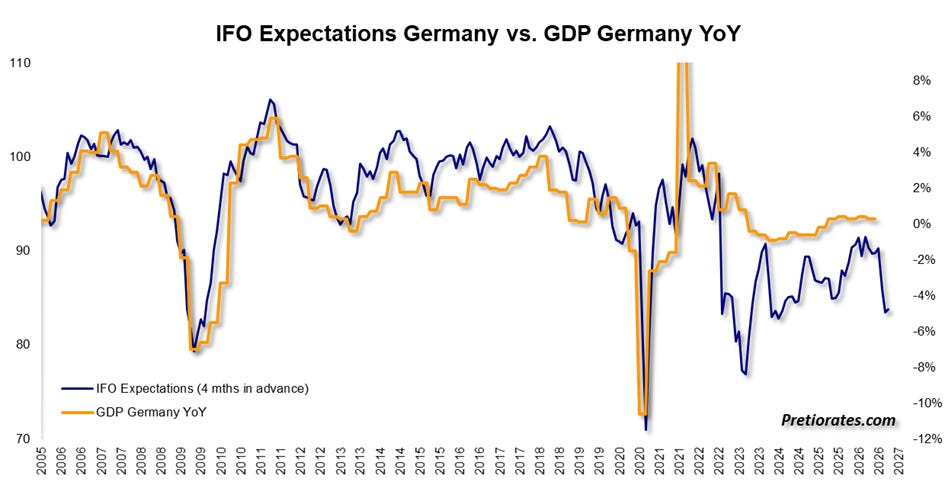
The IFO Economic Expectations Index shows that the outlook for Germany isn’t exactly rosy. This leading indicator for German GDP suggests that Europe’s most important economic zone could soon fall into a recession. That sounds less like a spring awakening and more like a weather report with a storm warning.
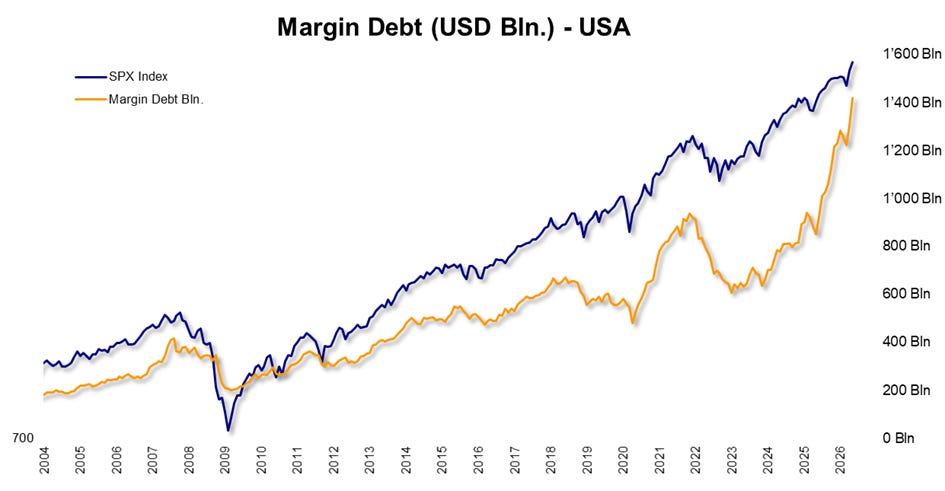
So the thick, dark clouds on the horizon seem to be drawing nearer. The new margin debt data for May has just been released and provides an important clue in this regard. As a reminder, these are investments acquired through borrowing. The more these loans increase, the more US investors are speculating. It therefore stands to reason that they tend to rise particularly sharply near long-term highs. At the same time, this makes the market more nervous because investors who finance their investments with debt do not have particularly deep pockets.
In fact, margin debt rose massively again in May, and at first glance, the figure is quite alarming: for the first time, the amount of credit for investments rose above 1.4 trillion U.S. dollars.
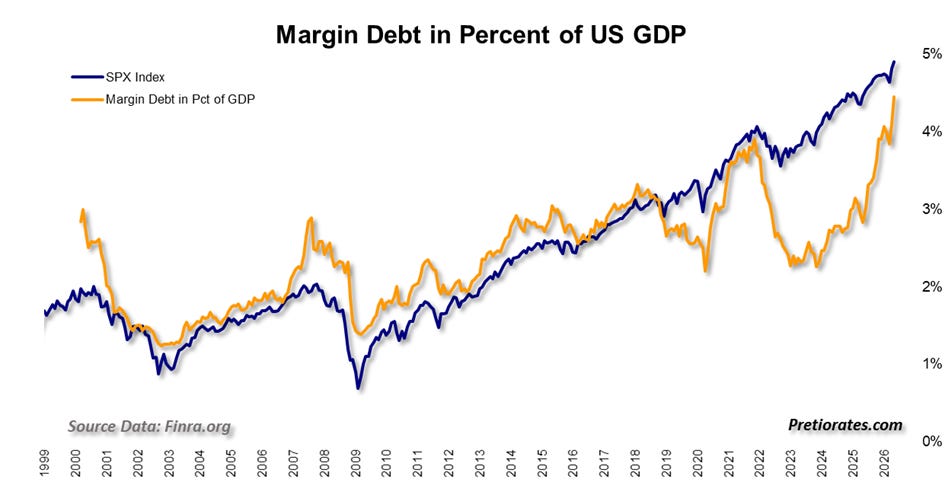
However, simply looking at the raw figure for credit extended for investments doesn’t really make much sense. This growth should also be compared to the growth of U.S. GDP. Yet even from this perspective, the trend appears quite dramatic. In recent months, this key metric has risen to a new all-time high even relative to GDP.
Relative to the growth in the market capitalization of all U.S. stocks, however, we are still at a lower level than during the past decade.
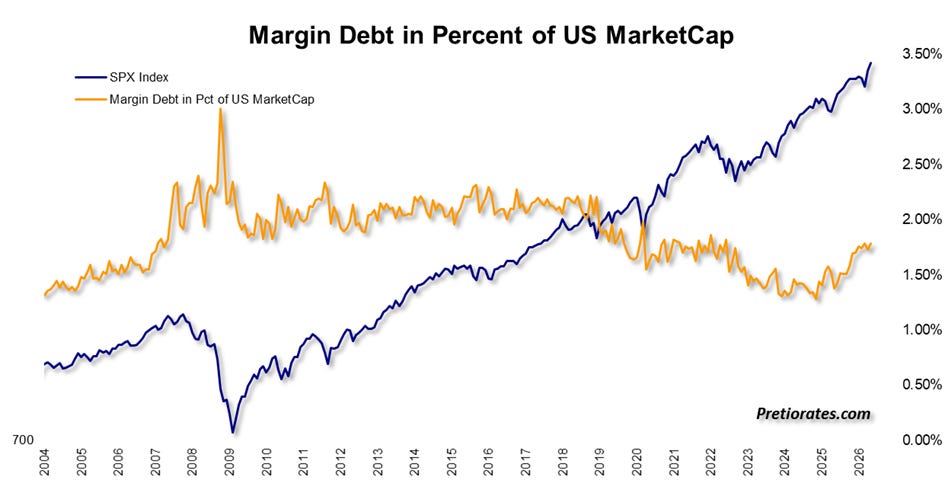
What is truly interesting, however, is the speed at which margin debt has increased. Over the past 30 years, the percentage change over the last 15 months has consistently proven to be a reliable indicator. A long-term sell signal has not yet been generated.
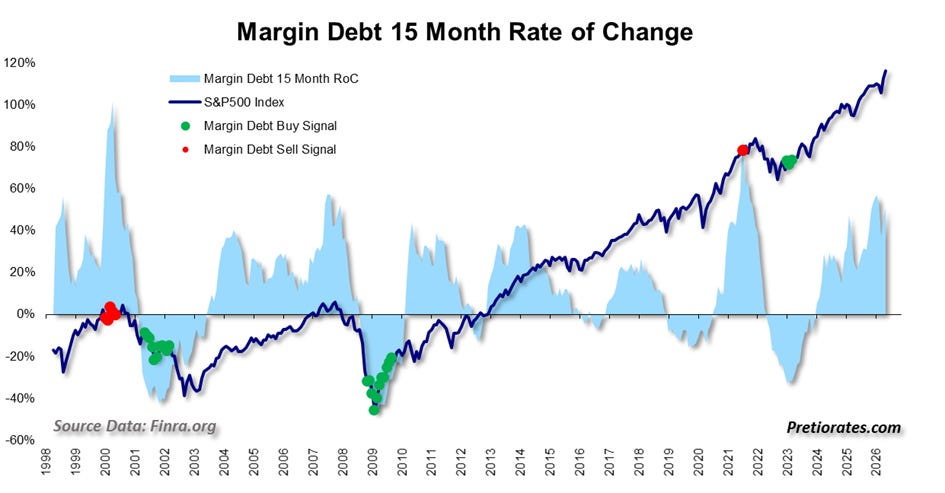
Another indicator is the percentage growth over twelve months. Whenever margin debt has increased by more than 60 percent within a year, the market has plummeted quite sharply in the following months. The 60 percent growth threshold is marked by the red line, and we must note: Investors are apparently so confident that they have expanded their investments using a great deal of credit. This is a serious, long-term sell signal for the overall market.
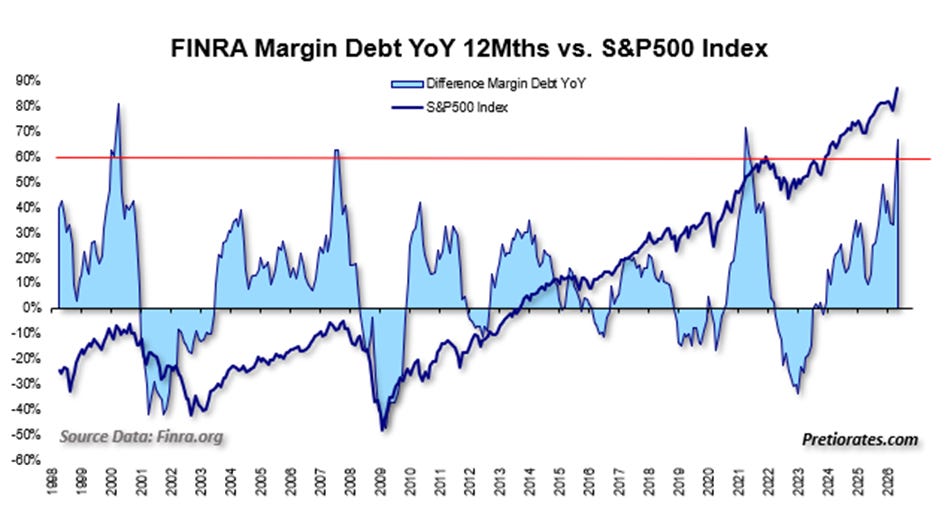
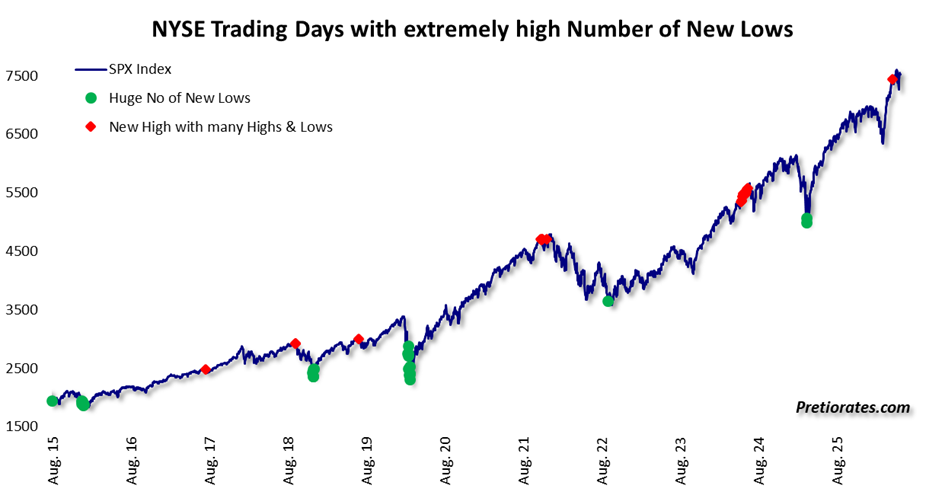
The health of the stock market is also reflected in the breadth of stocks showing positive performance. Here, too, a long-term sell signal appears: Although the S&P 500 Index recently reached new record highs, many stocks within the index have fallen to new 52-week lows. So the index is wearing a suit and tie, while beneath the surface, a few shirt buttons are already missing.
Bottom-Up: It’s worth noting that almost all of the charts discussed in today’s Thoughts are long-term in nature. So if the market continues to rise in the coming weeks, it might be time to lock in some profits…



Comments
Log in or sign up to join the conversation.