

Investors seem to have already gone on summer break. Wall Street is consolidating at high levels, the U.S. dollar is following suit, and precious metals continue to recover from their hangover after years of partying. Apparently, the party was a bit wilder than expected—and the morning after is lasting longer than we would have anticipated.
The Strait of Hormuz is also effectively closed again after U.S. President Trump declared the ceasefire over. Bombing has resumed, while reliable information is reaching the markets only in dribs and drabs. The oil price has nevertheless gotten the message and has risen from its interim low of $72 back to $85.
While the market stares spellbound at the oil price, natural gas—or Liquefied Natural Gas (LNG)—is almost falling by the wayside. Russia has the world’s largest gas reserves, but Europe has decided, through its sanctions, that no Russian gas should flow into EU storage facilities in the future. At the moment, however, Belgium, the Netherlands, France, and other EU countries still source about four-tenths of their gas from Russia. A significant portion of this is even forwarded to Germany. According to EU plans, this is set to end once and for all as of January 1, 2027.
Qatar, the country with the world’s third-largest gas reserves after Russia and Iran, has suspended its efforts to repair the destroyed LNG infrastructure following the renewed outbreak of war. It is highly unlikely that exports through the Strait of Hormuz will resume in the foreseeable future. Norway, for its part, can supply only about 40% of the EU’s daily LNG needs.
It is therefore hardly surprising that the German Association for Gas and Hydrogen Storage (INES) has issued a stark warning. Gas storage facilities in the EU are currently only 52% full, and in Germany, as low as 44%. This is well below the long-term average for this time of year, which stands at around 72% in the EU.
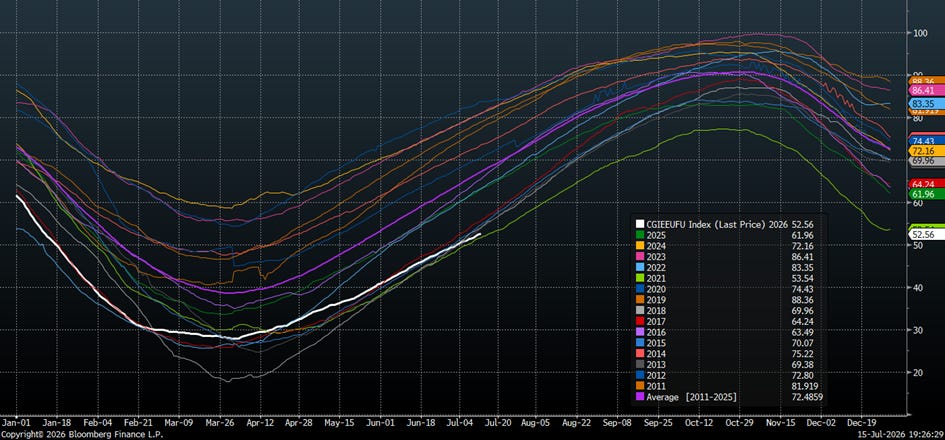
In the summer, gas storage operators typically purchase gas at lower prices. However, due to the war in Iran and the resulting high prices, they are holding back this time. The problem is this: the potential for daily gas injection into storage facilities is only about 0.2%. At this rate, storage facilities are likely to reach only about 70% capacity by the start of winter around November 1—that is, in just over 100 days. Sooner or later, purchases will have to be made. And when that happens, the bottom line is: price aside, the storage facilities must be filled.
In addition, of course, there’s the tried-and-true principle of hope: hopefully, winter won’t come too early. In the event of a cold winter, the INES Association is already forecasting a gas shortage of up to two terawatt-hours per day in February and March 2027. In that case, up to 40% of Germany’s daily natural gas needs could be missing. That wouldn’t be a small gap, but rather a full-blown hole.
Norway can’t supply everything. Russian gas is no longer wanted. LNG from Qatar could be off the table due to the Strait of Hormuz being blocked once again. Thus, the resurgent U.S. energy powerhouse will likely have to step into the breach once more. Do American LNG exporters know about Europe’s plight and are they therefore turning up the price screw a bit? You can judge that for yourself. Perhaps that’s why it might be interesting to bet on rising gas prices—for example, via an ETF.
It turns out that even though the gas price has recently lost further ground, the situation is by no means as negative as it appears at first glance. Buyers are simply waiting it out. For now.
The situation is similar for precious metals. The consolidation—or let’s call it a correction—is taking significantly longer than many had expected. In one of our recent issues, we highlighted the triangle pattern in which the gold price continues to trade. It is marked on the chart by the two red lines. Additional support is provided by the green line, which previously acted as resistance and has now become a support level. The purple Fibonacci extension with the golden ratio of 0.618 also runs at the same level, providing further support. When multiple technical levels converge at the same point, the market usually takes a closer look.
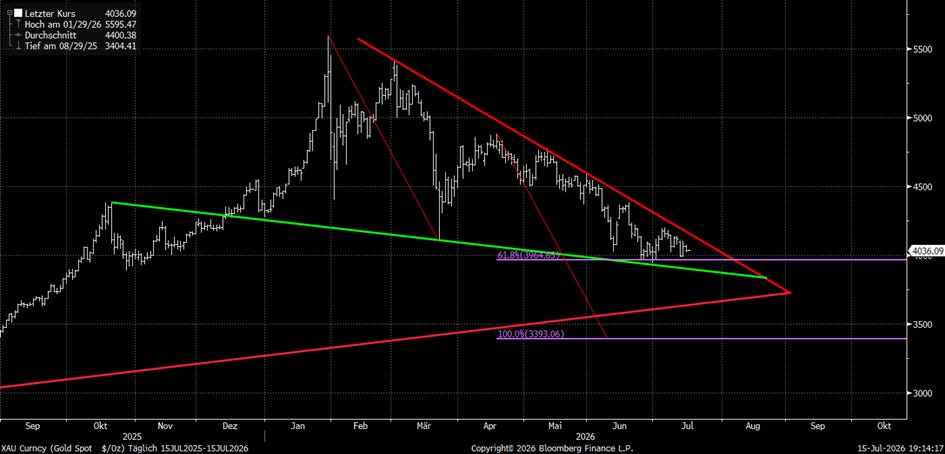
We can assume that a breakout is imminent in the coming days or weeks. Should a final washout occur before then, this would likely represent a buying opportunity. Many investors are now barely exposed to gold at all. This is evident from the number of open futures contracts on the COMEX, which has fallen to its lowest level in more than 15 years. Investors are underinvested because, according to numerous media outlets and analysts, there is currently little to support gold.
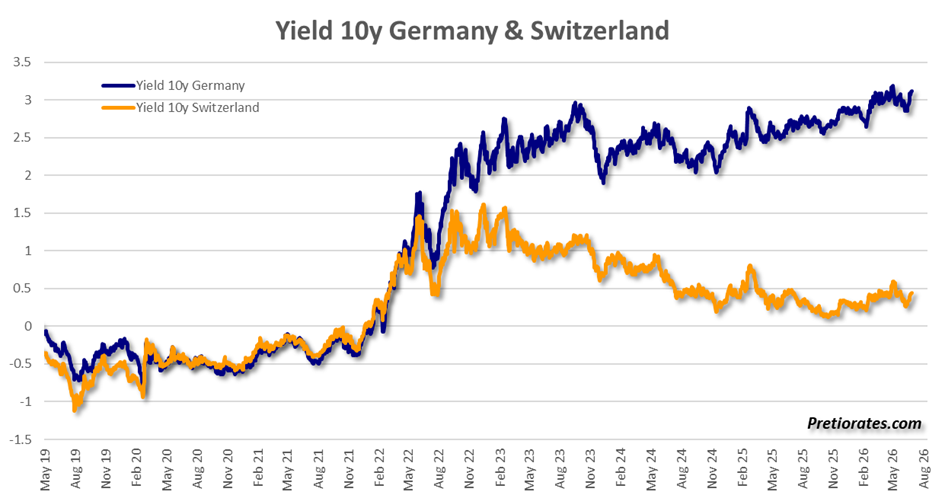
It’s true: Real market yields have risen, which is negative for the gold price. The national debt of many countries is not currently a focus, even though military operations are lasting longer and costing more as a result. U.S. national debt is therefore likely to become an issue again sooner or later. And Germany isn’t spared either: The market is already signaling that it no longer trusts the former EU powerhouse unconditionally. Market yields in Germany and its small neighbor Switzerland remained at similar levels for a very, very long time. However, the spread between the two countries has been rising steadily for four years.
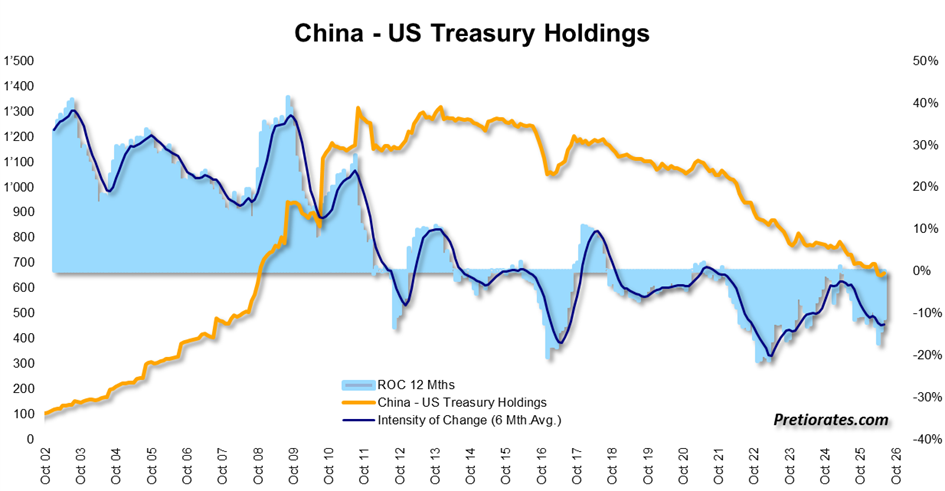
Meanwhile, China continues to sell U.S. Treasuries—and has been doing so at an even faster pace in recent months.
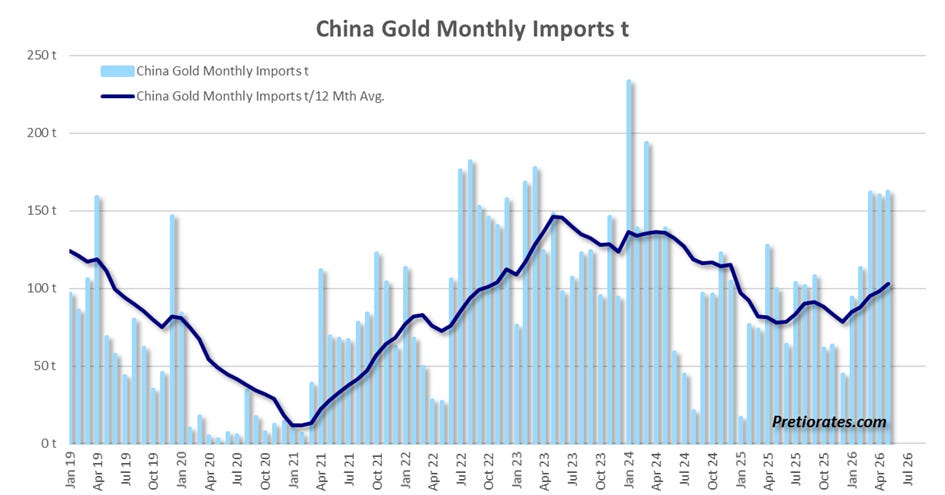
In contrast, gold purchases continue. The figures for June have not yet been released, but in May, China imported 163 metric tons of gold—the highest amount in two years. The 12-month moving average of the import rate shows that the pace has picked up significantly again since the beginning of the year. It is therefore fair to argue that China is taking advantage of lower gold prices to buy.
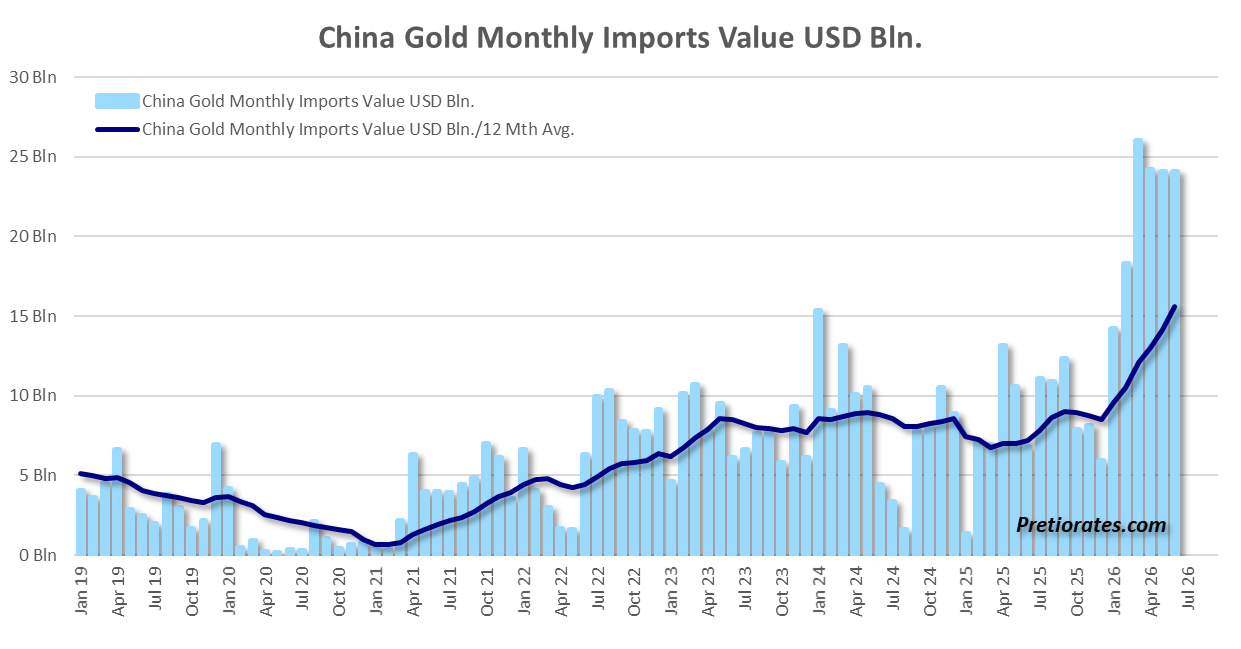
However, China’s gold imports become truly impressive only when one looks not just at the tonnage, but at their value. The monthly volume of imports may not be that much higher, but due to the rise in the price of gold, their value has increased massively compared to the previous year. The fact remains: China has not simply increased the pace of its gold imports over the past three months—it has multiplied them. Why? How? To what end? You can once again draw your own conclusions.

Comments
Log in or sign up to join the conversation.