


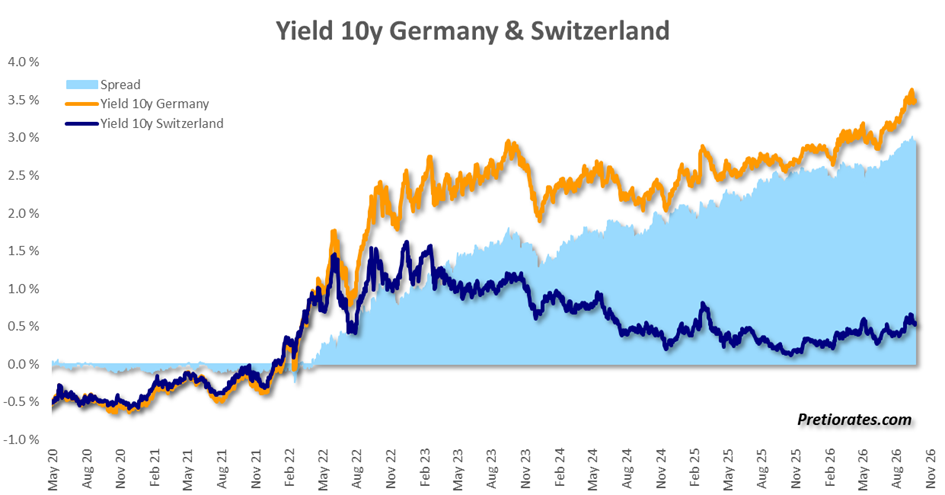
We showed this chart two weeks ago: The spread between 10-year German and Swiss government bond yields has widened from practically zero to about 3 percent—or 300 basis points—in just four years. That’s not a small step, but rather a significant leap.
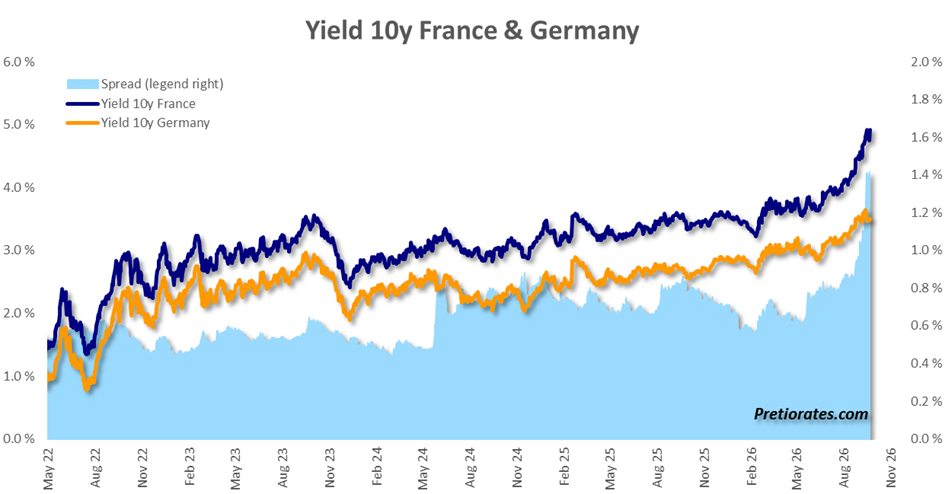
Nevertheless, compared to the other EU countries, German government bonds—the good old Bund—continue to look remarkably solid. The spread between German and French government bonds, which we discussed two weeks ago, has since risen to over 150 basis points. That’s a whopping 1.5%.
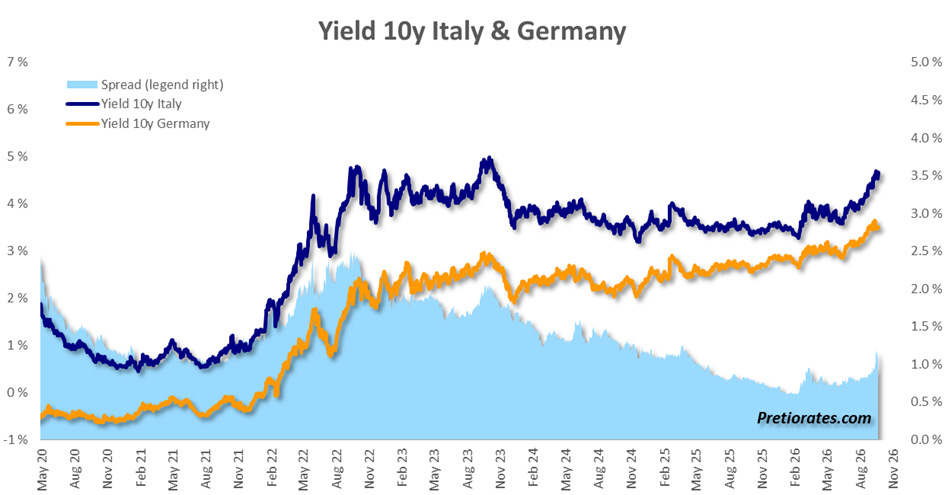
And the problem of excessively rising market yields is concentrated primarily in France. While the spread between German and Italian government bonds has also risen, it remains almost unremarkable by comparison.
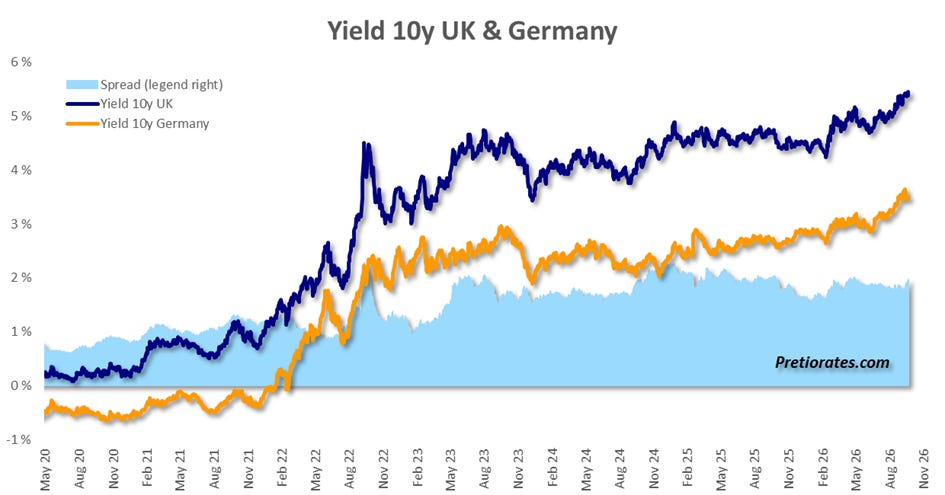
Even UK government bonds show no signs of unusual nervousness. The spread relative to German Bunds has hardly changed in recent years.
So the big question is: Why are French yields, of all things, rising so sharply—or rather, why are the prices of French government bonds falling so significantly? There are several reasons for this:
The French government has been running a budget deficit of more than 5% of GDP for years.
With rising interest rates, this deficit is likely to grow even larger by 2027.
The political landscape is so fragmented and divided that a sustainably healthy national budget can hardly be considered a realistic scenario in the coming years.
New elections are scheduled for April 2027. The likelihood that any of the numerous parties—even in a coalition—will have enough political leeway for genuine reforms is, to put it mildly, limited.
At the same time, major cities are currently experiencing numerous and, in some cases, violent demonstrations: students are protesting overcrowded classrooms, a shortage of teachers, and dilapidated school buildings in need of renovation. All of this costs money—money that isn’t available. Meanwhile, government employees and labor unions are demonstrating against austerity measures. These demands, too, can hardly be met—for the same reason: there isn’t enough money.
Asian institutional investors, in particular, are among the major investors in French government bonds. In light of points 1 through 5, they are currently—and will likely remain so for some time—understandably reluctant to make new investments. If such an important source of demand were to disappear, it would put additional pressure on French bonds.
The white knight that France is now eagerly awaiting is likely to be the ECB. President Christine Lagarde could soon publicly assure the market that the ECB is strong enough to restore calm to the French bond market. Much like her predecessor, Mario Draghi, put it during the last major sovereign debt crisis in July 2012: “Within our mandate, the ECB is ready to do whatever it takes to preserve the euro. And believe me, it will be enough.”
We do not belong to the camp that is convinced of sustained support from the ECB. It is not to be expected that such support will go significantly beyond verbal interventions. The ECB’s bond purchases under the APP or PEPP have expired, and a resumption in the near future seems unlikely.
There is still the ECB’s TPI program—the Transmission Protection Instrument—which was created specifically for such situations. This allows the ECB, if necessary, to selectively purchase government bonds of individual eurozone countries if, in its view, their yields are rising excessively and unjustifiably.
However, the TPI is likely to be one thing above all else: a threat intended to deter, which, ideally, should never actually be used. And France does not even clearly qualify for this instrument at present. The TPI is intended for countries that adhere to the European Commission’s recommendations regarding their deficits yet are still exposed to speculative market forces. Given France’s current deficit figures, it is difficult to argue that the country is already taking all appropriate steps to bring its fiscal situation under control. In short: If the ECB were nevertheless to come to France’s aid with the TPI, it could end up creating a credibility problem for itself.
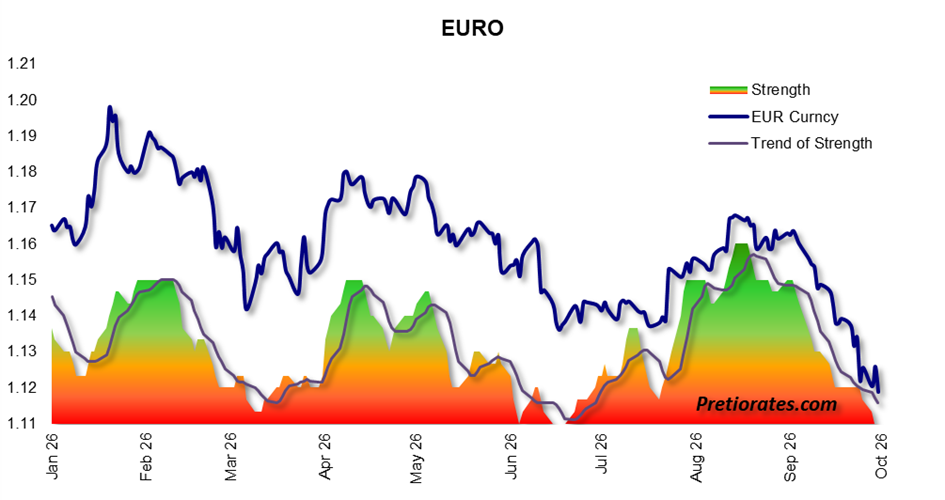
This points to a development we have already described several times here: The U.S. dollar is likely to lose support in the long term. But before it finds itself with its back against the wall, the euro could face precisely this fate first. European countries and the ECB have significantly fewer tools at their disposal for managing financial crises than the U.S. or the Fed. A capital flight is therefore likely to begin in Europe first—and then seek a new home. The most obvious alternative? The U.S. dollar. The euro is already showing initial signs of weakness. It is striking that the onset of this recent weakness coincides almost exactly with the weakness of French government bonds.
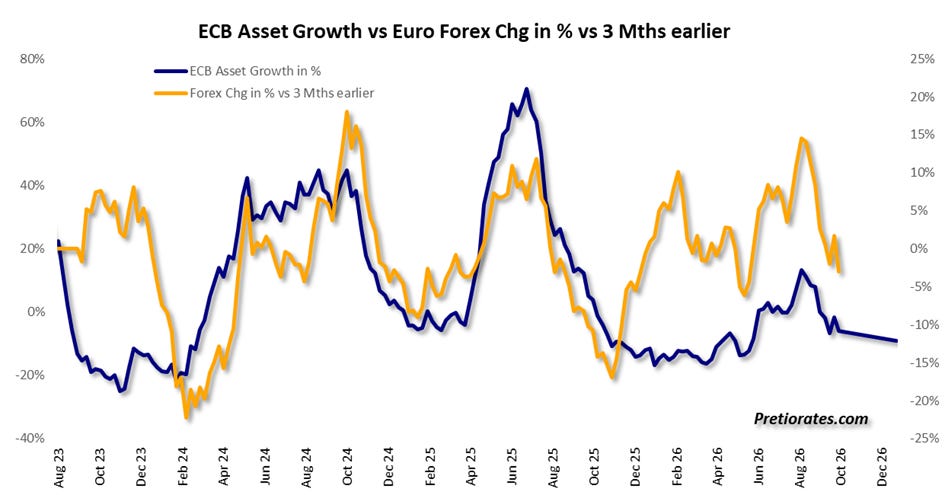
The trend in the European Central Bank’s balance sheet total shows a very high correlation with the trend in the European currency—with a lag of about three months. This indicator suggests that the euro is likely to remain on a downward trend in the coming months as well.
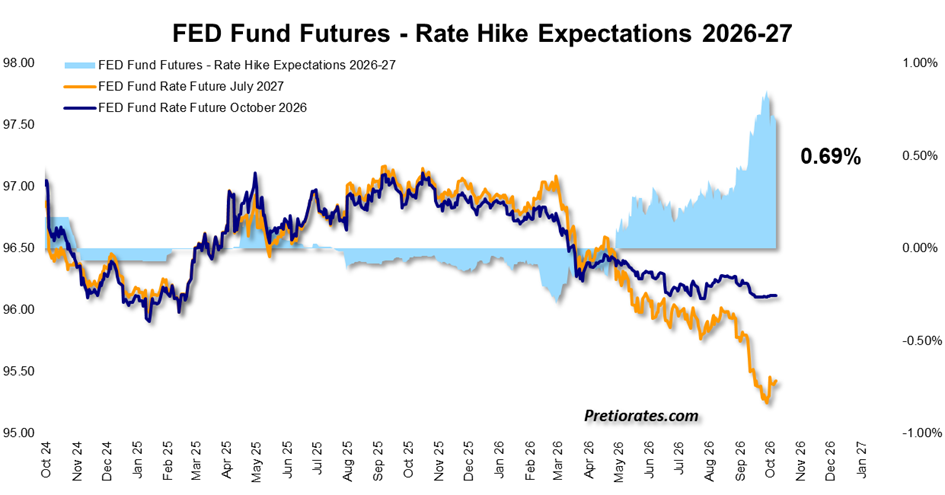
The U.S. dollar could benefit from this — both from a potential capital flight from Europe and from the higher interest rates that the market is now pricing in. The futures market has currently priced in interest rates that are about 69 basis points higher. That would mean the Fed could implement two or three rate hikes by July 2027.
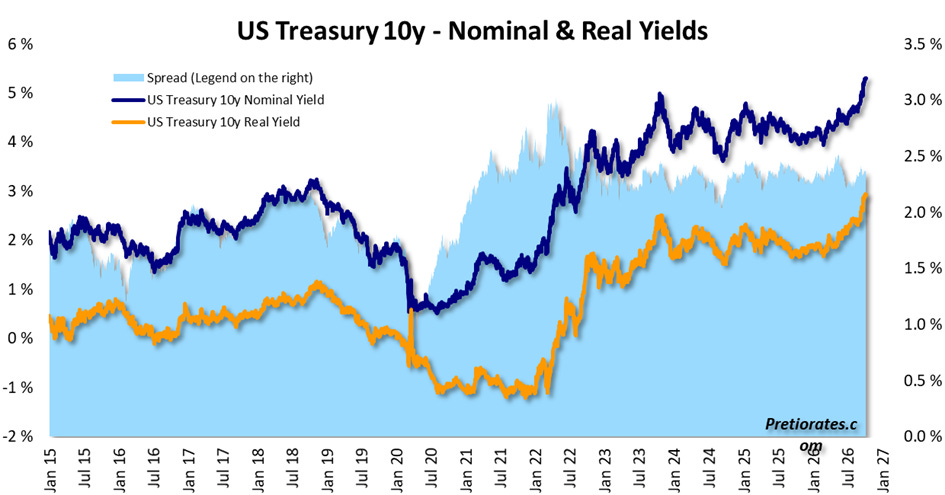
But this is precisely where the next problem lies: Investor concerns about government debt are also growing in the U.S. Market yields have also risen sharply recently. Inflation, energy prices, and similar factors are often blamed for this. But it’s not that simple: Unlike nominal yields, real market yields exclude expected inflation. If rising inflation expectations were the main reason for the rise in yields, the spread between nominal and real yields would have had to widen significantly recently. But that is precisely what has not happened. Nominal and real yields have risen largely in tandem, while their spread has remained surprisingly stable for about five years. Ergo: The rise in yields is likely attributable primarily to investors demanding higher yields to compensate for increased credit risk. The strength of the U.S. economy is likely to play only a minor role in this.
The next chapter of Pretiorates’ Thoughts: However, further rises in market interest rates on the bond markets are unlikely to leave the stock markets unscathed. Nervousness is likely to increase. And with that, we remain on the course whose direction we have already outlined here several times: Should the stock markets spiral out of control, quantitative easing (QE) is likely to be back on the table. This would be the Fed’s classic tool for calming interest rates — and the additional liquidity would simultaneously help stabilize the stock markets as well. However, the strength of the U.S. dollar would then likely be called into question quite quickly. And Fed Chairman Kevin Warsh would have to put his top priority—fighting inflation—on the back burner.
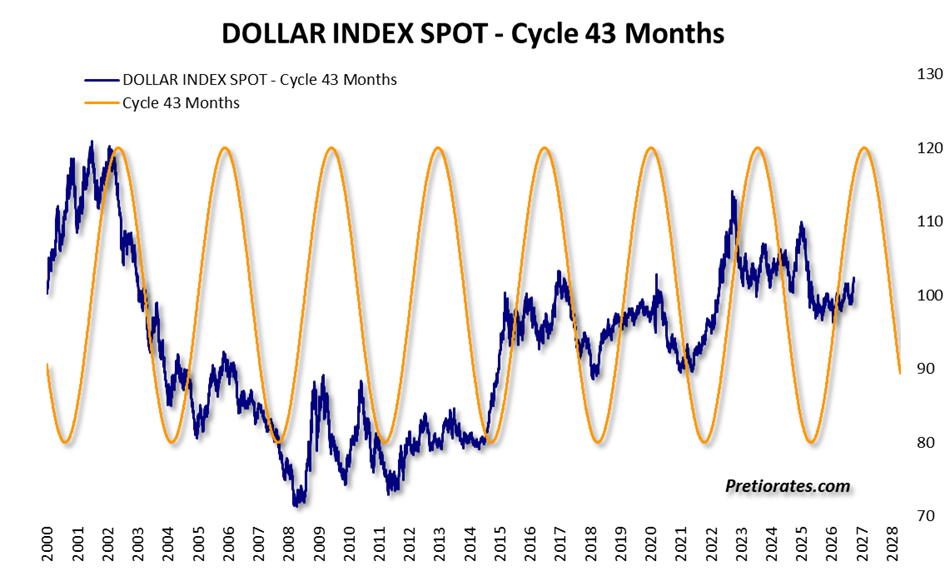
Is this scenario possible? We don’t know. But the long-term cycles of the U.S. dollar and U.S. Treasuries over 20 years offer interesting clues: The 43-month cycle of the U.S. dollar suggests a possible peak around the turn of the year.
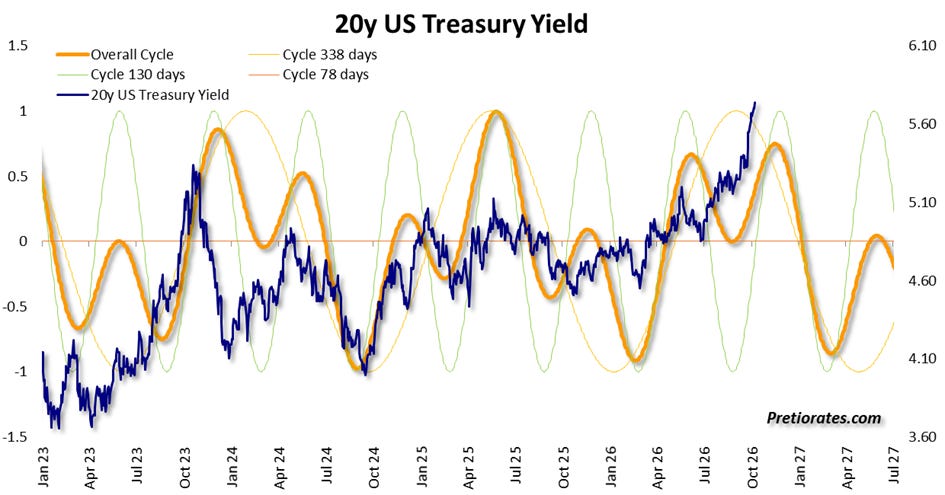
The 20-year yield cycle for U.S. Treasuries is somewhat more complex and consists of several cycles. If the track record to date holds true, we could see a massive correction in market yields in the final weeks of this year.



Comments
Log in or sign up to join the conversation.