

Two weeks ago, I published a detailed report outlining the very bullish case for commodities, natural resources, and basic materials stocks over the next decade, during which I expect another commodities supercycle similar to those of the 1970s and 2000s.
Since then, commodity prices have surged, with natural resources becoming the hottest area of the stock market and outperforming even AI stocks, led by powerful rallies in precious metals, copper, and related mining stocks. In this report, I will provide an update on my basic materials trade thesis, with a particular focus on non-precious metals mining stocks and ETFs and the opportunities that I believe have the most potential.
In order to better understand this report, I recommend reading my original report from two weeks ago, but I will provide a brief refresher before we get started. To make it simple, commodity prices have basically traded sideways for nearly two decades, at the same time that the U.S. cost of living has soared 55%, according to the Consumer Price Index (CPI), which is known for understating inflation. And though I used the U.S. as an example, it’s the same story all around the world, as fiat, or paper, currencies are rapidly losing purchasing power.
Commodities trading sideways for nearly two decades, combined with significant inflation and a massive expansion of the global money supply, has resulted in them being cheaper today in real terms than at any time in modern history. I strongly believe they are going to catch up in a big way in the years ahead, especially once investors wake up to the fact that this is the cheapest asset class out there in a world glutted with overvalued and overinflated financial assets, while the world’s supply of natural resources continues to dwindle every day.
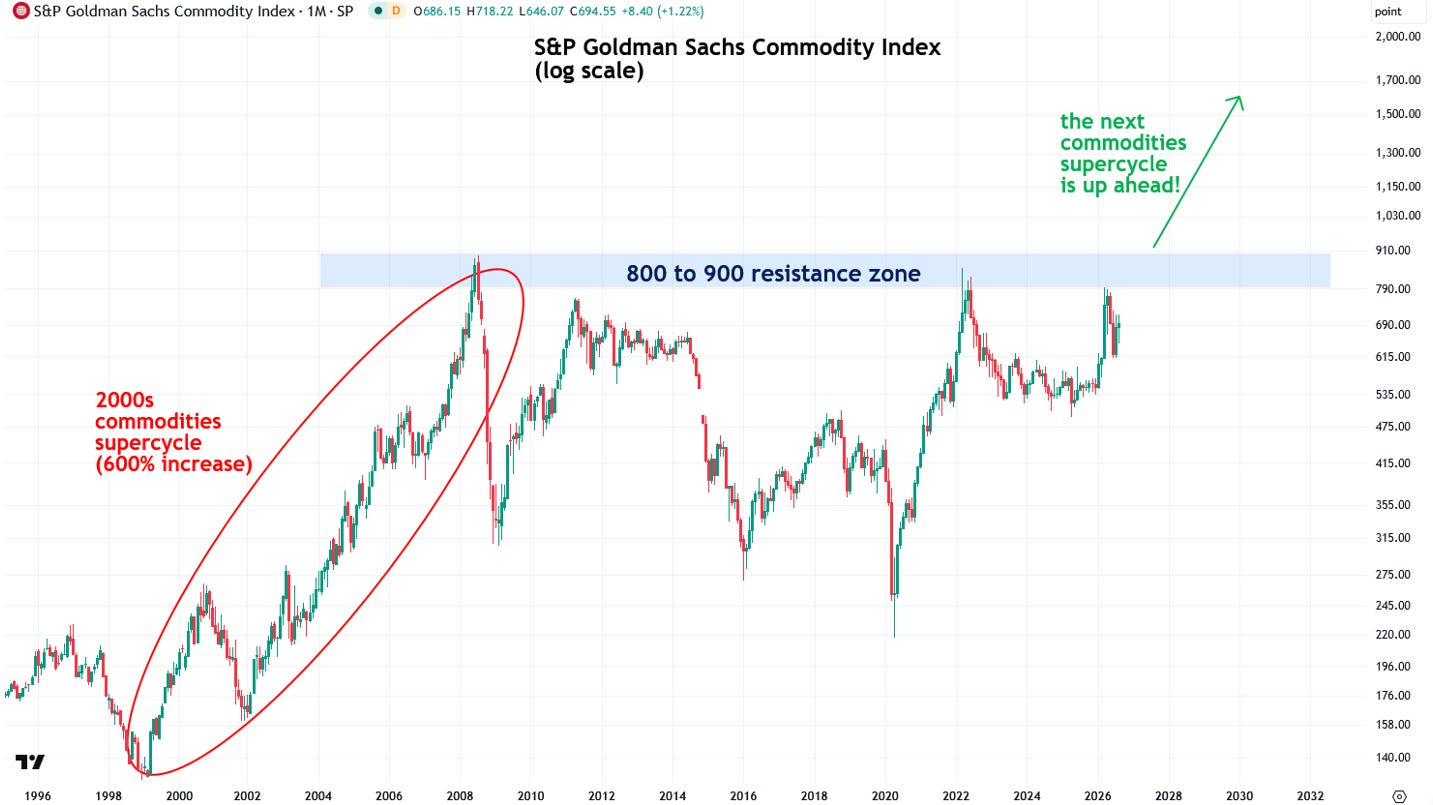
The S&P Goldman Sachs Commodity Index (GSCI), shown below, tracks a broad basket of commodities, including crude oil, gasoline, heating oil/diesel, wheat, soybeans, corn, cocoa, coffee, copper, gold, and silver, to name a few. The index can essentially be thought of as the Dow or S&P 500 of the commodities world, making it a useful benchmark for tracking broad trends in commodity prices.
The last time commodities became nearly as cheap as they are today was during the late 1990s, after which a powerful decade-long commodities bull market, or supercycle, ensued. Commodities surged roughly 600% on average during that period, outperforming most other asset classes, including technology stocks.
However, ever since that supercycle ended in 2008, commodities have largely been dead money as investors once again became enamored with technology investments. This is no coincidence, as commodities and technology compete for capital and investor attention, booming in alternating waves or cycles that typically last a decade or more.
From a tactical perspective, a very important resistance zone between roughly 800 and 900 formed in the GSCI when the commodities supercycle peaked in 2008, and the index has since encountered resistance around that same zone during multiple subsequent peaks, including in 2011, 2022, and most recently in early 2026.
To learn more about support and resistance zones, I recommend reading my two-part tutorial (Part 1 and Part 2).
My bet is that when the GSCI finally breaks decisively through that critical 800 to 900 resistance zone, it will kick off the next commodities supercycle, which will be extremely beneficial for the basic materials and energy sectors, precious metals, base metals such as copper and zinc, agricultural commodities including grains, softs, and livestock, as well as fertilizer, farmland, and other natural resource investments.
Over the next decade, I fully expect commodities, including precious metals, and natural resources stocks to become the world’s best-performing assets, handily trouncing today’s darlings, overvalued and overhyped tech stocks. I expect a repeat of what happened after the dot-com bubble burst in the early 2000s and gave way to the powerful commodities supercycle that followed.
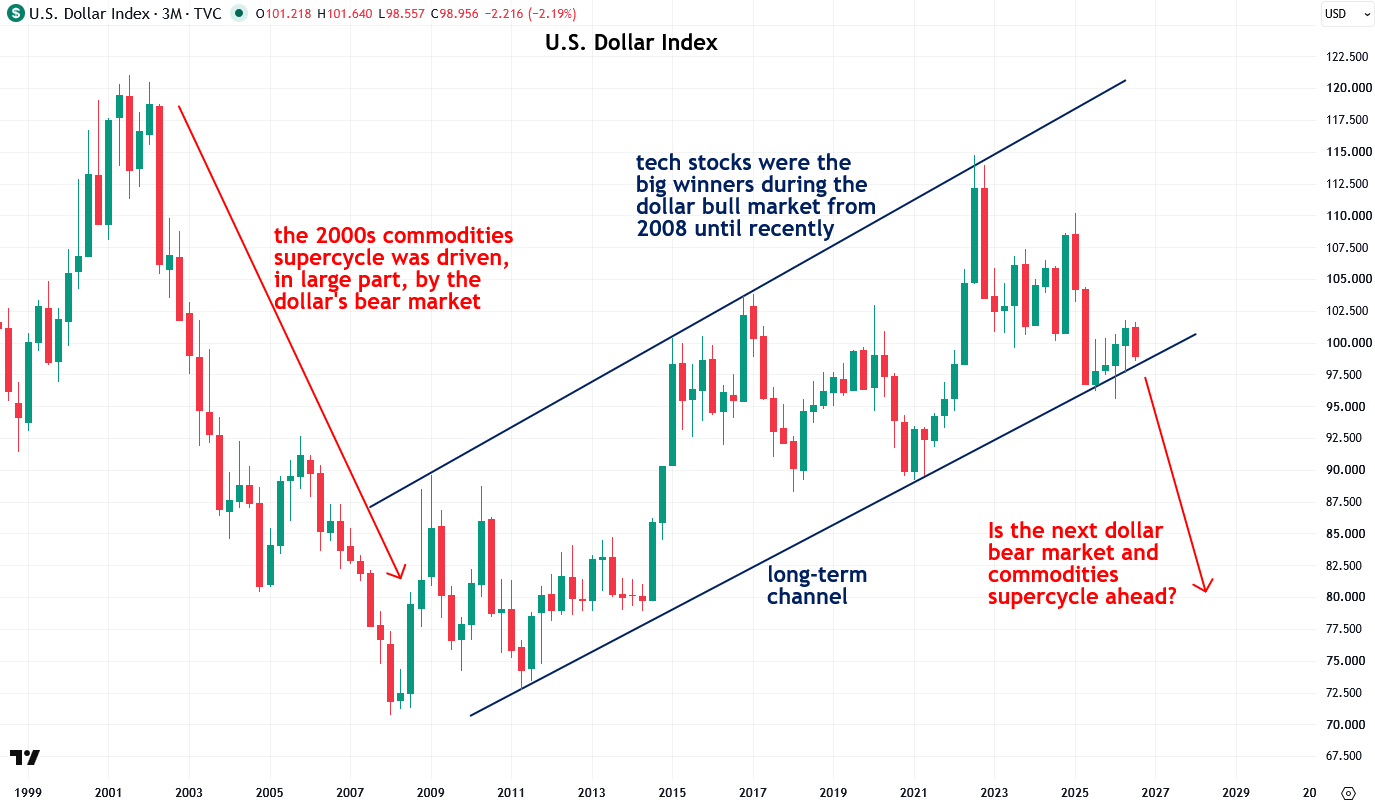
In addition to a future breakout in the GSCI Commodity Index, the other key clue that the next commodities supercycle has begun will be when the U.S. Dollar Index, which tracks the exchange rate of the dollar against other world currencies, breaks down from its two-decade-old rising channel pattern, kicking off another powerful bear market in the dollar just like in the 2000s.
The U.S. dollar is the world’s reserve currency, and commodities around the globe are priced in dollars. When the dollar weakens, commodities become cheaper for buyers outside the United States, allowing them to purchase more and thereby pushing commodity prices higher.
The primary initial trigger of the 2000s commodities supercycle was the bear market in the U.S. dollar at that time. But since 2008, the dollar has been in an uptrend, which was a major reason why commodity prices have been so stagnant. Therefore, it is important to watch for a future breakdown in the U.S. Dollar Index, and if that occurs soon, I fully expect it to launch commodity prices much higher in the decade ahead.
As for why the dollar is likely to enter a secular bear market soon, it is once again significantly overvalued, much as it was in the late 1990s, making a reversion to the mean increasingly likely. Another major factor is the surge in U.S. government debt, which recently surpassed 100% of GDP for the first time since World War II and officially reached $40 trillion last week. At the same time, central banks and investors around the world are rapidly reducing their exposure to U.S. government debt, with gold emerging as a major beneficiary.
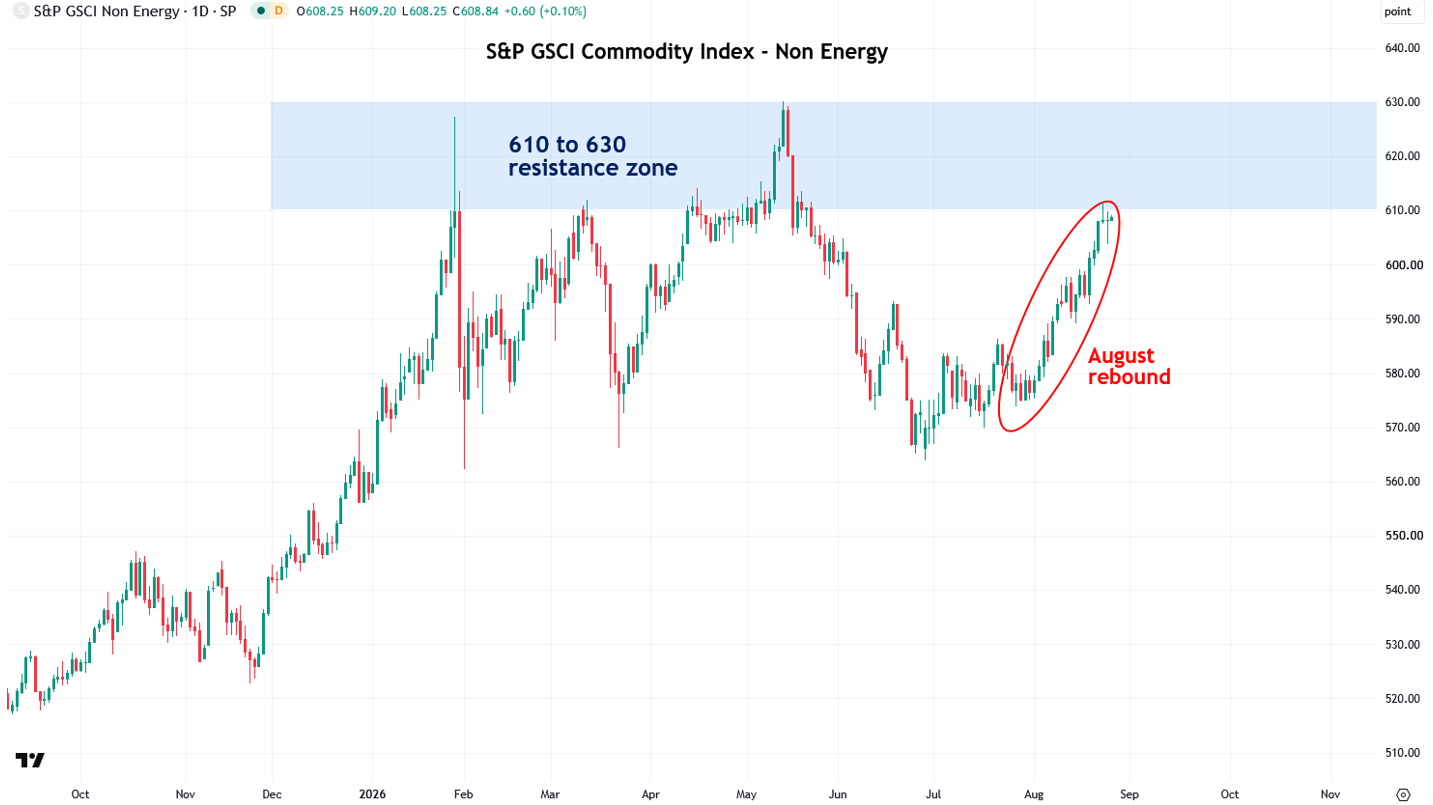
So far, I have reviewed the long-term bullish case for commodities, but now I want to turn to the short-term tactical perspective. After a rough first half of the year, non-energy commodities have perked up impressively in August, with precious metals, base metals such as copper, and grains among the top performers, along with mining stocks.
The chart below of the GSCI Non-Energy Commodity Index shows the sharp rebound that has occurred over the past month. I chose this index because, although I am also quite bullish on energy over the long run (click here to read my recent report), the sector is extremely volatile right now due to the U.S.-Iran war and is gyrating wildly with the recurring cycle of escalation and peace talks. As a result, energy prices are not currently a true reflection of the real-world supply and demand situation.
The immediate catalysts for the rebound in non-energy commodities in recent weeks have been the weakening U.S. job market and resulting decline in interest rate expectations, a sharp pullback in the U.S. dollar, the cooling of the AI stock mania, and last week’s surprise announcement from U.S. Treasury Secretary Scott Bessent of a Treasury bond-buying program aimed at pushing down yields after they spiked following the start of the U.S.-Iran war.
This bond-buying program is being perceived by the market as “QE Lite” and thus likely to result in further debasement of the dollar, prompting investors to wisely seek shelter in commodities, including precious metals.
A tactical look at the GSCI Non-Energy Commodity Index shows that it has rebounded right up to its 610 to 630 resistance zone, formed by the peaks from January through May. A decisive breakout above that zone should kick off a powerful new phase of the commodities bull market that will also be highly beneficial for mining, natural resources, and basic materials stocks.
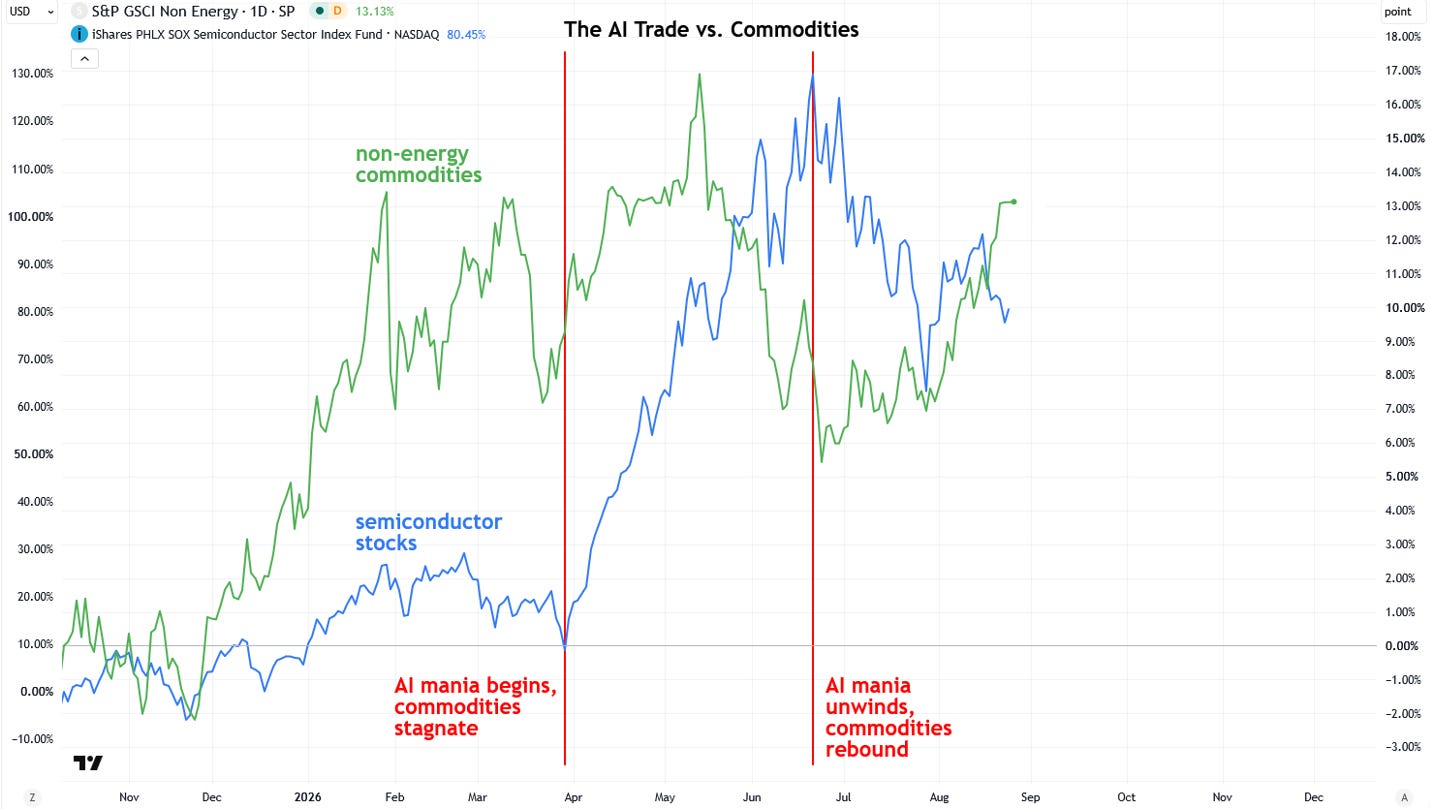
A little-discussed factor behind the recent rebound in commodities and precious metals is the air coming out of the AI stock mania, which I suspected in my July 19 analysis would be a bullish catalyst, and that now appears to be happening.
To summarize, the AI trade erupted into a full-blown mania this spring, with semiconductor stocks such as Nvidia and Micron becoming the primary focus. I strongly believe the tremendous amount of global capital sucked into this mania diverted both capital and attention away from commodities, exacerbating their correction. But the AI mania is now experiencing a much-deserved correction of its own, while attention and capital are flowing back into commodities, which is a wise move in my view.

Comments
Log in or sign up to join the conversation.