

Once again, the Bank of Israel has taken advantage of extraordinary conditions to lower its policy rate, the third cut in its current cycle. Yesterday, the Bank dropped its lending rate to 3.5%, having just cut the rate in May to 3.75% from 4%. The overriding consideration is that inflation is very tame, running at 1.9% over the last 12 months. Moreover, the Bank’s forecasters are confident inflation will decline further towards the end of the calendar year. This disinflationary environment gives the Bank considerable comfort to drop rates, especially in aid of specific sectors yet to recover fully from recent hostilities in Iran and southern Lebanon.
A huge part of bringing down inflation rate has been the surge in the Israeli currency, the Shekel, which has appreciated by 13% over the last 12 months. Although the Bank will not state as such, recent cuts in the bank rate were taken in response to pressures from the tech industry to tame the Shekel’s upswing. This has worked, in part, as the Shekel depreciated by 3.1% against the dollar since the last rate in May. The tech industry plays an outsized role in the economy, accounting for nearly half of its exports and as much as 20% of its employment. Selling products in US dollars, while paying for domestic operations in Shekels, has squeezed the tech sector. In a rather unusual admission, the Bank stated:
“A marked share of recent economic growth reflects production abroad by global firms operating in Israel. In contrast, other parts of the economy, particularly labor-intensive industries, have been more materially affected by the supply constraints that emerged during the war.”
In other words, the influx of capital to finance the tech sector along with the high value of those resulting exports, continue to drive the economy, while at the same time other sectors lag in the recovery process. Growth in the consumer sector continues to be healthy, but the industrial base still is recovering from a series of supply restraints. These restraints are now lifting and the Bank feels that cutting borrowing costs will do a lot to promote growth.
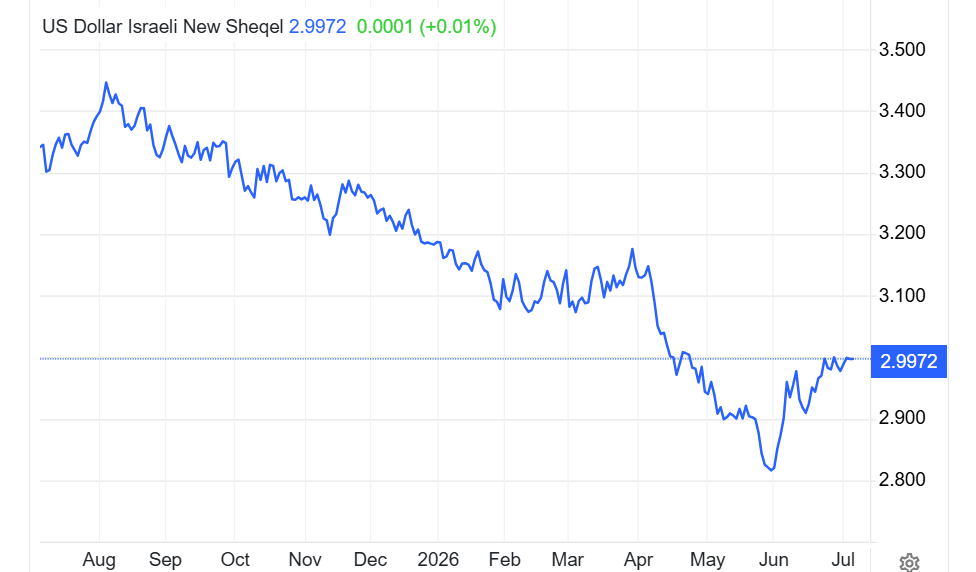
Consumption continues to expand above trend lines supporting aggregate demand. Consumers enjoyed wage gains of 6.8% over the past 12 months, reflecting the tight labour market conditions buoyed by wages rising at a relatively rapid pace, reflecting a tight labor market.
Underlying the Bank’s outlook for the economy is an assumption that there will be no more hostilities over the forecast period. GDP is expected to grow at 4% in 2026 and slightly faster at 5.5% in 2027, ranking Israel as one of the fastest growing economies in the OECD. Nonetheless, the Bank is concerned that the country gets its fiscal house in order, specially getting the deficit-to-GDP ratio down. The Bank’s forecast results in the government budget deficits to drop from 4.9% in 2026 to 4.2% in 2027.
Followers of the Israeli economy continue to be surprised at its resilience since the attack on Oct 7,2023. The economy grows at above average rates, foreign direct investment continues to fuel the tech sector and Israel continues to be a net lender in the international markets.


Comments
Log in or sign up to join the conversation.