

The Bank of Canada moved off a measure of certainty regarding rate hikes to a measure of considerable doubt, according to the most recent speech by Governor Poloz[1]. The Governor said the path toward higher interest rates is “highly uncertain”, citing worries about housing and business investment. Yet, virtually in the same breath, he stressed that borrowing costs eventually will need to go higher.[2] How are we to interpret this mixed message?
The speech did not get into specifics about the economy, other than to point to the obvious weakness in the oil industry and the fact that business investment has not panned out as the Bank anticipated. Somewhat on the defensive, the Governor argued that the five rate increases since mid-2017 were necessary. But he was quick to point out that the Bank has been on hold since October last year, mainly out of concern that consumer indebtedness was too high. More importantly, the Governor made it quite clear to Canadians that they should be prepared for a neutral bank rate, somewhere in the range of 2.5% to 3.5%. The Bank has been buoyed by surveys on capital investment intentions and a strong belief that exports would be one of the driving forces behind further economic expansion.[3]
Again, there is a mixed message when Poloz avers that “we expect investment spending to regain momentum in 2019, especially in light of the government’s new accelerated capital depreciation rules. However, we must acknowledge that the future of the global trade environment is highly uncertain right now.“If the trade environment is so uncertain, why would the Bank expect entrepreneurs to step up business capital formation? Given the recent disappointment in business investment in the United States after the passage of a huge corporate tax cut, Canada’s accelerated depreciation allowances will not generate the stimulus needed to boost growth.
Ironically, the Governor highlighted that housing activity is “a little weaker than we expected”. A major contributing factor to the slowdown in housing is the introduction of new mortgage rules, at the instigation of the Bank, that makes it much tougher for new owners to purchase homes.
(Click on image to enlarge)
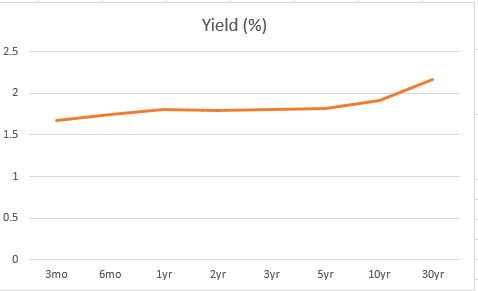
Canadian Govt Bond Yield Curve
In contrast, the Canadian bond market does not share any of the Bank’s angst regarding the future of interest rates. With the 6- month and 5-year rates trading at an identical yield of 1.8%, bond investors have adopted the view that the Bank rate will not even reach the lower bound of “neutral”. The bond market is not ambiguous regarding the path of rates. Inflation is not a threat and real rates of interest will continue to be around the zero mark.
We have what is often referred to as the “one-handed “economist. On the one hand, the Bank does not see a clear path pointing to higher interest rates. On the other hand, the Bank has not dropped its narrative that rate hikes are necessary and we should anticipate returning to neutral. Ambiguity is the last thing investors want to hear from a central banker.
[2] BoC Stubbornly Clings To The View That Rates Have To Rise
[3] Canadian Lagging Exports And The Future Of The Canadian Dollar


Comments
Log in or sign up to join the conversation.