

High earnings for the biggest oil carriers spread to smaller vessels.
The Next Inflation Shock
Bloomberg reports The Next Inflation Shock: $1 Million-a-Day Oil Tankers
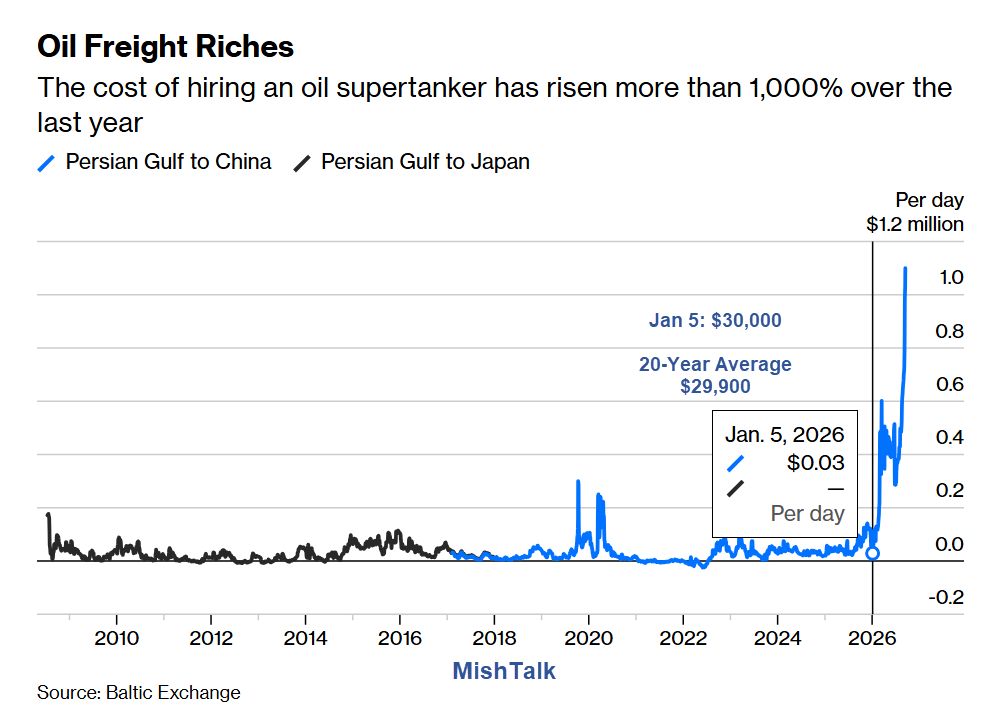
Earlier this year, most shipowners would have considered $100,000 a day a superb price and $50,000 a good one. Poten & Partners, a shipbroker that prides itself on being old-fashioned, couldn’t hide its amazement at today’s rates, telling clients recently: “Even seasoned market veterans are looking at current developments in the market and scratching their heads. What’s happening is truly unprecedented.”
Sure, the $1-million-a-day price tag reflects the danger of crossing the Hormuz waterway and the fact that few shipowners are willing to take the risk. But costs elsewhere, even far from the Middle East, have also ballooned. The route from the Gulf of Mexico to Asia is about $338,000 a day, up 400% from a year ago; from West Africa to China stands at about $486,000 a day, an increase of nearly 500%.
The role of Sinokor is key. The South Korean company has become the largest owner of supertankers, having spent 2025 and early 2026 buying vessels from Greek shipping tycoons. Thanks to its new position as the market’s dominant player, it has been able to push rates higher. Now, demand is so intense that buying a second-hand VLCC, which can be used immediately, is more expensive (about $150 million) than ordering a brand new one and facing a two-year wait (about $130 million).
Yet the shipping industry is even more prone to boom-and-bust episodes than the rest of the notoriously cyclical commodity sector, making a correction likely. The shipyards provide a preview. The industry is “on course for the most VLCC orders in a calendar year in over 50 years,” according to Affinity Shipping, a shipbroker. When that tonnage materializes, starting in 2028-2029, it will push rates down. How much depends on the balance between new ships and decommissioned ones. Because of the lack of orders in recent years, the global tanker fleet has aged. Iran and Russia have kept VLCCs sailing well past their retirement age as part of the dark fleet. Ultimately, those tankers will be sold for scrap, helping the industry absorb the new arrivals. I doubt, however, that will be enough to avoid an oversupply in a few years, considering the size of the current order book.
For now, the tanker industry is sailing into an incredible bonanza.
Not Just Supertankers
Also note Record Oil Supertanker Rates Make Waves for the Whole Fleet
There’s no precedent for what’s happening right now in the supertanker market.
Disrupted by the Iran war and Houthi threats in the Red Sea, the cost of renting a ship to transport oil has soared to levels never seen before.
This trickle-down of record earnings from supertankers to smaller vessels is good news for the world’s shipowners. The largest oil tanker equities saw their valuation top $70 billion last week for the first time ever, according to data compiled by Bloomberg.
It’s just another indication of how the waves caused by President Donald Trump’s decision to go to war with Iran continue to spread through the global economy.
Liar of the Day Award
Rubio Chastises Ukraine
Rubio Defends Media Ban
Send In the Clowns
Related Posts
September 20, 2026: Diesel New Record High Every Day, When Will Gasoline Follow?
An average increase of 1.26 cents per day would mean a new high by the election.
September 21, 2026: Republican Senators Seek Diesel Export Ban to Halt Soaring Prices
Trump must “do something” is the new battle cry by farm state Senators.


Comments
Log in or sign up to join the conversation.