

The welfare state in France is coming unglued. An EU-wide crisis is coming.

An Autumn of Discontent Grips France
The New York Times reports Strikes, Barricades and Fiscal Turmoil: An Autumn of Discontent Grips France
France suddenly finds itself engulfed by crisis — not a single spasm of unrest, but a cascade of disruption that is roiling city streets, trading floors and public offices across the country. France’s “rentrée,” or “return,” as the French call the back-to-school and back-to-work season, has been anything but orderly.
While the causes of the chaos may appear disparate, they can be traced to a common root: France’s two-decade-long struggle to fund its state, now exacerbated by high borrowing costs, surging fuel prices and political uncertainty, with jockeying underway to replace President Emmanuel Macron next spring.
French public finances, already fragile, continue to deteriorate, fanning fears in financial markets that France could be the next European country to tumble into a full-blown financial crisis. The fiscal jitters were amplified by recent polls that show the far-right candidate, Marine Le Pen, would beat all her rivals in presidential elections that will be held next spring.
On Tuesday, teachers and other public workers rallied against proposed wage freezes as the government labors to pass a budget. They joined thousands of students who have blockaded schools to protest underfunding that has led to crumbling facilities and a shortage of teachers.
With images of young protesters clashing with the police amid clouds of tear gas, the student protests have become the most vivid manifestation of France’s unrest and grievances. Hundreds of schools around the country have closed, dozens have been damaged, and many people have been arrested or injured.
The street clashes have rattled financial markets that were already nervous. Traders kept the yield on 10-year French bonds near 5 percent on Monday, one of the highest levels of any European Union member and a sign that investors lack confidence in the lame-duck government’s ability to manage its mushrooming challenges.
“In France, we say ‘fin de règne,’” meaning the end of Mr. Macron’s decade-long reign over French politics, said Jean-Yves Camus, a political scientist at the Jean Jaurès Foundation, a left-leaning think tank in Paris. “The regime is at the end of its term and does not seem to have a plan for the next seven months.”
With rates on French government bonds spiking, the cost of servicing that debt is projected to increase to roughly $100 billion in 2027.
On top of that, France faces higher health care and pension costs because of its aging population, as well as increased military spending driven by the war in Ukraine and the disengagement of the United States.
To pay for all that, and keep France’s budget deficit from exploding, Prime Minister Sébastien Lecornu proposes to raise some taxes and freeze spending on social programs like housing aid and family allowances.
To do that, however, the government will have to rely on Ms. Le Pen’s party, the National Rally, not to torpedo the legislation. It has 118 of the 577 seats in the National Assembly, the most of any party. Some analysts expect Ms. Le Pen to order her lawmakers to abstain and allow the budget to pass, if only to protect herself from facing fiscal chaos if she wins the presidential election in April.
While some analysts said they expected Ms. Le Pen to try to reassure bond markets about France’s deficit, they predicted she would continue to be implacably hostile to the European Union. If she were elected, they said, it would raise hard questions about France’s future contribution to the E.U.’s budget.
Magic Money Turns Into Debt Bomb
The Wall Street Journal reports France’s Appetite for ‘Magic Money’ Has Turned Into a Debt Bomb
France is on the precipice of a dangerous financial spiral.
The global surge in interest rates has exposed the country, once considered an oasis of relative stability in Europe’s financial markets, as one of the continent’s weakest links. France now pays more to borrow than former crisis hot spots like Greece and Italy. Its government is running a budget deficit surpassed only by the United States among its peers.
Last week, a slow-burning selloff in France’s government bond market took an alarming turn as it spread across the continent, reviving memories of the eurozone debt crisis last decade. France’s 10-year borrowing cost has risen toward 5%, the highest level since 2002.
Investors are bracing for things to get worse. The rise in rates is saddling the government with higher costs just as it needs to refinance a mountain of debt borrowed during the era of ultralow interest rates. France has more than $1 trillion in debt coming due by 2030, and next year is set to sell a record of about $380 billion in debt into a market where once-reliable sources of demand have evaporated.
The cost of servicing France’s debt is expected to climb 59% by 2030, according to a recent study commissioned by the French finance ministry. Debt payments are now one of the French government’s largest line items and could dwarf military spending by the end of the decade. France’s debt, now worth nearly 120% of gross domestic product, risks putting the economy in what its central-bank chief recently called a “gradual stranglehold.”
The selloff is fueled by concerns that France has become so ungovernable that its political system can no longer take corrective action. In recent years, lawmakers in the fractious National Assembly have ousted one prime minister after another who attempted to restore fiscal order with spending cuts. With presidential elections approaching in the spring, leading candidates to replace President Emmanuel Macron, who is term limited, are showering voters with promises to expand government spending.
Marine Le Pen, the far-right candidate who is leading in the polls, has vowed to push France’s age of retirement as low as 60 years old, a measure she says would cost the state an extra 9 billion euros (about $10.1 billion) a year.
Her closest rival in the polls, far-left leader Jean-Luc Mélenchon, wants the European Central Bank to freeze or wipe away the French bond holdings of the Bank of France, a sum worth 488 billion euros.
“Throw it in the fire,” Mélenchon quipped.
The National Assembly was now divided between three blocs—Le Pen’s, Macron allies and a rowdy leftist coalition including Mélenchon—that promised gridlock.
France’s debt level could reach 200% by 2050 if it doesn’t cut spending, the OECD recently estimated.
Thozet, of Carmignac, points to a simple equation that underscores France’s increasingly impossible debt math. In a reversal from the low-rates era, the interest rate on France’s total stock of debt is expected to surpass its level of economic growth in the coming years, guaranteeing the debt load will continue rising without drastic spending cuts.
Much Worse Than It Looks
Neither of the above articles mentioned EU budget rules.
But it’s EU budget rules that turns this mess into a potential Eurozone crises instead of a French political crisis.
European Union’s Stability and Growth Pact (SGP)
First set by the 1992 Maastricht Treaty, this rule mandates that no EU member state should run an annual government budget deficit that exceeds 3% of its Gross Domestic Product (GDP).
It is paired with a secondary rule stating that a nation’s total public debt should not exceed 60% of its GDP
I have been writing about this for years, just not recently, so let’s recap.
In 2024, unable to get a budget passed, French President Emmanuel Macron called snap elections to dissolve parliament, not dissolve the presidency.
Debt Brakes and Treaty Requirements
On June 9, 2024, I commented Marine Le Pen Set for Record Win, Macron Calls Snap French Election
Act of Trust or Act of Desperation?
Macron called for French parliament elections only, not presidential elections.
I fail to see how this does anything but aid Le Pen in the upcoming parliamentary election.
However, if Macron is clobbered, Jordan Bardella, the leader of Rassemblement National (RN, National Rally, Marine Le Pen’s party), may emerge as Prime Minister.
No one wants to take the blame for the impending crash.
Long Term Fiscal Issues
In addition to the Excessive Debt Proceedings against many countries, every EU county has defense spending issues, climate spending issues, and demographic issues
Hoot of the Day
To achieve a government debt-to-GDP ratio of 60 percent, EU countries will have to reduce spending or raise taxes by 2 percent of GDP, on average, every year for 46 years.
Please see Debt Brakes and Treaty Requirements About to Smash the EU for details.
The problem is not fixable. So, if Le Pen wants to be the next French President, the National Rally should not want to be in power when fiscal hell breaks loose.
President Macron’s Party Blown Out in First Round of French Parliament Elections
On June 30, 2024 I commented President Macron’s Party Blown Out in First Round of French Parliament Elections
There are 577 seats in the National Assembly. It’s possible National Rally pulls off an outright majority.
Given Marine Le Pen’s priority is to become the next president of France, National Rally will be in a better position if it falls short and Jordan Bardella is not the next prime minister.
Be Careful of What You Wish
If National Rally achieves an outright majority, Jordan Bardella will emerge as Prime Minister.
Then what? The EU will immediately enforce debt and deficit rules it let France ignore for decades.
Fortunately (for Le Pen), the Left and Center-Right conspired to keep Jordan Bardella from becoming Prime Minister.
That set the stage for Le Pen to win now.
France Becomes Ungovernable
On July 7, 2024, I noted France is Now Ungovernable Following a Pyrrhic Victory for the Left-Green Alliance
I did not expect National Rally to win a majority, but nor did I expect a third place finish.
What Happened?
The short answer is the center and left colluded to stop the right, as normally happens.
The long answer is France has a two-stage election where any party that gets 12.5 percent of the vote makes it to round two unless someone wins an outright majority in round one.
As typical in France, all but the lead or second place party drop out of the election so the Right faces a single opposition candidate.
Success for Macron?
This was no victory for Macron who called snap elections. Macron’s Ensemble coalition currently has 249 members of the National Assembly.
After this “win” Ensemble will have 150-170 seats.
Macron will come to regret the elections.
Pyrrhic Win
The Left and Center-Right kept Bardella (Le Pen’s party candidate) from taking over the Prime Minister’s spot. And the Prime Minister is responsible for the budget.
Congratulations?!
France has had seven prime ministers under President Emmanuel Macron.
Édouard Philippe (May 2017 – July 2020)
Jean Castex (July 2020 – April 2022)
Élisabeth Borne (May 2022 – January 2024)
Gabriel Attal (January 2024 – September 2024)
Michel Barnier (September 2024 – December 2024)
François Bayrou (December 2024 – September 2025)
Sébastien Lecornu (September 2025 – Present)
Bardella would have imploded as did the above seven.
Polymarket French Election Odds October 2026
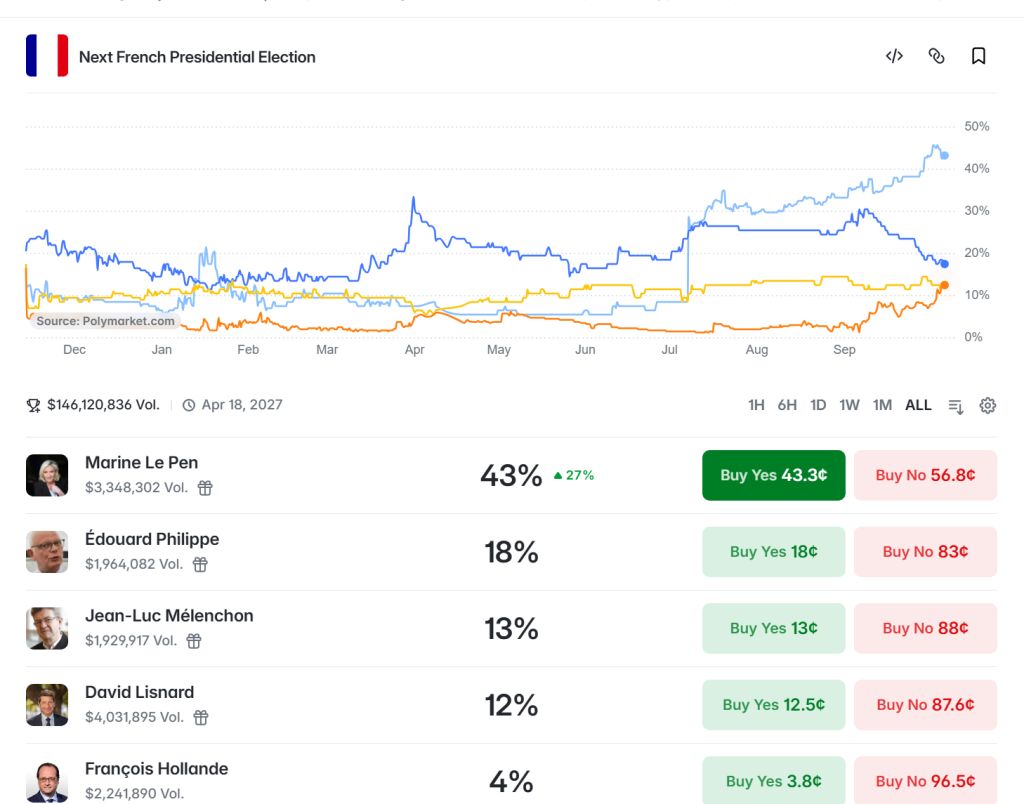
The center is dead and the center-right won’t exactly cheer far-left leader Jean-Luc Mélenchon’s call for the ECB wipe away the French bond holdings of the Bank of France, a sum worth 488 billion euros.
The most likely outcome is Le Pen will get her long wish to be president.
Then what? Le Pen and Mélenchon both want more social spending.
How’s that supposed to work?
In contrast, Édouard Philippe, the center-right leader of the Horizons party and former French Prime Minister under Emmanuel Macron, has built his fiscal and economic platform for the 2027 presidential election around a staunchly pro-business, supply-side economic model.
Philippe centers his strategy on tackling France’s ballooning public finances. He positions himself as a fiscally responsible alternative to both the high-tax left-wing coalition and Marine Le Pen, whom he recently criticized as being “spectacularly flippant” with national accounts.
Let’s compare the positions.
Le Pen’s Approach to National Debt
Pensions: Le Pen maintains her flagship promise to lower the retirement age back to 62 (and down to 60 for those who began working early). While independent think-tanks like the Institut Montaigne project this will cost up to €34.7 billion annually, Le Pen claims she will save €15–20 billion within the pension system by cutting “inefficient and unfair” rules and introducing private funded components,
Her plan prioritizes cost-of-living relief by slashing Value Added Taxes (VAT) on energy and essential goods.
Targeting Migration Costs: Le Pen plans to save €15 billion in her first year (and up to €29 billion annually later) by instituting a “national preference” policy that denies welfare benefits, social housing, and state medical aid to non-citizens.
Slashing EU Contributions: The shadow budget slashes France’s net annual contribution to the European Union budget down to a flat €5 billion, a massive reduction from the near-€29 billion initially projected for 2026.
Eliminating State Agencies: Le Pen aims to absorb tens of billions in costs by eliminating “almost all” state agencies, independent public bodies, and overlapping administrative bureaucracies.
Ending Green Subsidies: The party intends to completely dissolve state subsidies for wind and solar power projects, labeling them as net financial losses.
Replacing the Real Estate Wealth Tax: She aims to replace France’s current real estate wealth tax with a 30% financial wealth tax, but explicitly excludes business owners’ holdings in their own companies to retain corporate confidence.
Mélenchon’s Radical Approach to National Debt
“Burn” the Central Bank Debt: Mélenchon sparked a major economic debate by proposing that France cancel the roughly 18% of its public debt (amounting to roughly €600 billion) held by the national central bank (Banque de France), effectively calling to “throw it into the fire”.
The Rationale: He argues that removing this chunk of debt from the books would immediately lower France’s public debt-to-GDP ratio, creating massive fiscal space for public spending and infrastructure investments
He advocates for restructuring income taxes into a highly progressive 14-band system. Under his platform, any annual salary exceeding €400,000 would face a 90% marginal tax rate
Pensions: He strongly opposes Emmanuel Macron’s pension reforms and pledges to lower the retirement age back down to 60.
Wages & Social Programs: He supports a mandatory hike in the minimum wage, a real-wage increase for civil servants, and heavily expanding funding for public services like health, education, and green transition projects.
Édouard Philippe’s Approach to National Debt
Targeting Social Expenditure: Unlike the left, which seeks to expand the state apparatus, Philippe plans to restore fiscal discipline primarily by aggressively slashing public and social spending.
Reforming Sick Leave: He plans to severely tighten the conditions for paid sick leave—the cost of which rose nearly 40% between 2019 and 2025—by increasing the mandatory unpaid waiting periods for short-term leave
Capping Unemployment Benefits: Drawing direct inspiration from the German model, Philippe proposes to slash the maximum duration of unemployment benefits for workers under the age of 50 to 12 months, down from the current 18 months.
He supports keeping or raising the retirement age, strongly opposing Le Pen and Mélenchon’s plans to lower it, arguing that demographic realities require more aggregate hours worked to finance the pension system.
The €50B Cut: He has proposed eliminating €50 billion in production taxes on businesses to simulate entrepreneurship and job creation.
Le Pen’s Stance on the Schengen Agreement
Policy Evolution: While she previously called for an outright and immediate withdrawal from the Schengen Area, her platform has at times emphasized renegotiating the treaty or implementing a “double border” system of national checks, though experts note that unilateral implementation would conflict with existing EU legal frameworks.
Ending Free Movement: According to analysis by the Carnegie Endowment for International Peace, Marine Le Pen has characterized the Schengen zone as a security vulnerability that allows terrorists, criminals, and unauthorized migrants to move freely across Europe.
Reinstating Borders: She has pledged to re-establish permanent national border and customs controls for people and goods entering France from other EU member states, diverging from the treaty’s core open-border framework.
Three-Way Comparison Synopsis
Policy Category | Jean-Luc Mélenchon (Hard-Left / LFI) | Marine Le Pen (Far-Right / RN) | Édouard Philippe (Center-Right / Horizons) |
|---|---|---|---|
Core Economic Philosophy | High-spend, high-tax demand-side model centered on wealth redistribution and public sector growth. | Economic nationalism and fiscal consolidation balanced by targeted social spending for citizens. | Pro-business, supply-side model focused on corporate competitiveness and strict spending cuts. |
Deficit & Debt Strategy | Disregards traditional deficit limits; proposes canceling €600 billion in public debt held by the Banque de France. | Aims for €140 billion in savings by 2032; seeks a deficit below 3% of GDP by 2030 via a constitutional “golden rule.” | Strict fiscal discipline to rein in soaring public debt; views France as “dancing on a volcano.” |
Taxation Platform | Restructures income tax to a 14-band system with a 90% marginal rate over €400k; taxes “super-profits” and expands the wealth tax. | Replaces the real estate wealth tax with a 30% financial wealth tax (exempting business assets); slashes VAT on energy. | Swaps €50 billion in production taxes for €50 billion in subsidy cuts; raises tax-free inheritance and donation ceilings. |
Schengen & Border Policy | Advocates a doctrine of “disobedience” to renegotiate EU treaties; supports open borders and migrant rights. | Re-establishes permanent national border and customs controls; proposes a “double border” system. | Supports existing European frameworks while maintaining center-right security and labor policies. |
Retirement Age | Pledges to lower the retirement age to 60. | Pledges to lower the retirement age to 62 (and 60 for early career entries). | Supports keeping or raising the retirement age to boost aggregate hours worked. |
Labor & Welfare Reforms | Increases the minimum wage, raises civil servant pay, and regularizes undocumented workers. | Institutes a “national preference” policy saving €15–29B annually by denying welfare and social housing to non-citizens. | Cuts maximum unemployment benefits to 12 months for under-50s; tightens paid sick leave rules to curb costs. |
The Problem
Not a single one of those platforms has A) a snowball’s chance in hell of passing B) reducing the deficit to 3.0 percent from 5.4 percent C) Reducing long-term debt to 60 percent of GDP.
No matter who wins there will be a budget crisis.
The Broken Starting Point (The Arithmetic Problem)
To understand why these plans face such steep odds, it helps to look at the baseline numbers France is dealing with:
The Deficit Reality: The current government recently acknowledged that the 2026 deficit will hit 5.4% of GDP. Even with Prime Minister Sébastien Lecornu’s proposed €54 billion austerity drive in the 2027 budget, the government only expects to shave the deficit down to 5.0%.
The Debt Trap: Total public debt is officially projected to hit 119.3% of GDP in 2026 and climb to 121.7% in 2027.
To get from ~122% down to the EU-mandated 60% would require halving the national debt.
No European economy in modern history has achieved a fiscal contraction of that magnitude without decades of severe, politically impossible primary budget surpluses or massive inflation.
French politics will be very interesting in 2027. Greece was a cake walk compared to this mess.



Comments
Log in or sign up to join the conversation.