


We talk all the time about alternative strategies. I've cited my awareness/interest in the idea back to an article about Jack Meyer who used to run the Harvard Management Company, the endowment for the school. I think this might be the article, it talks some about Meyer's interest and belief in timberland as a diversifier. He talks about the opportunity to get a 7.5%-8% real return from timberland, there is the implication of getting that return but with a low correlation to domestic equities.
The prompt for today's post is an in depth look at timber investing by Meketa. The Meketa paper is thorough in terms of providing education but there wasn't too much in the way of how to access timberland. Many years ago, I owned Plum Creek Timber (PCL) for clients. It was a fine hold but I'm not sure it really captured the effect. A stock (or REIT in this case) that trades in the market will have a tougher time delivering a differentiated return stream. Weyerhaeuser (WY) took over PCL in 2016. I sold it long before then, I may have sold it to make room for RYMFX in late 2007 but I am not sure. For the last ten years, WY has compounded slightly negatively which isn't necessarily a catastrophe for a diversifier except that it was down more than the S&P 500 in 2022.
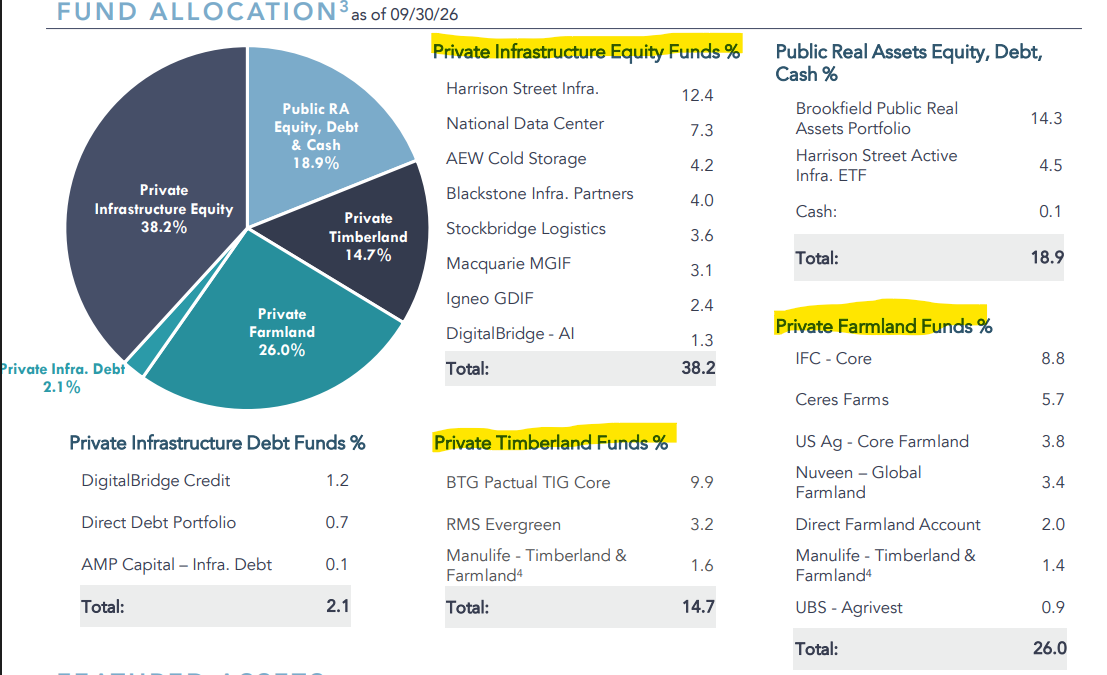
Neither Grok nor Gemini could find a dedicated timberland interval fund. That wrapper would work for timberland, that would be something worth learning about but I can't see using an interval fund for clients but I do spend a little time studying the space. Gemini pointed to the Harrison Street Real Assets Fund (VCCRX) which is an interval fund, despite having a symbol, it is not a mutual fund. The allocation is interesting;
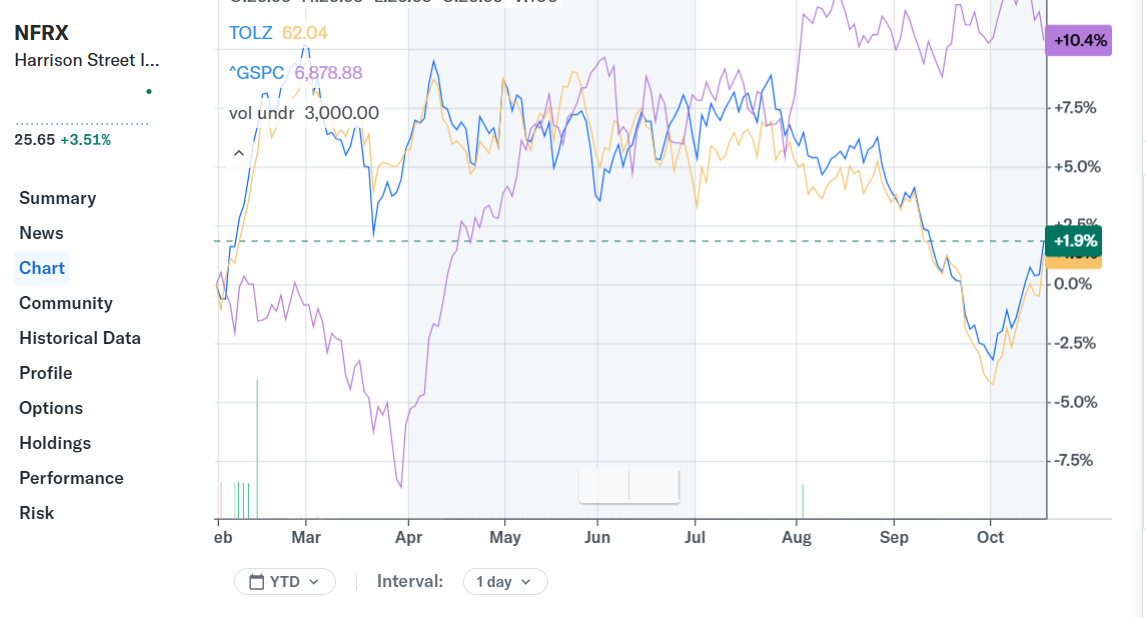
Included in VCRRX is Harrison's own infrastructure ETF. To Harrison's credit, the ETF is differentiated from the S&P 500 but looks very similar to some of the other infrastructure funds.
Here's a long term look at VCRRX, the parent fund so to speak.
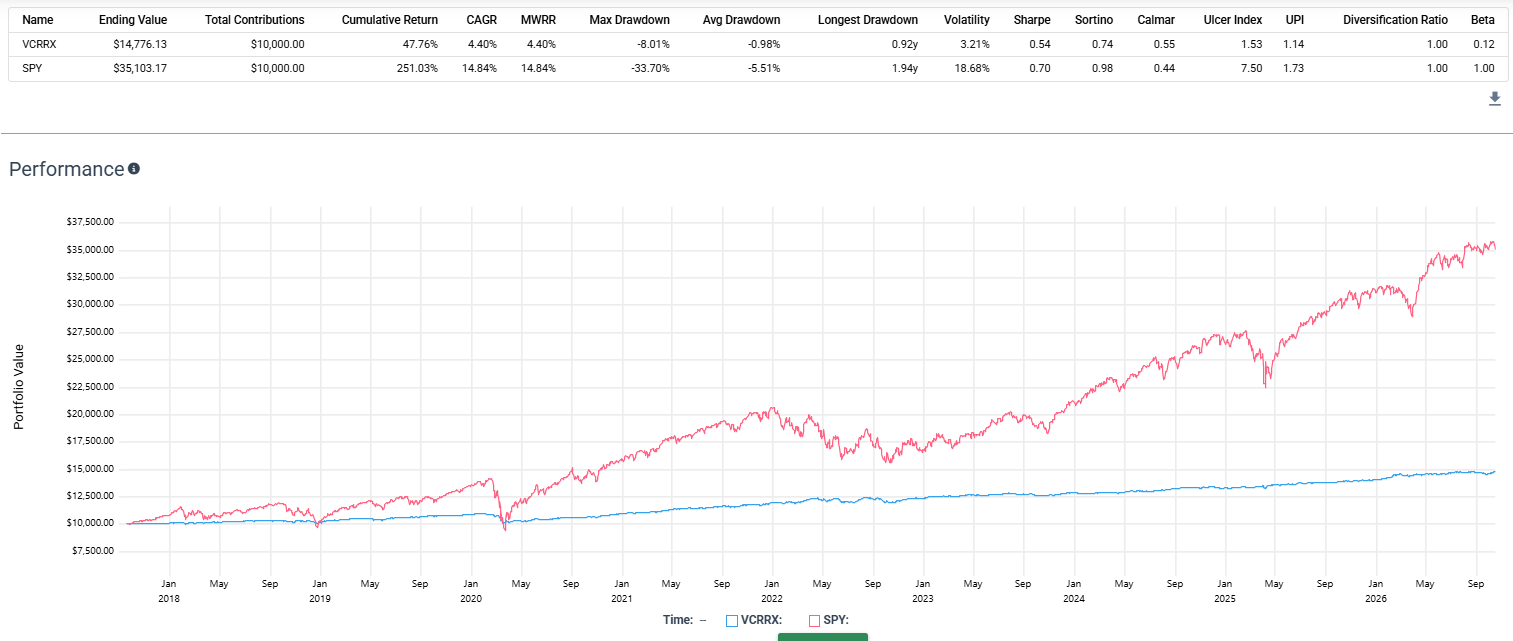
It's a horizontal line that tilts upward. From the literature, the fund consistently lags behind its benchmark for growth rate but with a fraction of the volatility. The result is very similar to client holding Merger Fund (MERIX) so I am not opposed to that but I'm not sure it makes sense to to endure the limited liquidity and the 2.2% expense ratio for that result. The fund is intended to be absolute return so it is pretty much doing what they have in mind but 50% MERIX/50% BOXX would have the same result for 1/3 the cost and with the advantage of daily liquidity.
A different path to MERIX' result interests me, we can revisit this if they ever put this into a vehicle with daily liquidity.
Closing out with a chart from Barry Ritholtz.
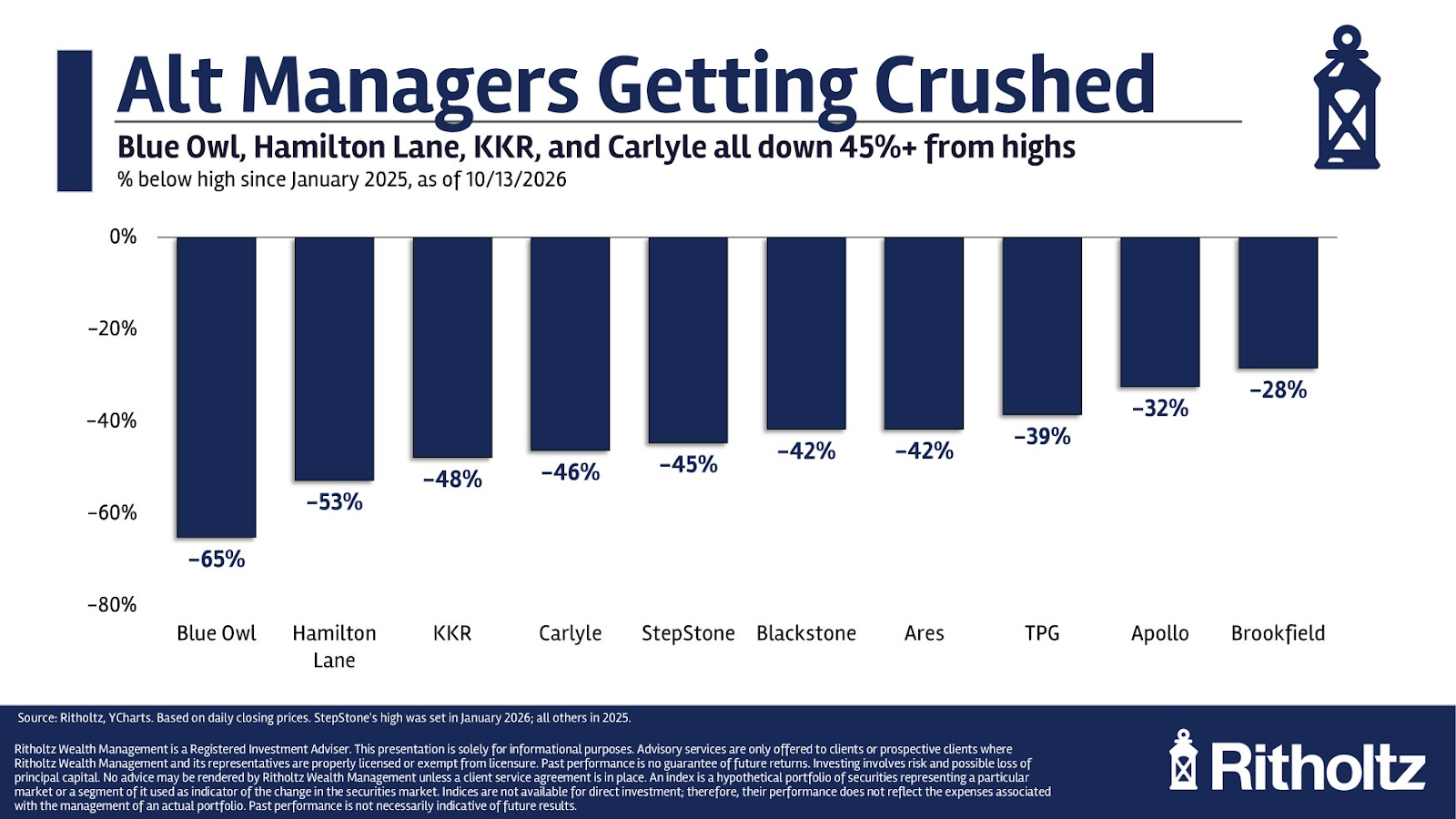
We've looked at these several times in the past for blogging purposes. The way we framed it, I think these stocks do a great job of being proxies for investing in private equity and private debt without the expense or limited liquidity. We looked at them when times were good, they mostly go up more than the broad market with more volatility and now things are going poorly and they are down more than the broad market with more volatility. I realize the broad market isn't actually down in any sort of meaningful way currently.
At some point these will bottom and I'm sure go back up again but based on the volatility, owning any of them seems like it would be very difficult. A quick editorial note is that I don't know anything about Hamilton Lane (HLNE), really nothing, and from what I've read about Blue Owl (OWL), that one might be in a more serious situation than the others. BX is the one we've looked at the most for blogging purposes. It is currently at $109, down from $199 in late 2024. I imagine it will get to $199 again at some point but the path back to $199 might go through some much lower number first.
Like I said, these are difficult to own.


Comments
Log in or sign up to join the conversation.