

Barron's wrote about how retirees spend down from their accounts versus when they take Social Security, but they asked some interesting questions and made a couple of interesting points. This post won't tie it all together; hopefully we all come away with some good questions to ask ourselves for our own situations.
First, Barron's always leans into waiting to take Social Security. I am not in the camp of trying to persuade anyone to take it early or late. It is crucial to understand the tradeoff of either approach to make an informed decision. I've been clear about my intention to wait until 70 because my wife is six years younger, and she would get a larger survivor benefit if I die early. Anything could happen to change that plan, of course, but if I started taking any time after I turn 69, I will consider that as having been able to stick to my original plan.
First, a "recent Vanguard analysis of more than 125,000 retirees ages 60 to 72 with balances of more than $100,000 found that nearly 80% hadn’t tapped their retirement accounts." The $100,000 number isn't helpful. We've talked about that at some point; someone had more of an emergency fund, not a retirement account. That point can certainly be debated, but, sorry to say, I think $100,000-$125,000 is more of an emergency fund than a retirement account. I appreciate that might be harsh.
The big argument being made in the article is to wait to take Social Security until 70 and use your IRA in the meantime so you have smaller RMDs when the time comes. What do you think your RMDs will start out at if you're not already taking them? If you have $1 million in your IRA at 75, your RMD would be $40,650. At $2 million, it would obviously start at $81,300. The percentage of IRA holders with an RMD of $150,000 or more is less than 1%. Only 1.8% of households have an IRA worth more than $2 million. 0.65% of Americans 65 or older are in the 37% federal tax bracket, and there's maybe 2% that age in the 32% federal tax bracket. Surprisingly, 35-40% of retirees have income streams beyond Social Security, pensions, and investment accounts.
The median income from these other sources is about $45,000. The point of all these numbers (from Gemini) is that the idea of waiting to take Social Security to have smaller RMDs may not impact too many people. There's no reason not to run your numbers to solve for this question, though.
We are all entitled to our beliefs about taxes. If someone can avoid having too many of their dollars in the 22% tax bracket up from 12%, that's probably a good idea.
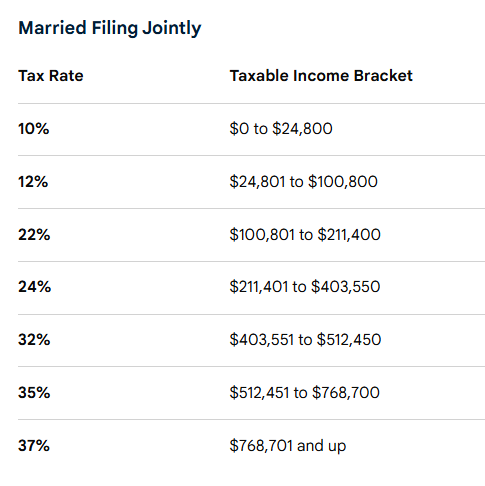
Keep in mind that a gross income of $120,000 will have a low effective tax rate even if they pay 22% on a few dollars. The effective tax rate for $150,000 married filing jointly is 10.6%. In today's dollars, what do you expect your Social Security to be? Do you want to shave 24% off that number in case Congress blows it? What are your RMDs likely to be? Will you have other sources of income? And of course, most importantly, how much are you likely to need for your preferred retirement lifestyle? With all of that, what are the odds you avoid having meaningful dollars in the 22% bracket? If it's borderline, then yeah, maybe you should run your numbers in the context Barron's is talking about.
My own belief is that I am not likely to turn myself inside out to avoid having a few dollars in the 24% bracket versus 22%. There's no reason for you to agree with me on that; it's my belief. If I can avoid the 32% bracket, though, that's something I would try to do if I ever got close. I am not close, and there is no visibility for me to get close. I don't know if I will still have an active income once I hit RMD age, but if not, then between Social Security and RMDs, and if we get out of the vacation rental business, I might not have many dollars in the 22% bracket.
Barron's also brought up IRMAA, which is the extra fee or tax that higher earners pay for Medicare Part B.
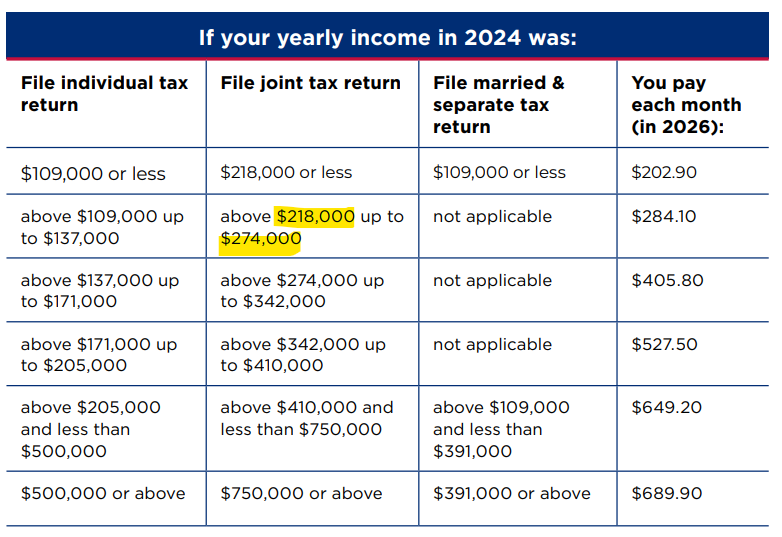
We know from the above about incomes that very few couples are paying the upper end of the IRMAA scale. Is your RMD likely to be the difference maker for whether you have to pay IRMAA? I don't live in a place that is expensive, so if we are making more than I expect at RMD time, then I am unlikely to spend a lot of time being upset about the extra $81 times 2. If you live somewhere expensive, like $20,000/yr on property tax, then that might be worth spending time seeing if there is a strategy that helps you avoid IRMAA.
One point not discussed in the article and one we should probably spend more time on here, is the huge jump in taxes when the first spouse dies. The IRMAA threshold cuts in half while income wouldn't go down as much. The lower Social Security payout goes away, but not the RMD income. Income tax brackets cut in half too.
On its face, that is an argument for digging in to see whether trying to reduce RMDs makes for good tax planning. That's not a blanket statement for what anyone should do in terms of SS filing, more like a suggestion to do a calculation that you might not have thought of doing. Roth conversions address this issue too, but those numbers and tradeoffs are also tricky.
There's a lot to matters related to Social Security, the order of accounts to draw from, and other parts of retirement planning that are easy to get wrong. Mistakes in this realm are probably not ruinous but can be expensive all the same.



Comments
Log in or sign up to join the conversation.