


The news around Jensen Huang's return is, of course, dramatic—not a big enough word—and obviously market-moving.
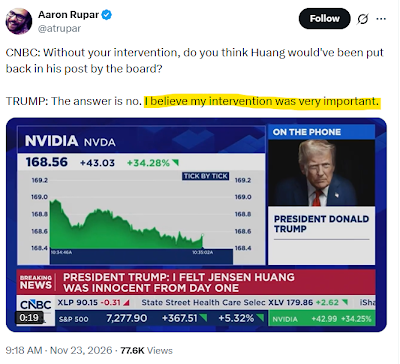
At this point, there doesn't appear to be any attempt anywhere to refute that the President did intervene in this situation, advocating for Jensen's return, and of course, he is back...for now. If you followed the story today, then you heard all the questions that I did, so I won't repeat them again here, and I don't feel the need to go into detail about whether or not he should be reinstated; you can draw your own conclusions.
The government "investing" in many companies generally and then today inserting itself into the boardroom seems like the antithesis of America's version of capitalism and certainly what Republicans used to believe in.
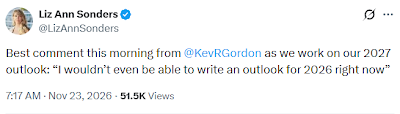
As ETF IQ covered the impact on the NVDA ETFsphere, Eric Balchunas said something to the effect, "days like this make you want to VOO and chill." VOO, of course, is the Vanguard S&P 500 ETF, and I think Eric coined "VOO and chill," which is a riff on "Trinity and chill" from Meb Faber about the Cambria Trinity ETF (TRTY). Somewhere in there is "T-bills and chill"; please leave a comment if you know who came up with the last one.
Here's a Tweet thread that I both hate and love. Hate may not be correct, but I fundamentally disagree with taking away or reducing control people have over their financial futures. I do think more could be done to provide education on this front, though. Love is not correct either, but there are a couple of good questions in there.
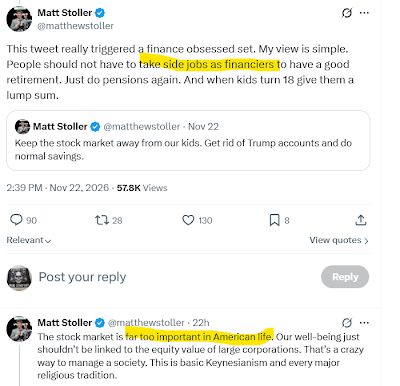
Do people need to "take side jobs as financiers" in order to build for a robust retirement? I like the question being asked; there's something to it. Some people devote a lot of time to planning and then managing their retirements, but target date and chill or VBAIX and chill are valid too. I've said before things like target date and VBAIX are valid and should get the job done, assuming an adequate savings rate and very few terrible, behavioral mistakes, but they are not optimal.
Are we collectively obsessed with the stock market such that the impact on society is net negative? Realizing I am probably in a bubble that doesn't capture reality on this question, I'd say, based on personal interactions with friends on Facebook, there are some people who do overly obsess. To the extent most people have a 401k, the stock market is very important; vital would be a fair word, but I don't think people obsess in the manner that Matt seems to be implying.
Better education would allow more people to get to the point of whatever allows them to chill. For Eric, that might be VOO; for Meb, that might be Trinity; and from today's Bespoke Morning Lineup, for some people it might be risk parity. Not really, but they took a useful look at it, and while it has been really difficult to make risk parity work anytime recently, it still is a fascinating idea.
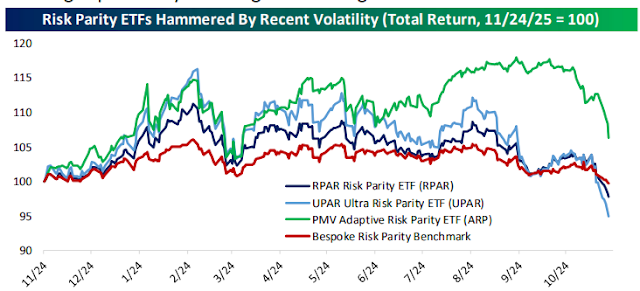
Bespoke maintains a risk parity model, and they report it currently has the lowest equity target that it's had in a few years. ARP is a new (to me) fund, but it has been around for several years.
The holdings overlap some with the BTA ETF that we looked at recently.
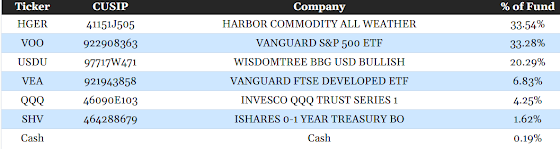
Both funds have a large exposure to USDU. BTA currently has a lot of exposure to managed futures and some simpler commodity exposure, while ARP has 1/3 of the fund in commodities. BTA's fixed income exposure avoids duration, while ARP has essentially no fixed income exposure, which I don't think I've ever seen in a risk parity strategy.
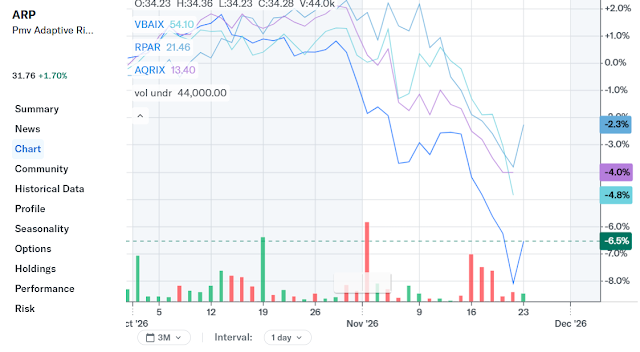
Here's a short look at ARP, RPAR, and AQRIX, which has a foot in the risk parity door.
And a longer look;
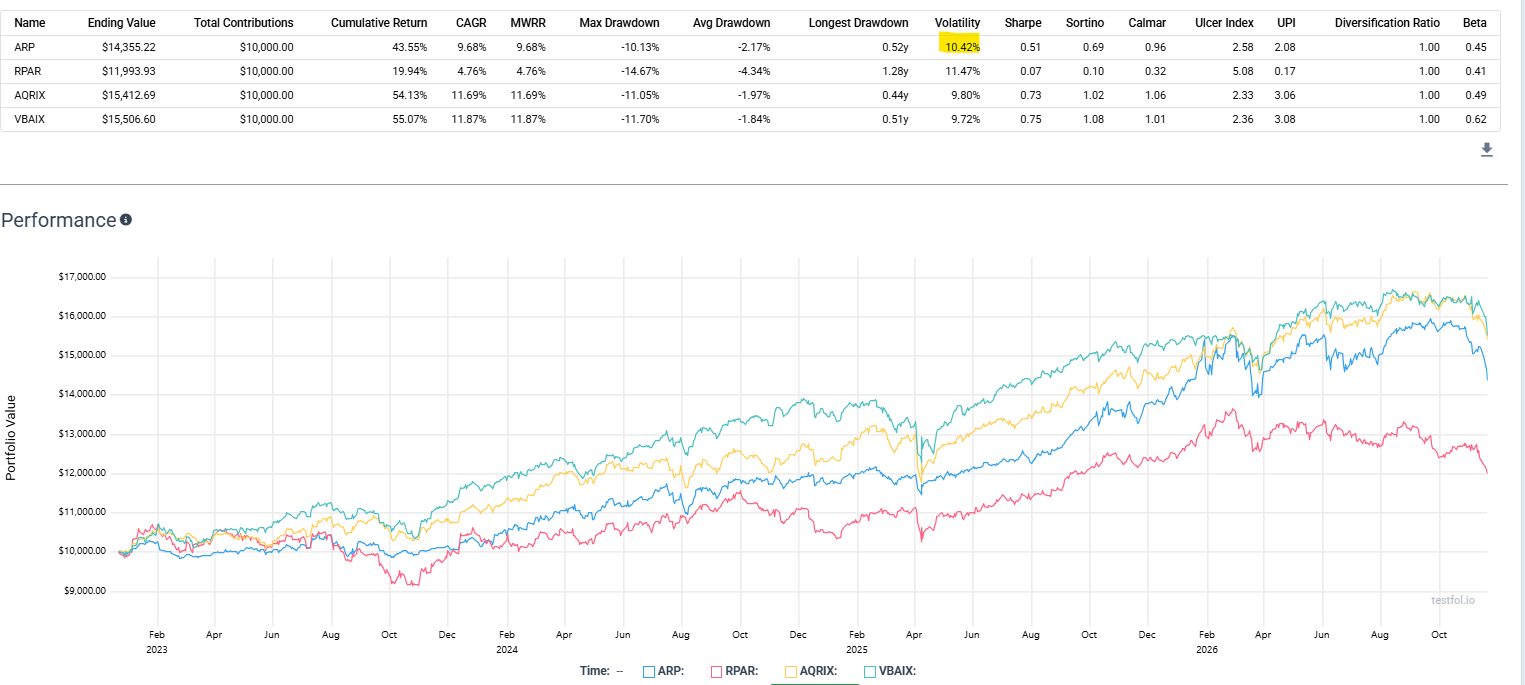
ARP has outperformed RPAR in three out of four years that ARP has been trading. RPAR continues to struggle. I am amazed it is still open and trading. ARP has been fine, not terrible. Accepting a lower return than a benchmark like VBAIX in exchange for lower volatility is a valid tradeoff, but ARP doesn't appear to offer that. The concept of weighting by risk would seem to fit right in with ... and chill, but it doesn't play out that way.
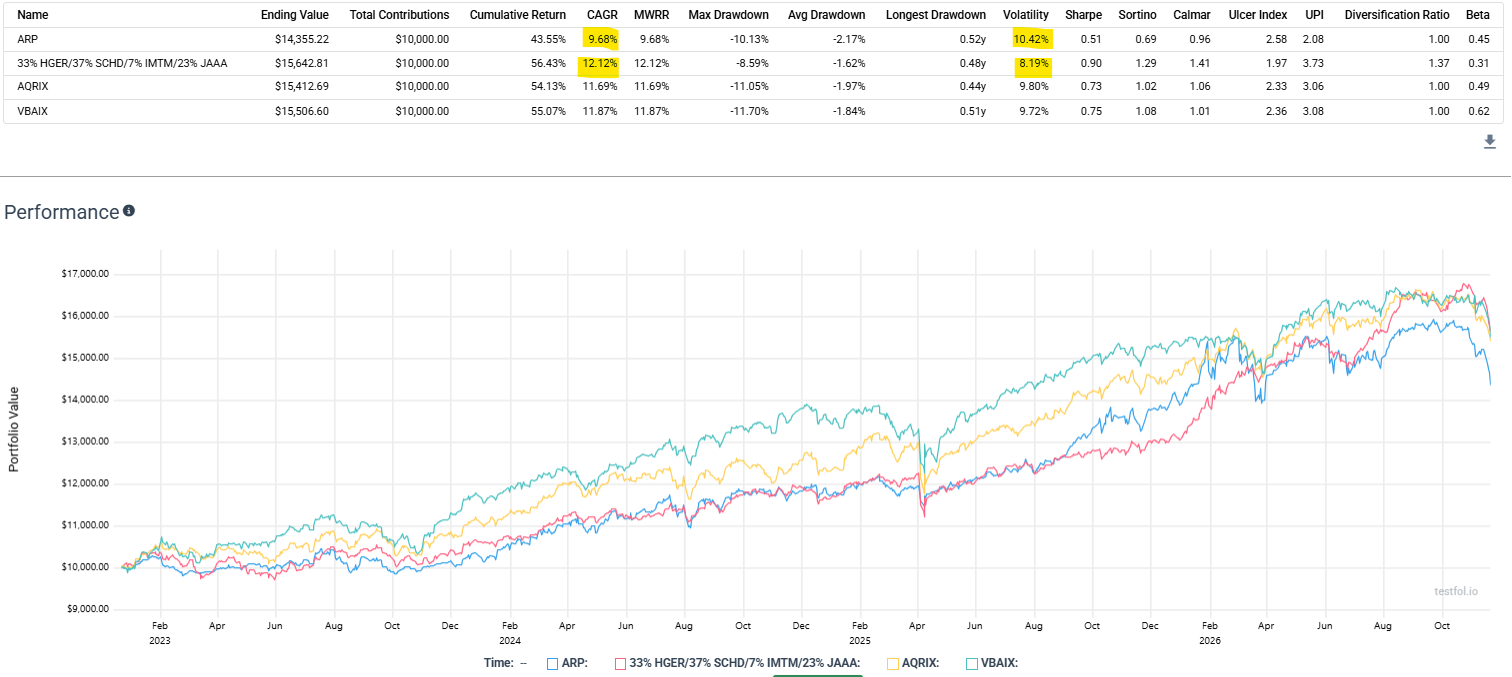
Portfolio 2 pretty much takes ARP's weightings but with different funds other than HGER. Who can say if it meets anyone's idea of chill, but it is much closer than ARP. In real life, I'd want to split that 33% in HGER into several different funds. Maybe a managed futures fund and two commodity funds that differentiate from each other somehow. One-third of a portfolio in a single commodity strategy seems like the opposite of chill.



Comments
Log in or sign up to join the conversation.