


I think we can call what is going on in markets a fast decline. While this is not fun, market history tells us that slower declines have tended to be more problematic. Look at how slowly the market rolled over from the internet bubble and at the start of the Financial Crisis. Now think about the end of 2018, the Covid Crash and the Tariff Panic. They fell hard and fast and snapped back quickly. Down 6% in a month seems closer to being a fast decline. From my time at Fisher Investments and an indicator I have cited before, to the extent bear markets start slowly, look for an average 2% decline for three months in a row. Anything could happen from here, of course, but for now, this seems fast.
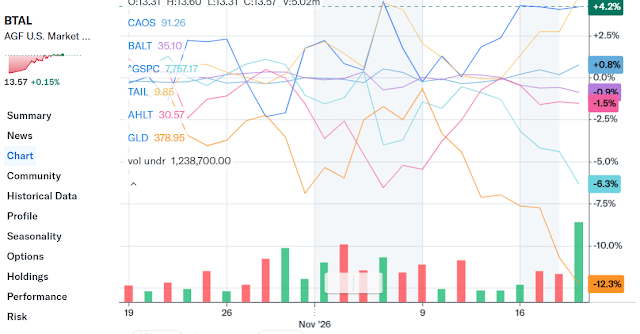
The above chart is a great example of why you diversify your diversifiers. Clients own all of those except for TAIL, and actually, for gold I use GLDM.
BTAL and CAOS are generally working. CAOS responds a little better to declines that are even faster than the current one, but up a little is OK. Managed futures tend to do better with longer, slower declines than where we are at this point. They could be doing well now as a matter of luck, like during the COVID crash, so I am optimistic that they would start to become additive if this in fact does become a more serious event. Gold has had long runs where it has struggled, and lately there has been a short run where it has been struggling.
I've pounded the table on diversifying your diversifiers probably to the point of being boring, but right now is exactly why. Occasionally they'll all work, but expecting that is not realistic. The chart is exactly why I've said I think 25% in gold is a terrible idea. I'm obviously a big believer in managed futures and while we do some interesting theoretical stuff with managed futures here, I keep the allocation in real life pretty small, mid-single digits for the most part.
Some days my mix of diversifiers works very well and we're down a lot less, and some days they are less effective. There's no way to know what will work best in the next market event or to what magnitude they will work, but I think they help more often than not. To the extent they are working, times like now are why you hold on while markets are doing well. There is no way to know when the market will turn or how serious it will be.
In notes to clients I usually say something to the effect that there is no way to know whether this will turn into something serious or be one we soon forget about. If it does become serious, we already know how it will end. It will just stop going down and then start to go back up, eventually making a new high. The only variable is that we don't know how long it will take.
I've included versions of that here on the blog too. It would be great to completely nail every downturn, but "don't let the pursuit of perfection be the enemy of pretty good" or words to that effect. If you care about going down less when the markets are going down and you are going down less, that's pretty good.


Comments
Log in or sign up to join the conversation.