


Starting out with a quick follow-up from yesterday, as markets went down a lot again on Friday. Oddly though, the things I follow, more of them were up today in the bigger decline versus yesterday's slightly smaller decline.
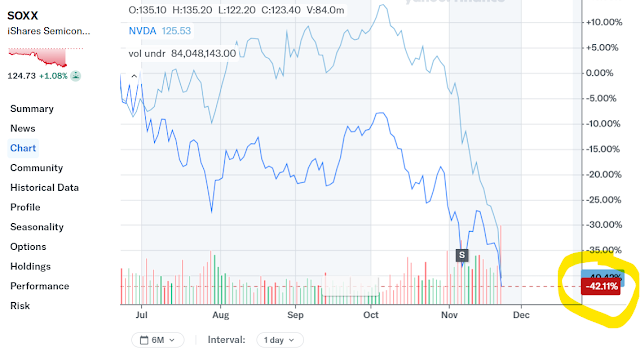
For a long time here and in client letters, we've been talking about obvious excesses in the tech sector while being clear that there was no way to know when or if there would ever be a consequence for those obvious excesses. If there was no way to know when or if there would be consequences, then the only protection was to be underweight versus the index. Zero weight was not/is not practical, but being underweight was/is practical.
For the last six months, the iShares Semiconductor ETF (SOXX) is down 40%, as you can see. Since the beginning of October, SOXX is down 35%. I have no idea what will happen, but that seems awfully fast. I'm not trying to predict anything, more like just read the room. Fast declines tend to snap back quickly, so maybe this one will too?
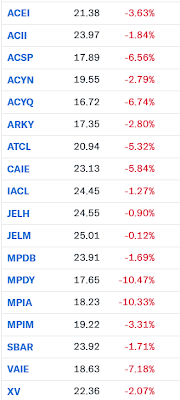
Where we've spent a lot of time trying to understand autocallable ETFs, this event has been a great chance to learn more about how they behave when markets get hit. Some of the declines have been massive. Those are just Friday's declines.
I was talking to a buddy today who said he's concerned about all the stuff going on with outages and the like. I'm not really concerned that there will be some sort of societal-level breakdown, but similar to COVID, there could certainly be some inconveniences. If you haven't already done so, it's a good idea to add two-factor authentication to all your accounts. There's no reason not to have extra batteries on hand, a little cash in the house, get a little ahead on food (I'm not saying doomsday levels) and for us a little bit of gasoline which is for our ATV and generator. I'd say it's always a good idea to have some level of preparedness for emergencies if you want to think of it that way, or a little less dramatically, preparedness for inconveniences.
The rest of the post from here was written a couple of days ago, but events got in the way.
The new iShares Macro AlphaBeta Active ETF (GMIX) takes a page out of ReturnStacked's playbook, allocating 100% to large-cap domestic equities and 100% to global macro, so it is leveraged. Here's a write-up from BlackRock in support of the new fund.
iShares has a newer ETF that is in the macro realm with IALT, and so far, that fund has done pretty well. I saw some chatter, though, that the macro sleeve of GMIX might look more like PBAIX, which is a BlackRock fund I'd never heard of before. PBAIX is a 5-star fund, and it has done well, but I wouldn't say it's done better than some of the other macro funds we've looked at. As I learn more about it, maybe it will turn out that it takes a different path to a similar result as the others, which would make it interesting.
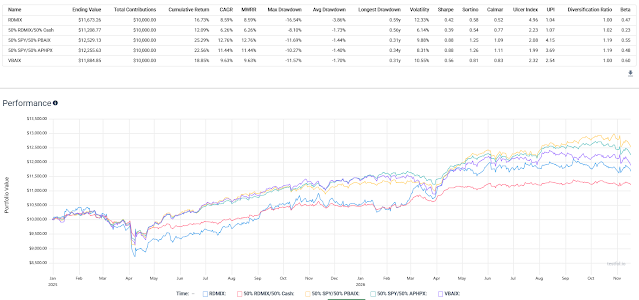
RDMIX is a ReturnStacked product that, similar to GMIX, has 100% equity/100% macro. The latest incarnation goes back to the start of 2025. The ReturnStacked guys don't suggest 100% or 50% of a portfolio into their funds but the backtest maybe gives a little color on how equities and macro could work together.
Staying in the macro realm, the other day we mentioned the Victory Pioneer Multi-Asset Income Fund (PMFYX). Despite the name, it is not a straightforward fixed income fund. It is legit multi-asset. Morningstar categorized it as Global Moderate Allocation. This is from the fund's July 30 factsheet.
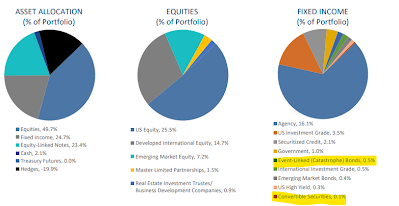
It goes pretty far afield. A good portion of its high sixes yield comes from equity-linked notes in a similar manner as how JEPI uses equity-linked notes. That is not a precise explanation, but thinking of them as short-term autocallables might give some context.
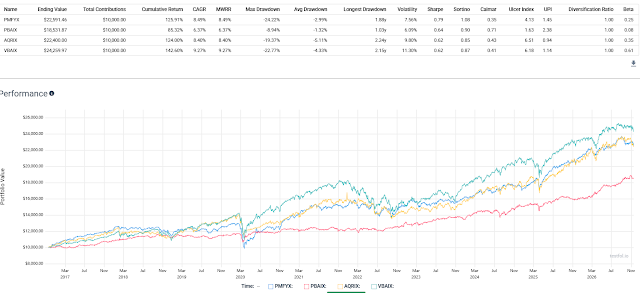
This chart is helpful for framing what I think are different objectives. PMFYX isn't really a stand-alone fixed income fund, and it doesn't trade that way. Similar to AQRIX it seems like a potential replacement for VBAIX, so maybe calling it macro isn't fair. PBAIX does look like a replacement for a stand-alone fixed income fund, at least what I think people want bond funds to look like with very low volatility and very shallow drawdowns. It hasn't had a down year in our ten-year backtest.
If you think you want to dabble in macro funds, I would suggest trying to draw a conclusion about what you think it is trying to do. Right or wrong, I don't think PBAIX is a replacement for VBAIX. Right or wrong, PMFYX very well could be...more so than PBAIX anyway.
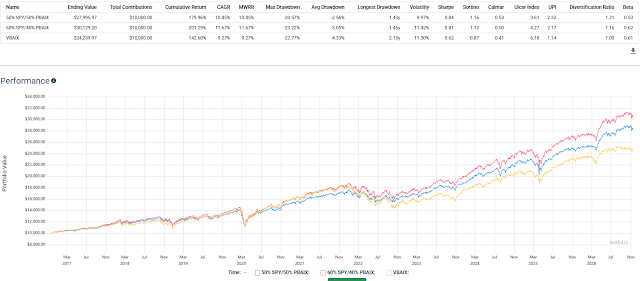
You can decide for yourself whether the above is compelling or not. There's not much differentiation over time except in 2022. Portfolio 1 was down 6.01% that year; Portfolio 2 was down 8.45% compared to a drop of 16.87% for VBAIX. In other words, it differentiated when investors most needed it to. In 2023, 2024, and 2025, both were very similar to VBAIX, but this year, as bonds have struggled price-wise again, Portfolios 1 and 2 are way ahead again.
This next chart throws a different type of macro fund into the mix with DYMIX.
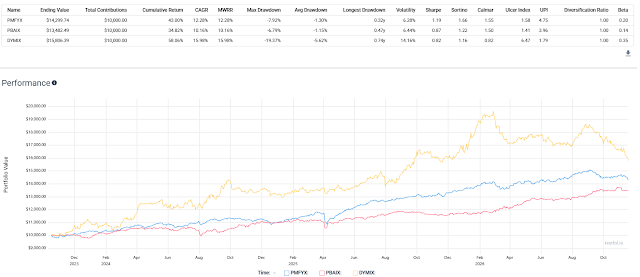
It's a shorter lookback because DYMIX is a newer fund. DYMIX looks much different in terms of growth rate, volatility, and drawdowns. Higher growth rates aren't the only determining factor. Anyone who cares about this sort of alternative needs to consider not just the growth rate but how it would fit in with their other holdings. There's no way to know how well they will do in the future for their respective growth rates, but it is reasonable to conclude that PBAIX will be far less volatile than DYMIX.
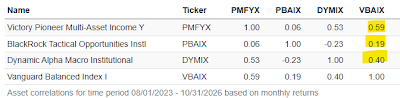
In terms of correlations, I'd be more confident in PBAIX maintaining its low correlation to VBAIX, but based on DYMIX's volatility, I would expect the correlation to VBAIX to be more volatile too.



Comments
Log in or sign up to join the conversation.