


A quick note before jumping in. Yesterday's post about Bitcoin (BTC.X) apparently hit the Twitter algorithm just right because it had a ton of engagement there, with a couple of hundred thousand views and many comments. The comments were a combination of calling me stupid and using profanity to call me stupid. In terms of trying to create a dialogue, it would have been helpful if someone had actually refuted what I said. This was my favorite;

Quantica wrote a short paper noting how effective bonds were for managing portfolio volatility in the 2010's and that now, managed futures is better suited for that role. I stumbled into that paper via a Tweet from Meb Faber, who captioned it "Trend and Bonds?" This, of course, led me to think about the Cambria Trinity ETF (TRTY) that we look at from time to time and which is very heavy in trend.
TRTY's concept of 35% into trend, 25% each into equities and fixed income, and 15% into alternatives works far better than the actual ETF. Gemini says that TRTY has struggled due to equity factor tilts like deep value, heavy foreign equity exposure, the occasional choppiness of trend, and, as we've mentioned before, TRTY's willingness to take on duration.
We've taken quite a few attempts at using TRTY's idea (35,25,25,15) and been able to get better results than the actual ETF. This ties in with an idea we started talking about ages ago and should probably reference more frequently, which is to take bits of process from various places to build your own process.
Today I wanted to combine a TRTY replication with the idea of getting off the stock market roller coaster that we've been playing around with lately. For this post, we'll use ABYIX, which is the least volatile managed futures fund that I know of, SCHD for equity, SHRIX for fixed income, and EGRIX for the alt. EGRIX is a tip from a reader. That fund used to be managed by the team that now manages APHPX, so EGRIX might be a way to backtest APHPX further back than 2022.
Portfolio 2 does the TRTY weighting, and Portfolio 3 weights the four equally like the permanent portfolio.
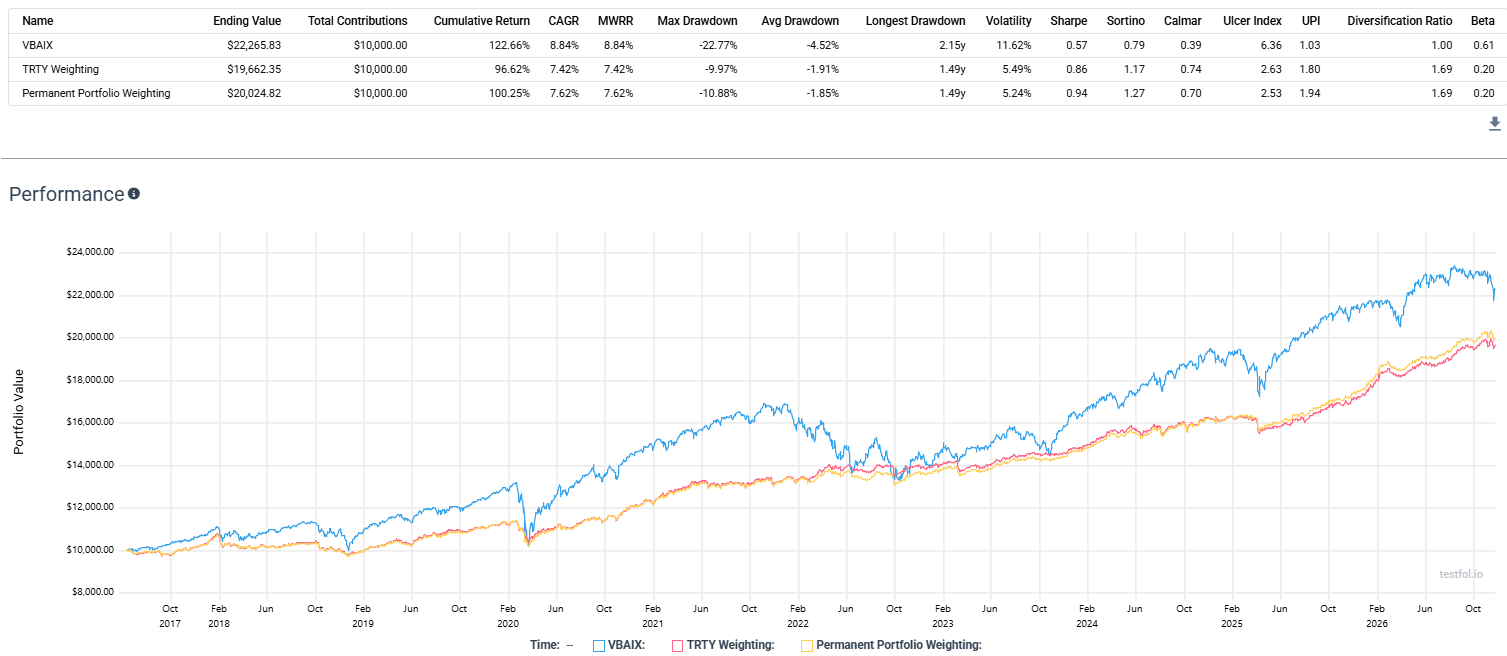

The idea is to try to suck out all the volatility but still get a decent growth rate. The backtest looks a lot like 75/50, which is the idea of getting 75% of the upside with only half the downside. It's done that looking back; it even softened the blow during the COVID crash, which is not common to these studies we do. It is important to note that I think managed futures was lucky to have done well in the COVID crash; usually, fast reversals like that tend to punish managed futures. That's a point I've made before and will continue to bring up.
In years that 60/40 rips higher, both Portfolios 1 and 2 will probably lag by a lot. They both lagged VBAIX by 800-1000 basis points in 2019 and 2023.
In real life, 35% in managed futures is too much for me. Anyone who likes this idea might want to split the 35% between several funds. Gemini says WTMF and FMF are also lower-volatility managed futures funds, but I haven't studied either one. Just owning one equity factor fund means that sleeve will lag market cap weighting from time to time, which is easier to say than to actually live through. I'd want to split the fixed income sleeve too while still avoiding duration; 25% in cat bonds is also way too much. Something like merger arbitrage could help with splitting the 15% we used today in EGRIX.
Just using four funds is certainly tidy for blogging purposes but is a very unnecessary risk to take with an actual portfolio.



Comments
Log in or sign up to join the conversation.