

The U.S. Stock Market Indexes are still sizzling like a Fourth of July barbecue. Yes, that means some stocks are hot, but you can get burned, too. The Dow, the S&P and the Nasdaq all closed up Monday, though currently the day’s stock futures are wading in the red.
Much rests on the Fed’s FOMC meeting on Wednesday, but more on the ability of U.S. lawmakers to pass some kind of additional stimulus legislation before their August 7, recess. We will have to wait and see. There are 4 trading days left in the month, including “after the bell” Thursday, when Alphabet (GOOG), Amazon (AMZN) and Apple (AAPL) will report Q2 earnings.
Today’s round-up of TalkMarkets contributors finds some good news and (possibly) good picks amongst the COVID-19 havoc.
Arthur Donner finds that a rise in personal income, amidst the COVID-19 recession, supported by government stimulus has in turn supported the rise in the equity markets and the increase in consumer spending reported in June, as states started to re-open. He says in his exclusive for TalkMarkets, US Personal Income, July 2020 that, “I have accepted the consensus wisdom that the equity market’s resilience can be heavily traced to the Fed’s promise to do whatever it takes in providing monetary support.”
However Donner goes on to add:
“But another explanation for the support of equity markets may lie in the evidence that personal incomes can be well supported by government programs, even in an environment of a partial or full economic lockdown.
The recent evidence underscores that despite the enormously deep US recession and the steepest job losses in generations, US labor income, heavily supported by government transfers, has been surging and retail sales has been rebounding.”
Below is the chart which proves his point.
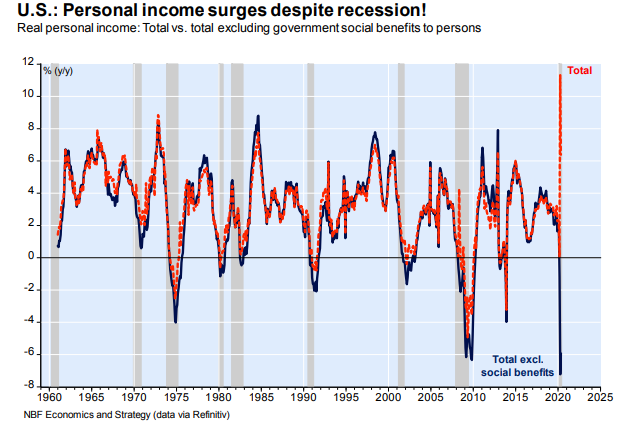
The red line showing % growth in personal income including government benefits and the blue line showing a % decline in personal income when government benefits are excluded. The lines for 2020 are nothing short of astounding. Having showed all of this, Donner is as concerned about what is to come as the rest of us. “Perhaps the markets take this as an early sign of a V-shaped recovery. If so, the markets are wrong.” Let’s hope lawmakers are looking at a similar chart this week.
Seth Golden in his extensive weekly round-up, Profits Are Generated By Looking Above And Beyond: Investors Don't Care About Bad Data Today remains bullish about the long term and in the middle of his thorough analysis of different sectors of the market he comes out saying that, “Investors are willing to pay up for stocks presently, as they are clearly anticipating a vaccine sometime after the election.”
Which means investors believe the market is still trading at a hefty discount. Here are a few other items of good news he reports:
“We see a weaker dollar as confirmation that global investors feel the worst of the COVID-19 Crisis has passed and validates the rally in equities since March. A weaker USD (UDN) is not a warning sign about a sudden turn lower for U.S. equities. History tells us this would be a nonsensical counter-argument.”
” For the last 4 consecutive weeks, the S&P 500 has managed to stay within the weekly expected move… S&P 500 realized volatility is at its lowest 10-day value since the new bull market began. This is another good sign that the measures taken-up by the Fed and legislative bodies have manifested in more stable market conditions.”
Golden includes this chart from the Conference board showing the rebound in the LEI or Leading Economic Indicators Index, along with a quote from LPL Financial Chief Market Strategist Ryan Detrick.
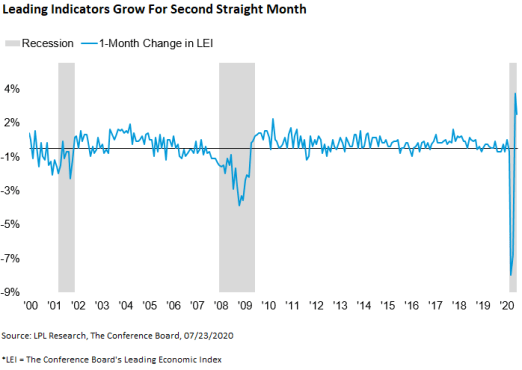
“"Yesterday’s LEI reading confirms our view that a major economic bottom has already formed and that the recovery is underway but, we are not out of the woods yet. Though we are optimistic, there are still challenges ahead, and we expect a choppier economic march higher in the second leg of this recovery following the initial bounce off the bottom."”
Stephen McBride from ValueWalk in his short column, Shopify Inc. Is Seizing An $80 Billion Pot Of Gold does another review of the top ten stocks of the last 3 decades, noting that Microsoft (MSFT) is the only one appearing across all three.
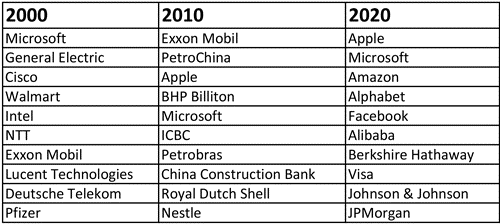
As for good picks McBride is keen on Shopify (SHOP). He says that “Sales hit $1.5 billion last year. SHOP’s revenues could soar 10X and it would still have captured just 20% of its target market.”
“Online business is still only in its first inning. Shopify is the key to unlocking business on the internet for millions of mom-and-pops. It’s one of the most important internet companies investors aren’t paying attention to. And I expect by 2030, we might be talking about Shopify like we talk about Amazon and Apple today.”
According to TheFly.com Goldman Sachs has just rated Shopify a Buy, Shopify Upgraded To Buy From Neutral At Goldman Sachs and TalksMarkets contributor, Kiana Danial, also analyzes Shopify in her video, Is Shopify Stock A Buy Now?.
Ironman writes in New Home Sales A Bright Spot For U.S. Economy that new home sales have been one of the few beacons of light in the COVID-19 economy (we should get used to calling it just that) noting that “the most remarkable aspect of new home sales is that the number of sales has nearly returned to its pre-coronavirus peak in February 2020.” This can be seen in the chart below:
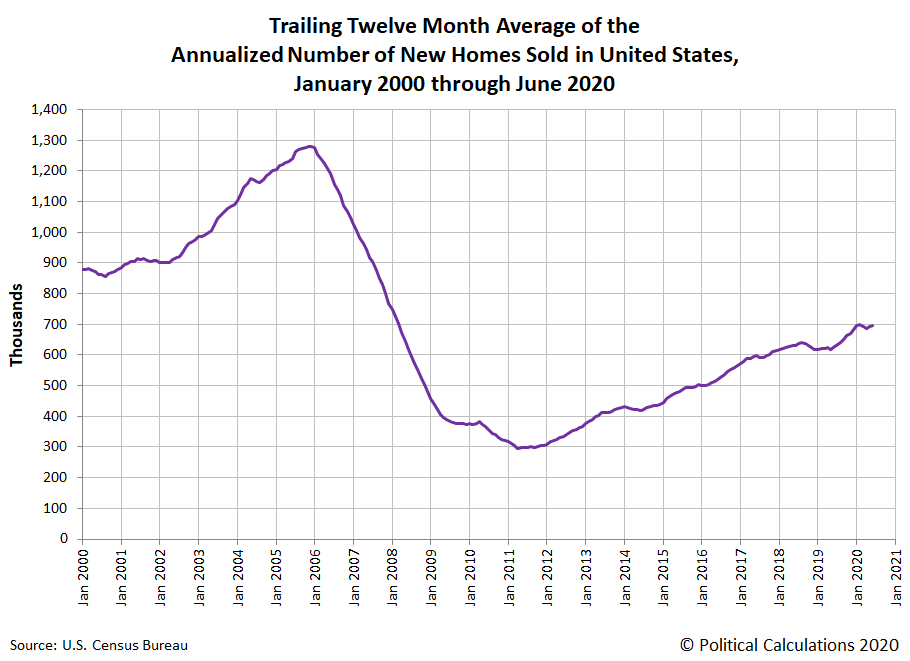
In addition Ironman notes that, “the average sale price of new homes in June 2020 rose to an initial estimate of $384,700, near the final estimate of $386,200 recorded for February 2020.”
Bob Lang in an educational essay entitled, Waiting On A Stock Market Crash? That’s A Bad Idea has a good suggestion for anyone investing in the market, “(Why) sit and wait for a crash when the market is bullish and there are trades to be had? Protection is inexpensive right now; you can buy index puts to defend your portfolio in case the market suddenly goes south.”
Lang’s article is a quick and worthwhile read, but what I liked best was his inclusion of this quote from the famous economist John Maynard Keynes,
“Markets can remain irrational longer than you can remain solvent.”
I’ll see you in August.



Comments
Log in or sign up to join the conversation.