

US index futures were flat by midday London, a day after taking a noticeable dip. That was before the US Treasury announced that it was increasing buybacks of long-term debt. That announcement has just caused yields to take a dip, while stock futures and gold have rallied. Let’s see if it will have a lasting impact. Until now, sentiment was quite downbeat as US equities had fallen for three consecutive trading days, with warning signals from the oil and bond markets finally beginning to weigh more heavily on risk appetite.
Yesterday, the Nasdaq 100 futures fell around 1.7%, with other US indices and European markets also lower. The overcrowded AI trade is losing momentum as yields press higher. The key question is whether this is just a temporary respite before new highs are seen, or whether this marks the beginning of something more meaningful this time. If the rally in oil or bond yields is not stopped, a period of market turmoil cannot be ruled out, even if the odds of a September Fed rate cut have fallen with the release of weaker US data lately.
Sentiment remains cautious amid Middle East tensions
Despite the relative calm this morning, the mood remains cautious. Sustained higher oil prices have revived concerns about inflation, with investors becoming increasingly concerned about the risk of a prolonged disruption to energy markets. For European equities, this is particularly important given their dependency on energy imports. If oil prices continue to climb, the region could face another inflationary shock. But even Wall Street is now coming under pressure.
For now, the situation in the Middle East is showing little sign of easing. Donald Trump has rejected an extension of the truce, while Iran says the Strait of Hormuz will remain closed until the blockade and oil embargo are lifted. With oil prices remaining elevated and Natural gas prices already close to their highs for the year, the message from the energy market is therefore fairly clear: The risk of a prolonged disruption to energy supplies remains significant - and that could prove to be a problem for overvalued stock markets.
Bond yields weigh on growth stocks
Bond markets have also been providing a major source of concern. But yields took a tumble after the Treasury announced its doubling of buybacks of long-term debt. This comes after yields had climbed to multi-year or multi-decade highs across several major markets.
Higher yields increase the opportunity cost of holding assets that come with high risk and low yields. For example, growth stocks in the technology sector. And that could become a problem for the likes of the Nasdaq 100 (NDX), as well as Germany’s DAX, given the European nation’s reliance on imported energy and the big technology stocks that make up the index.
Yesterday, the sell-off in bond markets accelerated, pushing yields even higher across the world, before easing a bit. US yields on the 30-year bonds have now risen to 5.337%— its highest level in almost TWO decades. Elsewhere, Japan’s 10-year yield has also moved close to 3%, a level not seen since the mid-1990s, while eurozone yields also remain at multi-year highs.
For equities, the combination of higher energy costs and higher long-term borrowing costs is becoming increasingly uncomfortable.
Nasdaq 100 technical analysis
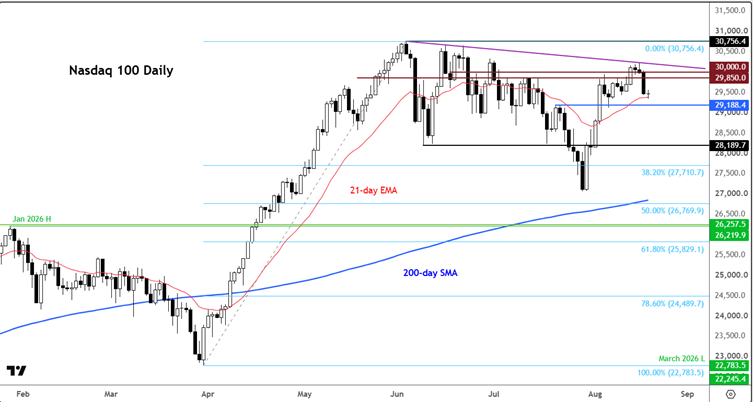
While it is too early to declare the end of the bullish trend, the risks of a correction are rising for the Nasdaq 100. The index has turned lower after again failing to hold sustainably above the 30,000 level. Here, a bearish trend line also offered resistance. With the next support at 29,850ish also taken out, this will now be the first level of resistance to watch in case we see a rebound. The next support is at 29,180ish, a prior resistance level. Below that, we could see a more meaningful drop, possibly towards 28,190ish.
With oil prices rising, bond yields climbing and geopolitical risks still elevated, equities may find it increasingly difficult to ignore the pressure coming from the macro environment.
Comments
Log in or sign up to join the conversation.