

The Federal Reserve delivered a distinctly hawkish message yesterday, initially sending both equities and risk-sensitive currencies lower. Yet the reaction has already faded to a large extent. By the time of writing, index futures have recovered to levels close to where they were before the FOMC decision. Once again, the ability of equities to absorb negative news is proving difficult to ignore.
So, is this the start of a new bullish phase and can we see new record highs for the S&P 500 index, or will this turn out to be a big bull trap?
FOMC was quite hawkish
The message from the meeting was fairly clear. Alongside the expected 25bp rate increase, the latest dot plot showed that most Fed officials still envisage further tightening before the year is out. Twelve of the 18 policymakers see another hike, while four are pencilling in two additional increases. At the same time, the Fed raised its forecasts for growth and inflation and lowered its unemployment projection.
There was little in Chair Kevin Warsh’s press conference to suggest that the Fed sees current policy settings as particularly restrictive. He stressed the importance of maintaining price stability and characterised the latest move as a reduction in the “dose of accommodation”, rather than a move towards an aggressively restrictive stance.
Markets have responded accordingly. Around 13bp of additional tightening is now priced for October, rising to roughly 32bp by December. Put simply, investors are effectively pricing another quarter-point increase before the end of the year.
Why haven’t stocks sold off more?
The question is why equities have been able to shrug this off so quickly.
Part of the explanation is that some of the pressure elsewhere in markets has eased. Oil prices have declined for a second straight session, while bond yields have also moved modestly lower. More importantly, though, the relationship between rising yields and weaker equities is not always as straightforward as it might appear.
Higher bond yields increase the return investors can earn without taking equity risk, which should make stocks less attractive at a given valuation. If investors can earn more from bonds, they will generally demand a greater prospective return from equities to justify taking on the additional risk.
But valuations are only one side of the equation. Stronger corporate earnings can provide a counterweight to rising yields by supporting profits and allowing companies to justify higher valuations. That appears to be the dynamic at work so far.
For now, investors appear to be assuming that the economy can continue to grow without slipping into a stagflationary environment. Whether that assumption proves correct remains to be seen. But with earnings still expanding, profitability appears to be carrying more weight with equity investors than the rise in yields.
That balance could change, however. A meaningful deterioration in economic data over the coming months, combined with persistently high or rising oil prices, would bring stagflation back into focus. Such a combination would be particularly uncomfortable for equities: weaker economic activity would undermine earnings expectations at the same time as higher yields put further pressure on valuations.
Oil remains the key risk
This makes the direction of oil prices particularly important. Ideally, they need to come down from current levels, or at least stop rising materially. The longer energy prices remain elevated, the greater the strain on US households is likely to become.
Higher petrol prices leave consumers with less disposable income, gradually tightening household budgets. So far, however, that squeeze has not been severe enough to materially undermine corporate earnings or push the wider economy into contraction.
S&P 500 technical analysis
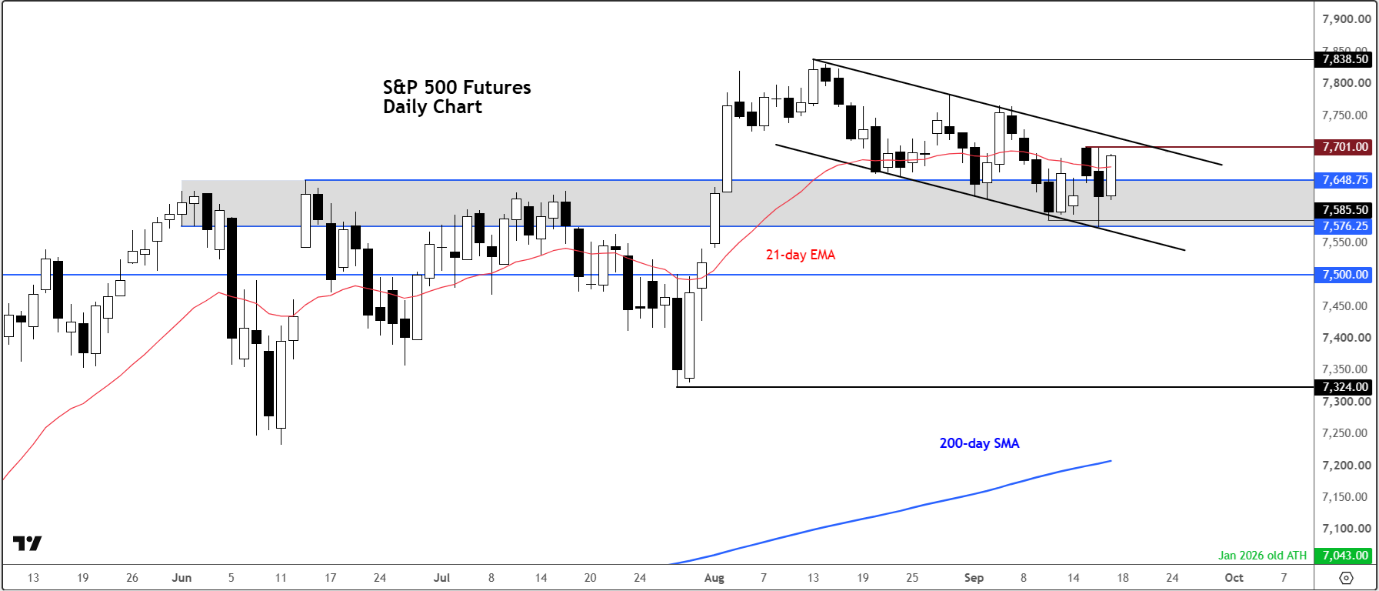
The S&P 500 future has bounced from the bottom end of the large 7576-7648 range. Previously resistance, this the 7576 level also converges with the support trend of the bull flag/bear channel that one can see on the daily time frame. Resistance comes in around 7700, and then the resistance trend of the channel sits slightly above that area, if we get there. Bullish if we see a breakout of the channel. Continued consolidation otherwise.
The abovementioned resilience is what equity investors are betting on. If earnings continue to hold up, the market may be able to absorb higher yields and a hawkish Fed. But if growth starts to weaken while the oil shock persists, the equation becomes considerably less favourable. In any case, we still don’t have a confirmed bearish technical reversal signal despite everything that’s been happening.



Comments
Log in or sign up to join the conversation.