


The Democratic sweep in the US midterms has delivered the negative dollar reaction I had anticipated, although fears that a Democrat-controlled Congress would trigger a broader sell-off in technology stocks have so far proved premature. Nevertheless, the political outcome may help explain the Nasdaq’s relative underperformance.
While the removal of midterm uncertainty provided a broad-based boost to risk appetite, investors may be increasingly pricing in the prospect of tighter regulatory scrutiny of Big Tech, particularly around AI, under greater Democratic influence in Congress. This creates a potential headwind for technology valuations, even if the immediate earnings impact remains unclear. Indeed, Nasdaq 100 futures were off by 0.8% at the time of writing.
Markets not out of the woods yet
With the midterm uncertainty now behind us, investors were quick to embrace risk yesterday, helped by a sharp 9-10% retreat in oil prices. Global equity benchmarks rallied alongside gold, as easing energy concerns and the removal of a key political risk provided a welcome boost to sentiment. But the question of follow-through remains, particularly as the recovery in technology stocks is already looking less convincing. Interesting, oil prices were bouncing back, up around 3% following yesterday’s plunge. Bitcoin was also pointing to a modest risk off tone with prices falling back below $80,000. Markets are therefore not out of the woods yet, despite the big surge yesterday.
Tech shares under pressure
Qualcomm shares came under heavier pressure after disappointing smartphone chip sales, with sluggish handset demand, rising memory costs and declining Apple-related revenue weighing on performance. Disappointing margin and earnings guidance added to the negative reaction.
Heavy overnight selling across major semiconductor and memory names dragged South Korea’s KOSPI down by more than 5%. Index heavyweights SK Hynix and Samsung fell sharply, while Japan’s Kioxia slumped by double-digits. The moves partly reflect a catch-up with weakness seen in US technology stocks but also renewed concerns about the potential for tighter AI regulation under a Democrat-controlled Congress.
What makes the latest weakness interesting is that it comes against a backdrop of increasingly upbeat commentary on underlying memory demand. Kioxia recently indicated that customers were negotiating supply contracts extending into 2029, while Samsung expects memory supply to remain tight through 2027 and 2028. In other words, the fundamental demand picture has not materially deteriorated. Instead, investors appear increasingly concerned about valuations, regulatory risks and how much of the AI growth story is already priced in.
That pressure is carrying into today’s session, with US equity futures mixed and the Nasdaq 100 underperforming, down around 0.8% as the semiconductor and memory sell-off continues, while other index futures were hanging onto the bulk of their sharp gains made yesterday.
Nasdaq 100 Technical analysis and levels to watch
From a technical analysis perspective, the Nasdaq 100 remains one of the weaker-looking charts among the major global equity indices.
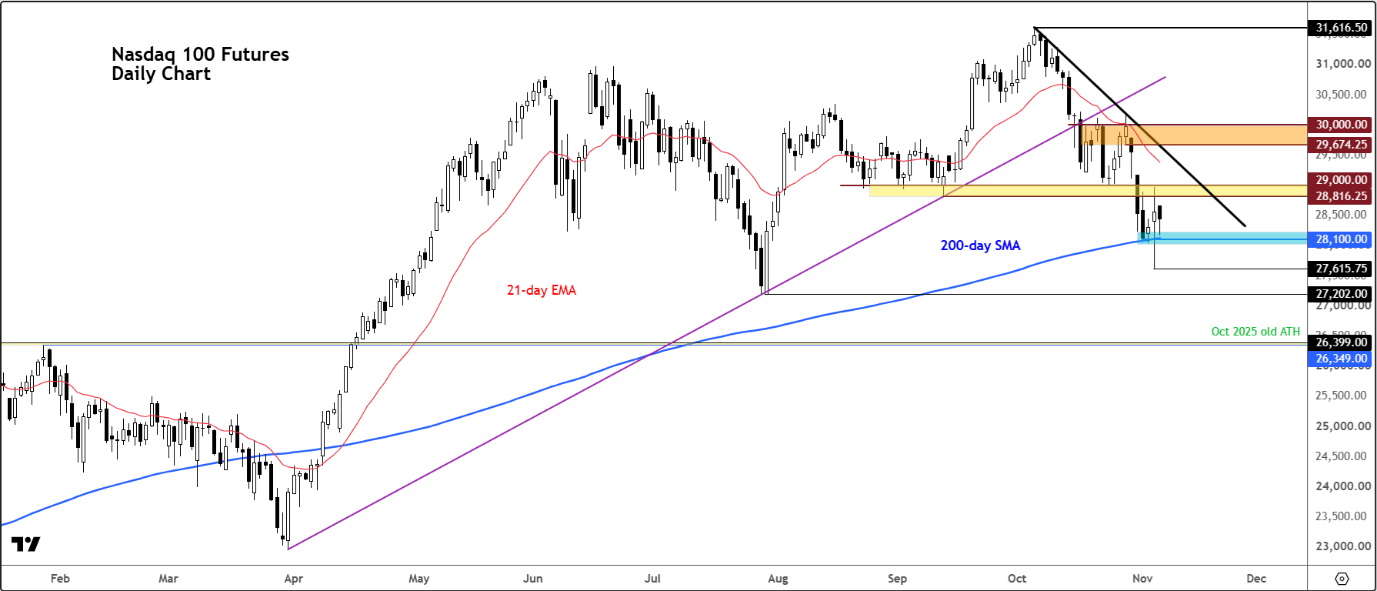
The recent price action has been bearish, with the index forming a succession of lower highs and lower lows since peaking in October. Until that pattern changes, the path of least resistance remains to the downside.
For now, however, the index has found support around its 200-day moving average, which comes in at approximately 28,100. This level has held on a closing basis so far, but a break below it in the coming days is something I would be watching closely.
A daily close below 28,100 would increase the risk of a deeper correction, potentially bringing the summer low around 27,200 into focus. Below that, the next major area of potential support comes in around 26,350–26,400, which coincides with the previous all-time high.
On the upside, immediate resistance is now concentrated in the 28,800–29,000 region. This area previously acted as support in late August and early to mid-September. The index also found buyers when it revisited this zone on 23 October, before breaking lower last week.
Since that breakdown, the same area has been tested twice from underneath: first on Monday and again on Wednesday, following the US midterm election results. On both occasions, sellers stepped in, reinforcing its importance as a resistance zone.
Consequently, a move back above 28,800–29,000 is the minimum requirement to start turning the technical picture around and provide an early indication that bullish momentum may be returning.
For stronger confirmation, however, we would also need to see a break of the short-term bearish trendline, which would invalidate the sequence of lower highs. If that happens, there would be a stronger case for the Nasdaq 100 to resume its recovery and potentially make another attempt at record highs.
There are, of course, several resistance levels along the way. The next significant area beyond 29,000 comes in between 29,675 and 30,000, where the previous wave of selling began, eventually driving the index towards its recent lows.
For now, though, the 28,800–29,000 zone is the key near-term resistance area to monitor, while 28,100 remains the crucial support level. A break on either side could determine the Nasdaq’s next significant move.
In summary
The broader concern for equity markets is that the AI trade is becoming increasingly selective. Strong long-term demand projections are no longer enough to support every stock linked to the theme, particularly where valuations leave little room for disappointment. With political and regulatory uncertainty adding another layer of risk, investors may be becoming more discriminating about which companies stand to benefit most from the next phase of AI investment.



Comments
Log in or sign up to join the conversation.