


The US dollar is finding fresh support as a broad unwinding of risk positions drives investors back towards defensive currencies. The strongest defensive currency is the Swiss franc, followed by the US dollar and the Japanese yen. Uncertainty over the US technology sector, expectations of further Federal Reserve tightening and renewed tariff threats are all continuing to weigh heavily on emerging-market and commodity-linked currencies like the Australian and New Zealand dollars.
With the US dollar index holding just below recent highs ahead of today's PCE report, the risk to the near-term US dollar outlook remains tilted to the upside.
Risk aversion puts the dollar back in demand
The investment backdrop remains distinctly unfavourable for risk-sensitive currencies. Uncertainty surrounding the US technology sector, expectations of further Fed tightening and renewed tariff concerns are combining to drive a broader unwind of risk-seeking positions. Emerging-market and commodity-linked currencies are bearing the brunt of it, and there is little reason to expect a sustained recovery while these headwinds persist.
That unwinding provides the dollar another source of support, even if the greenback looks stretched relative to short-term interest-rate differentials. While investors continue to cut their exposure to higher-beta assets, the greenback is unlikely to be hit by the narrowing of the rate differentials. That partly explains why it has remained supported despite the big drop in crude oil prices and bond yields – factors that had previously helped to propel the currency, when oil and yields were surging higher. It also explains why precious metals are falling and why XAGUSD slipped below $40 today.
Tariff threat piles pressure on commodity currencies
Reports of the latest tariff threat exacerbate uncertainty. According to a Wall Street Journal report, the US administration is preparing fresh levies following Section 301 investigations into excess manufacturing capacity overseas, with tariffs of around 5–10% possible on manufactured exports from China, the EU and many other trading partners.
If the report is true, it would be particularly bad news for economies exposed to global trade and industrial commodities. Copper has already taken a beating, while weakness across the broader industrial metals complex is reinforcing concerns about the global growth outlook.
PCE data could reinforce Fed tightening bets
Today's PCE report could add to the dollar's momentum, should the data come in largely as expected or beat. Following Tuesday's stronger US consumer confidence reading, an expected 0.3% monthly rise in core inflation would do little to reassure policymakers that price pressures are easing. The combination of resilient activity and sticky inflation could therefore encourage markets to price in a more restrictive path for the Federal Reserve.
Markets are already pricing an almost certain 25bp rate increase in December, leaving scope for speculation over whether a larger move might eventually be required should inflation continue to surprise to the upside.
DXY key levels to watch
From a technical analysis point of view, the dollar index is in a strong bullish trend. It is now up for the third consecutive month and on a 5-week winning run. Clearly, the RSI and other momentum indicators are flashing overbought signals. But so far, we haven't seen any clear signs of a reversal.
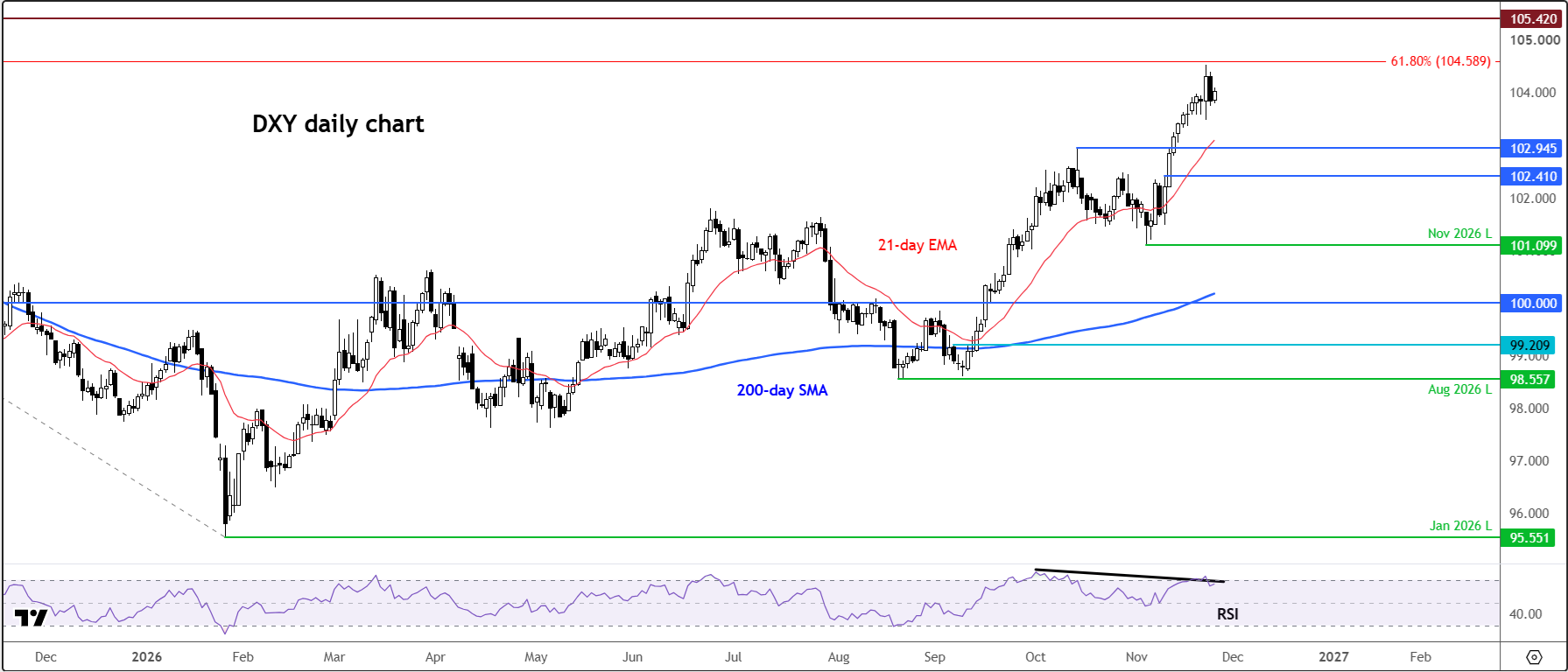
At the time of writing, the DXY was holding just above the 104.00 handle, having eased back from the multi-year high of 104.53 reached earlier this week. A stronger-than-expected inflation reading could bring that high back into view, with 105.00 likely to be the next important resistance area just above, followed by 105.42/45, an old support level. For now, the preference therefore remains for defensive currencies, particularly the US dollar, Japanese yen and Swiss franc, while the Australian and New Zealand dollars, alongside emerging-market currencies, are likely to remain vulnerable as long as the broader risk-off environment persists.
In terms of support levels to watch, 102.95 and 102.40ish were the previous resistance levels that were taken out during the current rally. These levels could turn into support upon re-test from above. The line in the sand is now at 101.10, marking the low prior to the latest rally, hit earlier this month. Bearish below that.


Comments
Log in or sign up to join the conversation.