


Photo by Joshua Hoehne on Unsplash
Equity markets were attempting to stabilise further earlier today, following the sharp rebound earlier this week. But we have just seen fresh weakness come back into markets—largely tied to a renewed upsurge in oil prices. This is continuing to keep markets in a cautious state and in an almost entirely headline-driven environment. Developments around the Middle East conflict and fluctuations in oil prices continue to dictate short-term direction. With the Federal Reserve and other central bank meetings also looming, it’s no surprise that traders are reluctant to take aggressive positions, favouring a more defensive stance in the interim. But make no mistake, it is energy prices that are calling all the shots right now. US index futures have turned lower along with a drop in European stocks after Brent crude oil prices surged to $105 per barrel.
Oil, Middle East and Market Resilience
There was a growing sense earlier this week that markets were trying to look beyond current geopolitical tensions. Comments from President Donald Trump suggesting a potential de-escalation had encouraged some optimism, particularly around the reopening of the key energy route of Strait of Hormuz. But today that tone has changed again, with Trump posting:
“I wonder what would happen if we “finished off” what’s left of the Iranian Terror State. And let the Countries that use it, we don’t, be responsible for the so called ‘Straight?’ That would get some of our non-responsive “Allies” in gears, and fast!!!”
Meanwhile, the Israeli Air Force struck the largest natural gas processing facility in Iran, located in the southwest of the country. The strike was carried out in coordination with and with the approval of the US, raising the possibility of even more retaliation from Iran and more volatility in the oil market.
So, that tentative optimism had helped underpin equities somewhat and prevented oil from breaking further higher, looks to have now faded. Brent is now well above the $100 mark at $105 at the time of writing. The resulting pullback in the US equity futures and the rally in the dollar also reflects expectations that supply disruptions may not ease so quickly and that the economic damage may well be as severe as initially feared.
But Trump could be doing another “TACO”, soon. That’s the only hope for markets right now and is partly why investors had bought the dip in US markets, causing the S&P 500 index to bounce back earlier this week.. With US allies refusing to join the fight, I wouldn’t be surprised if Trump ends the war sooner than expected. But now tensions are likely to persist or even escalate for a while. The risk is that oil prices remain elevated, which would likely weigh on equities.
Central Banks in Focus
Later today, attention shifts to the Federal Reserve and central banks in Europe tomorrow. The key question is whether they adopt a hawkish stance in response to higher oil prices or take a more cautious, wait-and-see approach given the uncertain geopolitical backdrop.
A hawkish tilt could cap equity upside by tightening financial conditions further. On the other hand, a more measured tone may provide short-term support for stocks, especially if inflation risks are seen as temporary.
S&P 500 technical analysis and levels to watch
From a technical point of view, the S&P 500 continues to trade within a broad consolidation range, but with a short-term bearish tilt. That said, despite persistent geopolitical risks, the market has avoided a deeper sell-off—suggesting underlying resilience and the potential formation of a base.
For the bullish case to gain traction, though, the index must reclaim a key resistance zone between 6,751 and 6,815. This area has been a major pivot point in recent months, acting alternately as support and resistance. A decisive daily close above this region would signal a shift in momentum and likely open the door for a stronger recovery.
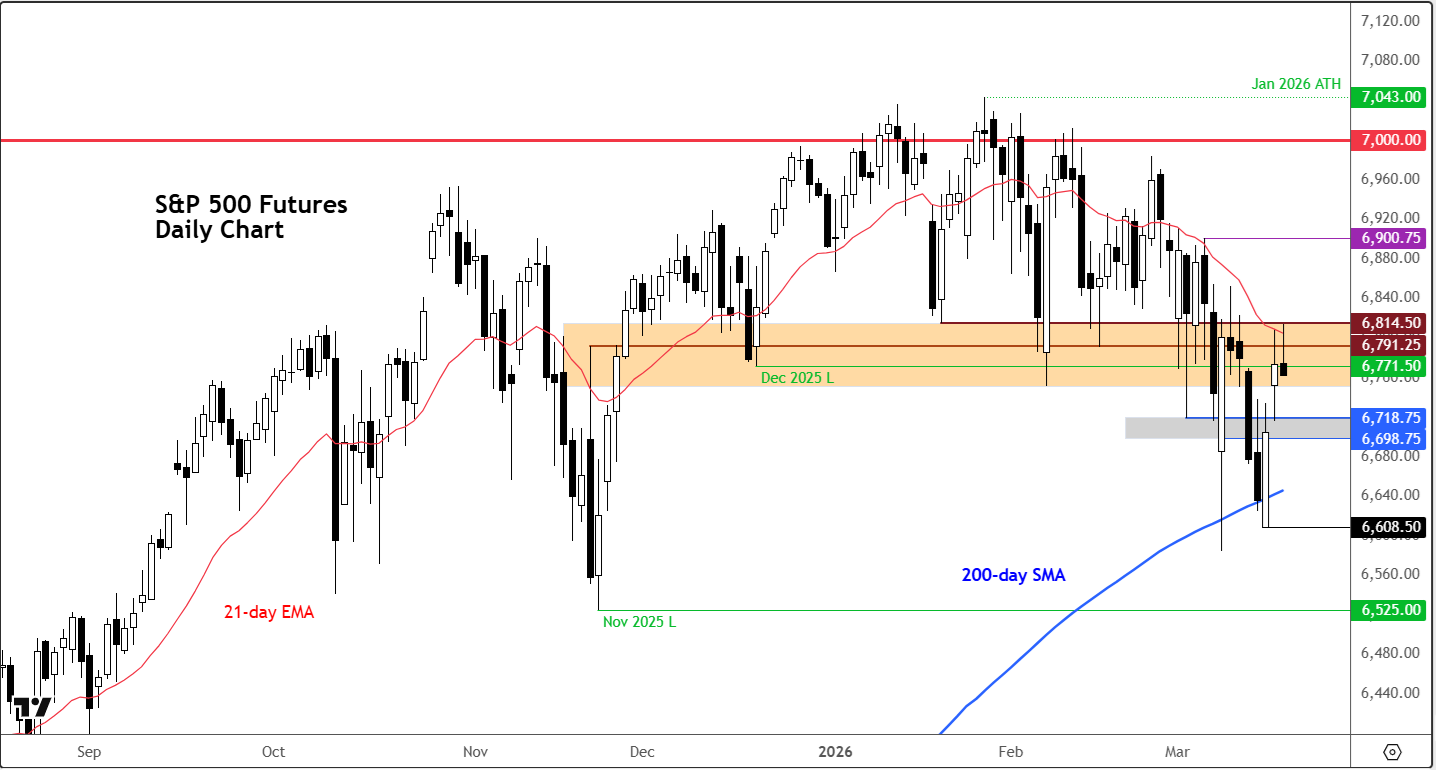
On the downside, initial support sits between 6,698 and 6,718. Holding this zone is critical to maintaining near-term bullish structure. Below that, the 200-day moving average—currently near 6,640—remains a key long-term support level and has already attracted buyers on multiple occasions.
A break below the 200-day average on a closing basis would be a notable shift in sentiment. A move below this would invalidate the recent recovery attempt and expose the index to further downside, potentially toward the November low near 6,525.
How to trade these headline-driven markets?
Overall, the market’s ability to hold steady despite elevated oil prices and geopolitical tensions points to underlying strength. While uncertainty remains high, particularly around the Strait of Hormuz and central bank policy, the lack of sustained selling pressure is notable. For now, the outlook leans cautiously bullish—but with a clear caveat: markets remain highly sensitive to headlines. Any meaningful shift in oil dynamics or geopolitical developments will likely dictate the next major move. With that in mind, it is essential to book profit when markets make it available, before moving onto next opportunities. Also, smaller position sizes and managing risk with extra care is the way to go.


Comments
Log in or sign up to join the conversation.