


US index futures fell along with European indices on Thursday morning. Yesterday’s intervention in the Treasury market suggests the recent rise in longer-dated yields had become increasingly difficult for policymakers to tolerate. The sharp pullback in yields helped trigger a broad rally across risk assets, although the relief has proved short-lived for global indices, unlike Bitcoin (BTC.X) (BTC) and gold (GLD). The fact that the S&P 500 (SPY) is failing to make new highs on the back of the Treasury’s move suggests the stock market remains more concerned about oil and sky-high valuations.
Yields have edged higher again today, while crude oil has extended its surge after Donald Trump vowed “economic warfare” against Iran and threatened financial penalties for countries supporting Tehran. The UAE has also said it is suspending trade with Iran. European equities and S&P 500 futures have consequently come under renewed pressure, highlighting the persistent concern that higher oil prices could feed back into inflation.
Yields rebound after yesterday’s plunge
Long-dated Treasury yields moved higher on Thursday morning after falling sharply in the previous session, following the Treasury Department’s decision to significantly increase its purchases of longer-dated government debt.
The decision to double its buybacks of long-dated Treasuries appears designed to address growing concerns around the long end of the curve, where borrowing costs have risen amid worries about the US debt trajectory and potential crowding-out effects from heavy corporate issuance, including by hyperscalers.
Treasury yields have risen sharply since June, reaching levels not seen since before the global financial crisis. The latest move comes as total US government debt has surpassed $40tn, more than double its level a decade ago.
The unscheduled announcement was a clear indication of the Treasury’s discomfort with the recent sell-off at the long end of the market. Ultimately, a more structural solution — particularly fiscal consolidation — would be needed to deliver a sustainable improvement in the bond market. But the message that the Treasury is prepared to be more active in managing conditions at the long end has nevertheless been welcomed by investors.
For now, the intervention appears to have done the trick. Lower yields have improved the appeal of higher-risk assets such as Bitcoin, while also supporting non-yielding assets such as gold. Equities have benefited too, helping to keep the AI trade alive for a little longer and providing some support to US indices.
The key risk, however, remains oil prices, which continue to press higher.
Crude oil extends surge
Crude oil prices rose more than 2% after Trump said Iran had been given an opportunity to reach a deal but had failed to take it. He subsequently announced what he described as an unprecedented economic operation against Iran, warning of severe economic consequences for countries providing support to Tehran.
The latest escalation pushes the prospect of a renewed ceasefire or diplomatic agreement further out of reach, while raising the risk of continued disruption to energy supplies.
While the softness in US and Chinese data of late does point to some moderation in demand, oil prices remain predominantly supply-driven. Crude oil is largely demand inelastic anyway, meaning buying stays strong when prices go up and down. Demand only gets disrupted when prices go up by significant amounts and stay elevated. I am not sure the current prices of around $85-$95 fit that bill. Unless the Strait of Hormuz re-opens, I just can’t see how oil prices will fall back meaningfully in the near-term.
For markets more broadly, that is the problem. The Treasury intervention may have bought some breathing room for bonds and risk assets, but a sustained rise in crude could quickly undermine that relief by putting renewed upward pressure on inflation and yields.
S&P 500 technical analysis and levels to watch
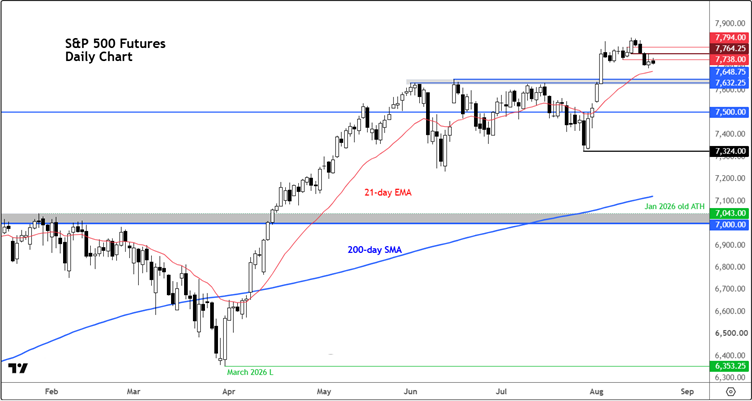
The S&P has created some short-term bearish price action lately, although the longer-term support levels still remain intact. Resistance is seen around 7738 and then at 7764, followed by 7794 on the S&P 500 futures. These levels were previously support. If the selling gathers pace, we could see the index dip down to the old all-time highs near the 7632 to 7648 range. Below that, there is not much until 7500, the psychologically important level.


Comments
Log in or sign up to join the conversation.