

Why Are Wall Street Banks Divided on the S&P 500 Outlook 2027?
The S&P 500 outlook 2027 is becoming a major debate among institutional investors. While UBS and Goldman Sachs expect further gains, Panmure Liberum warns that higher interest rates, expensive valuations and slowing AI investment could trigger a substantial market correction.
The difference between an optimistic 8,900 target and a bearish 5,000 forecast highlights how uncertain the next phase of the US equity bull market could be.
UBS and Goldman Sachs Lead the Bullish S&P 500 Target 2027 Forecasts
UBS maintained its S&P 500 year-end forecast 2027 at 8,900 on November 10, implying approximately 17.7% upside from the November 13 closing price of 7,561.67.
UBS strategist Keith Parker expects earnings growth and a recovery in investor confidence to support equities. The bank forecasts S&P 500 earnings per share (EPS) of $430 in 2027, representing 18% growth, followed by $490 in 2028.
Meanwhile, the Goldman Sachs S&P 500 forecast 2027 places the index at 8,700 over the next 12 months, implying approximately 15.1% upside from the November 13 close.
Goldman expects US earnings growth to slow from 36% in 2026 to 11% in 2027. However, it believes improving valuations, economic growth and potentially lower borrowing costs could support further gains. he said,
"From here, we expect equities to generate positive returns, albeit with higher volatility than in recent years,"
Other institutional forecasts are similarly optimistic:
Barclays: 8,800 by year-end 2027.
Wells Fargo Investment Institute: 8,600 to 8,800 by year-end 2027.
These targets suggest that major institutions generally expect the broader US equity market to extend its advance, although their forecast periods and assumptions differ.
Panmure Liberum Warns of a Bearish 5,000 Target
Not every investment bank expects the S&P 500 to continue climbing.
Panmure Liberum research analyst Joachim Klement forecasts the index could fall to 5,000 by the end of 2027, representing approximately 33.9% downside from its November 13 close.
His bearish outlook reflects concerns about persistent inflation, elevated bond yields and the possibility that the AI investment boom could lose momentum.
The concern is particularly relevant because technology companies have contributed significantly to recent index gains.
According to Reuters report, quoted Klement:
Joachim Klement said,
"If we keep seeing higher bond yields and interest rates..."
He warned that continued monetary tightening could bring the current equity bull market closer to its end.
The bearish forecast stands in sharp contrast to UBS's 8,900 target, illustrating the uncertainty surrounding the S&P 500 prediction 2027.
S&P 500 EPS 2027 Forecast: Earnings Growth Remains Critical
Corporate earnings will be one of the biggest drivers of the S&P 500's performance in 2027.
EPS, or earnings per share, measures how much profit a company generates for each outstanding share. For the S&P 500, aggregate earnings growth helps investors assess whether higher index valuations are supported by corporate profitability.
UBS expects index EPS to reach $430 in 2027, representing 18% annual growth.
Goldman Sachs, meanwhile, expects US earnings growth to slow to 11% in 2027 from 36% in 2026.
This difference matters because slower earnings growth could limit further valuation expansion, even if companies remain profitable.
The price-to-earnings (P/E) ratio, which measures how much investors pay for each dollar of earnings, also plays an important role.
UBS strategist Keith Parker noted that the S&P 500's forward P/E ratio declined approximately 20% during 2026, despite strong earnings growth.
UBS argues that this valuation adjustment could create room for further gains. However, Goldman warns that slowing AI capital expenditure could affect technology-related earnings and increase market volatility.
AI Investment and Treasury Yields Could Determine the Market Direction
Artificial intelligence investment and interest rates remain two major variables behind the competing S&P 500 year-end forecast 2027 scenarios.
Goldman Sachs expects AI capital expenditure growth to peak, potentially slowing earnings momentum among companies benefiting from data-centre and semiconductor spending.
UBS also identifies slowing AI investment and another increase in Treasury yields as major downside risks.
Higher bond yields can make equities less attractive because investors receive better returns from government securities. They can also reduce the present value of future corporate earnings, putting additional pressure on growth-stock valuations.
The US 10-year Treasury yield stood at 5.143% on November 16, 2026, according to Reuters-reported market data.
Goldman Sachs Chief Global Equity Strategist Peter Oppenheimer highlighted the changing risk environment.
Oppenheimer said in Goldman's 2027 outlook, reported November 13:
"Risks are becoming more two-sided."
Technical Indicators: What the SP500 Chart Says?
The S&P 500 closed at 7,561.67 on November 13, 2026, below its November 12 high of 7,652.76. The recent trading structure indicates short-term weakness, although the index remains within its broader 2026 advance. A sustained move above recent resistance could improve momentum, while a break below November's support levels could expose further downside.
Resistance: 7,621.78 and 7,652.76.
Support: 7,499.40 and 7,470.43.
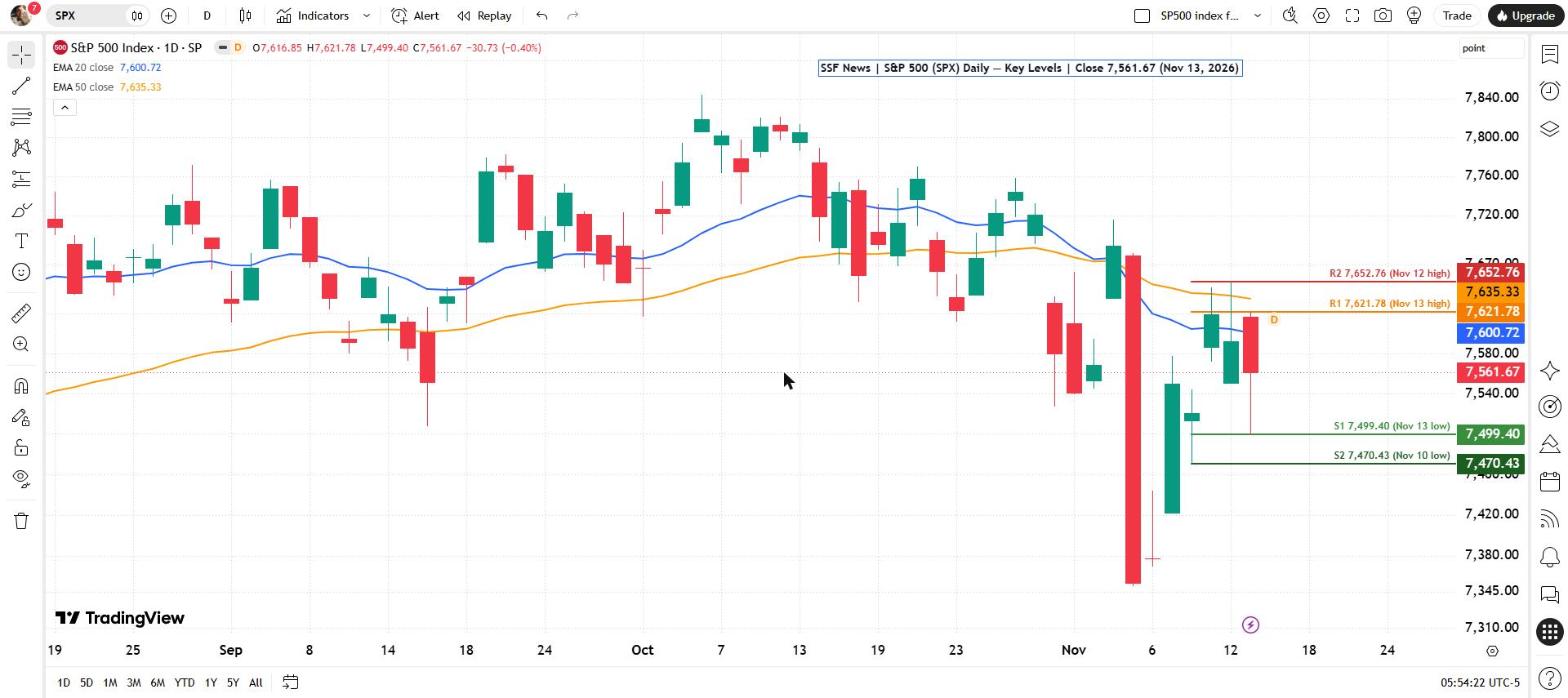
S&P 500 (SPX) daily chart, mid-August to November 13, 2026 (TradingView). The index closed at 7,561.67 on November 13 after a sharp sell-off to 7,350.35 on November 5 and a partial rebound.
Price sits below the 20-day EMA (7,600.72, blue) and 50-day EMA (7,635.33, orange). Both averages have turned lower since the early-October peak, when the index set its 52-week high of 7,844.52.
Resistance is marked at 7,621.78 (November 13 high) and 7,652.76 (November 12 high).
Support is marked at 7,499.40 (November 13 low) and 7,470.43 (November 10 low). November 13’s long lower wick shows buyers stepping in near 7,500 before the close.
Why is the stock market down today?
US stocks are facing pressure from concerns about elevated Treasury yields, slowing AI investment growth, corporate earnings expectations and uncertainty surrounding Federal Reserve policy. Higher bond yields can make equities less attractive, particularly high-valuation technology stocks.
Is a recession coming in the US in 2028?
A US recession in 2028 is possible but not confirmed or inevitable. Slower corporate earnings growth, persistent inflation, higher borrowing costs and weaker consumer spending could increase recession risks. However, investors should monitor employment, GDP growth and consumer demand before drawing conclusions.


Comments
Log in or sign up to join the conversation.