


Why is NZD/USD falling?
NZD/USD is falling primarily because of US dollar strength, driven by higher US inflation and growing expectations of a Federal Reserve interest rate increase. Weak global risk sentiment and limited support from New Zealand economic data have added to the Kiwi's decline.
Hawkish Fed Expectations Push the US Dollar Higher
The strengthening US dollar is the primary driver behind the NZD/USD decline.
The US Dollar Index (DXY), which measures the dollar against a basket of six major currencies, climbed to 103.69 on Tuesday, its highest level in 19 months, before easing slightly.
The rally followed hotter-than-expected US inflation data released on November 10. US consumer prices increased by 0.4% in October, exceeding the 0.3% forecast. Core inflation, which excludes food and energy prices, also rose 0.3%, above the 0.2% estimate.
These figures reinforced expectations that the Federal Reserve could raise interest rates at its December meeting.
According to market pricing, traders see roughly a 95% probability of a 25-basis-point rate increase. Expectations of tighter US monetary policy have made dollar-denominated assets more attractive, supporting demand for the Greenback.
Higher US interest rates can also increase the opportunity cost of holding currencies with less attractive yields, putting additional pressure on NZD/USD.
RBNZ Inflation Expectations Rise, but Offer Little Support to the Kiwi
New Zealand's latest inflation expectations data provided limited support for its currency.
The Reserve Bank of New Zealand's fourth-quarter Survey of Expectations showed one-year inflation expectations rising to 2.92% from 2.60% in the previous quarter.
However, the closely watched two-year inflation expectations measure increased only slightly, reaching 2.36% compared with 2.34% in the third quarter. Five-year inflation expectations also declined to 2.17% from 2.31%.
The mixed figures have done little to change the broader outlook for New Zealand monetary policy.
The RBNZ previously kept its Official Cash Rate (OCR) unchanged at 2.75% on October 28, following a closely divided 4-3 vote.
Although markets are considering the possibility of another rate increase, expectations of more aggressive Fed tightening have kept the US dollar in a stronger position.
The difference between the two central banks' monetary policy outlooks remains an important factor for NZD/USD traders.
AI Stock Selloff Hits Risk-Sensitive Currencies
Beyond monetary policy, deteriorating market sentiment is contributing to the Kiwi's decline.
A sell-off in global technology and AI-related stocks has reduced investor appetite for riskier assets. Concerns about AI investment valuations and uncertainty ahead of major technology earnings have encouraged investors to move toward safer assets.
The New Zealand dollar is considered a risk-sensitive currency because its performance is often influenced by global economic growth expectations and investor confidence.
When markets become more cautious, demand for safe-haven currencies such as the US dollar can increase. This creates additional selling pressure on NZD/USD.
The combination of dollar strength and weaker risk appetite has contributed to the pair's sixth consecutive daily decline.
CBA economist and currency strategist Carol Kong said in comments to Reuters,
"Continued AI-related capital inflows and expectations of faster Fed tightening should support the USD."
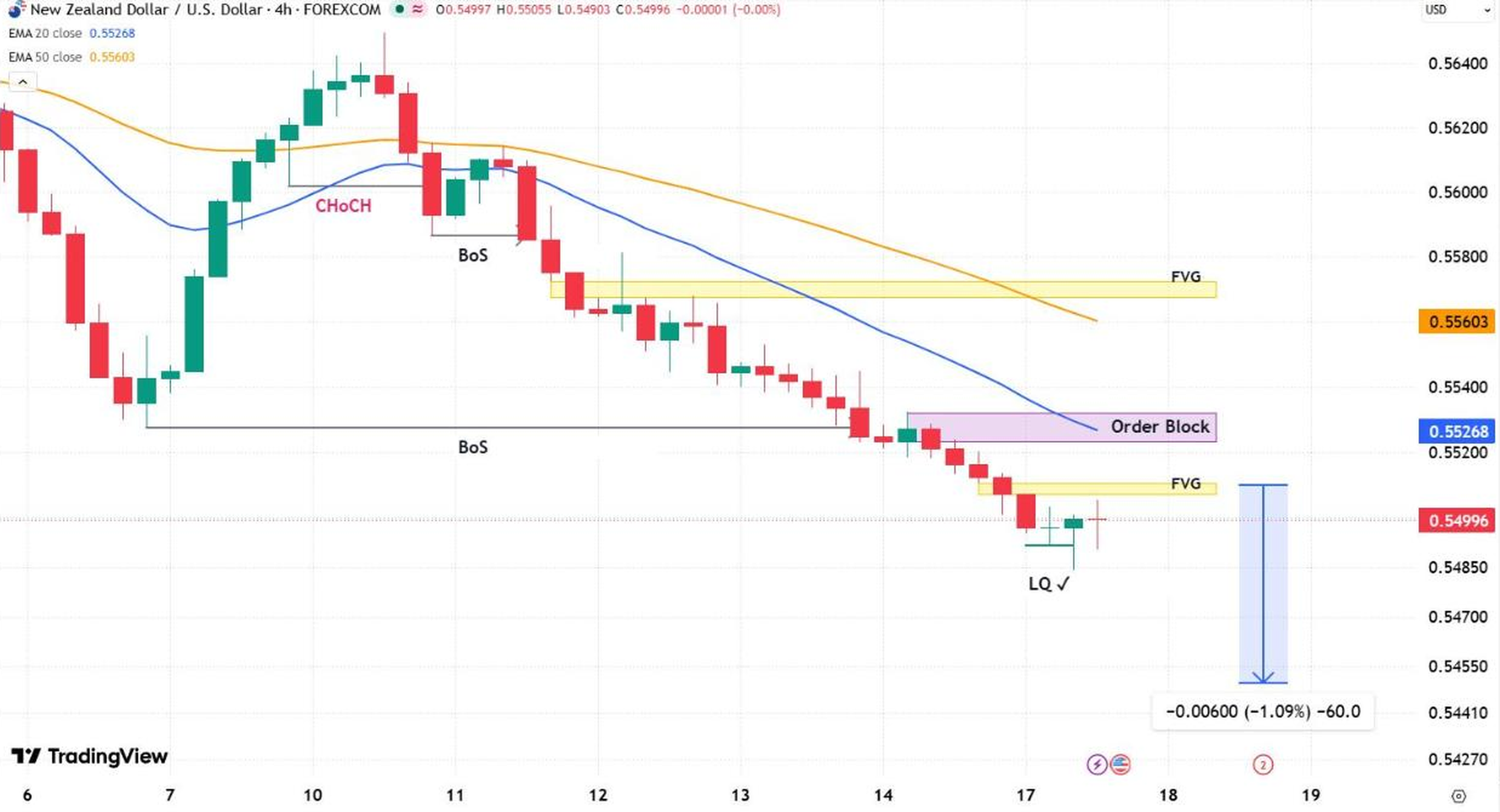
NZD/USD Technical Analysis: Can the Kiwi Hold 0.5485 Support?
NZD/USD remains firmly bearish on the daily chart, with sellers maintaining control of the broader price trend.
The pair is trading below both its 20-day and 50-day exponential moving averages (EMAs), indicating persistent downside momentum.
The 20-day EMA stands near 0.5585, while the 50-day EMA is around 0.5649. These levels could act as resistance during any short-term recovery.
The 14-day Relative Strength Index (RSI) is hovering around 33.8, approaching the oversold threshold of 30.
Although selling momentum remains strong, the RSI reading suggests that the pair is getting closer to oversold territory. This means a temporary recovery is possible, even if the broader bearish trend remains intact.
Key NZD/USD Levels to Watch
Resistance: 0.5530, 0.5585
Support: 0.5485, 0.5450
NZD/USD Forecast: What Should Traders Watch Next?
The near-term NZD/USD outlook remains bearish as long as the US dollar maintains its strength and the pair trades below its key moving averages.
However, upcoming US economic data could influence expectations for the Federal Reserve's December policy decision and trigger short-term volatility.
Warning: high-impact event ahead.
US Retail Sales for October are due today at 8:30 a.m. ET. Forecast: +0.2%. Previous: +0.8%. A strong reading could add fresh pressure on NZD/USD.
What affects the New Zealand dollar against the US dollar?
The NZD/USD exchange rate is influenced by interest rate expectations from the Federal Reserve and RBNZ, US and New Zealand economic data, global risk sentiment, commodity market conditions and international capital flows.
Will NZD/USD go up or down?
The near-term NZD/USD outlook remains bearish while the pair trades below its key moving averages. However, a weaker US economic report or improving global risk sentiment could trigger a temporary recover.
What is the next support level for NZD/USD?
The immediate support is around 0.5485. If sellers push the pair below this level and sustain the breakdown, the next potential downside target is 0.5450.



Comments
Log in or sign up to join the conversation.