


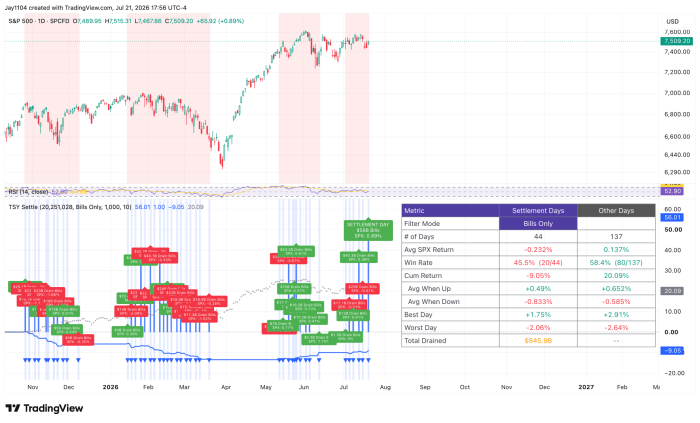
The S&P 500 rose today, making it an outlier relative to our normal Treasury settlement data. In fact, today’s gain of 89 basis points was nearly double the average gain on an up T-bill settlement day, which is just 49 basis points.
So, we know it doesn’t work every time, and clearly a stock like Micron (MU) rising 12% is going to skew the results. The data is the data, and whether it works consistently does not change the historical record. That said, the sample size is relatively small.
I have been posting and writing about this regularly, and I am comfortable saying that today was an outlier.
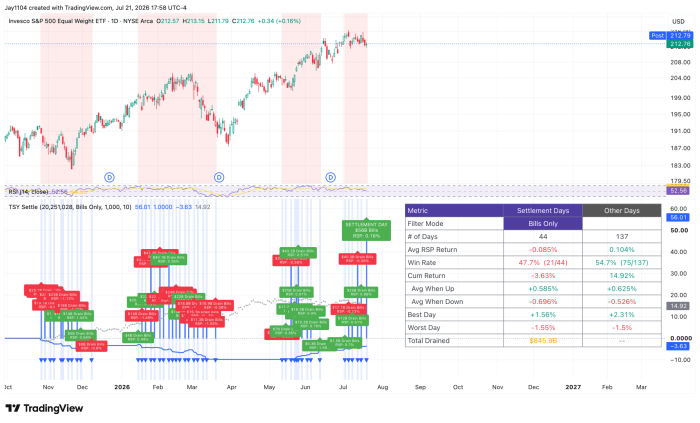
It was not a great day for the RSP, which rose by just 16 basis points. The divergence between the equal-weight S&P 500 and the market-cap-weighted S&P 500 highlights the impact that Micron and the semiconductor sector had on the broader index today.
The RSP’s performance was more in line with what one would have expected based on the historical Treasury settlement data.
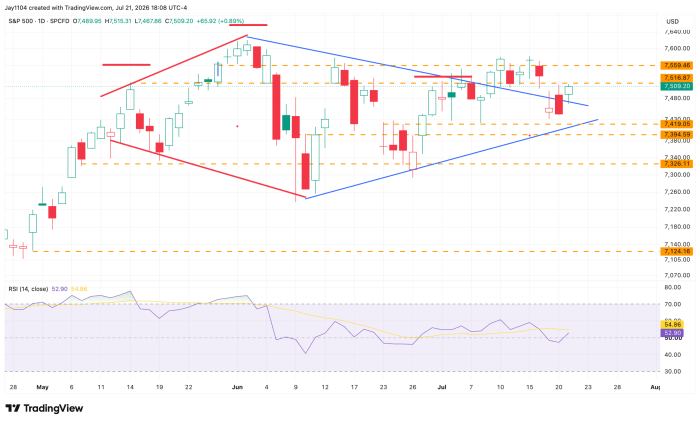
Technically, the index just managed to close the gap from Friday’s decline. Now, however, it has created a similar gap up ahead of today’s rally, suggesting the potential for a pullback and retracement toward yesterday’s close at 7,443.
The 7,515 region has also served as an important support and resistance level since mid-May. The index will likely need to gap higher tomorrow and break above that resistance level to sustain the rally and have a chance of returning to its recent highs.
However, given the historical statistics and the significant amount of liquidity leaving the market, today’s move appears more likely to have been a bounce following Friday’s and Monday’s weak performances than the start of a sustained advance.
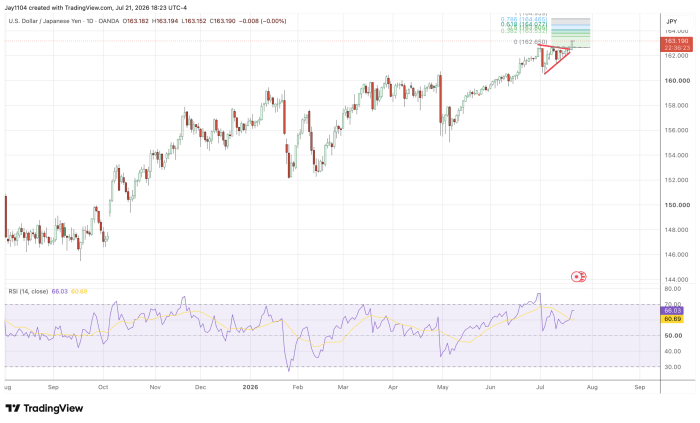
The spread between U.S. Treasuries and Japanese government bonds (JGBs) is widening again, with the five-year spread trending higher since mid-April. That widening rate differential has been one of the key factors putting downward pressure on the yen.
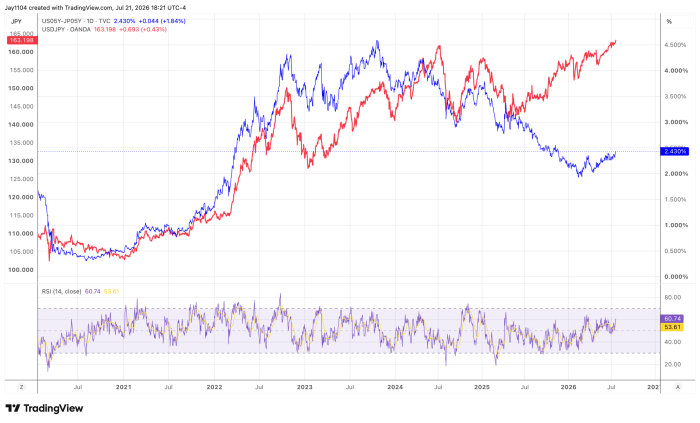
USD/JPY broke out today, finally pushing above the upper boundary of the triangle and rising to 163.18. Based on a measured move from the height of the triangle, a move toward 165 appears to be a reasonable technical target.
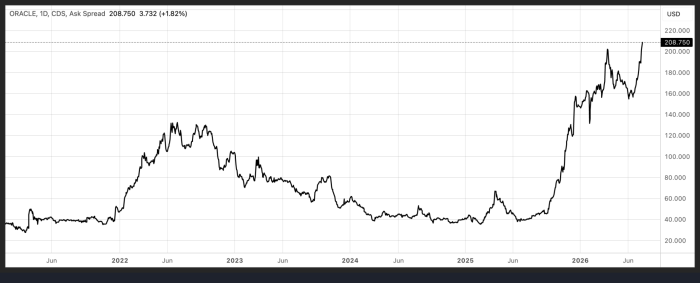
Finally, Oracle (ORCL)’s five-year CDS spread rose to 208.75 today, implying a cumulative five-year default probability of roughly 15.6%. That is a meaningful level, which is why I was somewhat surprised to see the stock finish the day up nearly 5%.
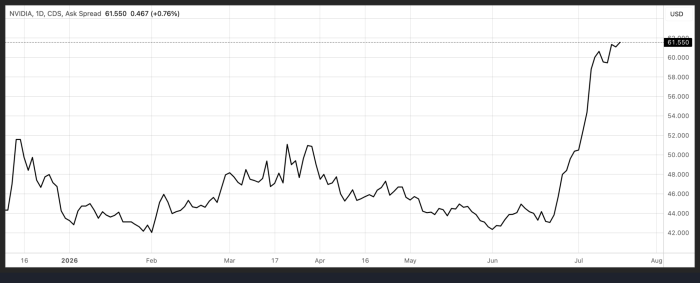
Nvidia (NVDA)’s five-year CDS spread rose slightly today to 61.55, implying a cumulative five-year default probability of roughly 4.8%. That seems remarkably high for the world’s most valuable company and one that continues to generate enormous amounts of cash. I don’t have an explanation for it, but it suggests the credit market is pricing in risks that aren’t yet reflected in the equity market.


Comments
Log in or sign up to join the conversation.