

Financial markets remain trapped in a familiar pattern: every tentative sign of diplomatic progress between Washington and Tehran is quickly offset by fresh military escalation. The result is another week of uncertainty, choppy price action in oil markets, and rising worries about inflation. While US core PCE inflation data is due later today, it is unlikely to dislodge the Middle East from centre stage. The question remains, though, whether US stock markets will continue to ignore these concerns, or will the resilience finally ware off.
Tensions flare again in the Gulf
Hopes of a near-term breakthrough in US-Iran negotiations deteriorated overnight following another round of military incidents and increasingly confrontational rhetoric from both sides. Oil prices rose again, although they were off their earlier highs.
US officials said American forces conducted fresh strikes on an Iranian military installation and intercepted several drones deemed a threat to military assets and commercial shipping near the Strait of Hormuz. Tehran responded swiftly, claiming responsibility for targeting a US air base, describing the move as retaliation for American operations near Bandar Abbas airport. Iranian officials also warned that any additional US action would provoke a “more decisive” response.
Oil markets reacted predictably. Brent crude pushed higher after reports of explosions near Bandar Abbas, reinforcing concerns that disruptions to Gulf shipping routes remain a credible risk.
Technical analysis: No reversal signs yet but market is looking overstretched
From a technical standpoint, the broader direction for US indices remains upward for now. Yet after weeks of near one-way gains, the S&P 500 chart is beginning to show signs of fatigue, which, combined with a lack of any breakthrough in the Middle East situation, does raise the risks of a correction. Valuations and positioning alike also appear increasingly stretched over the short term.
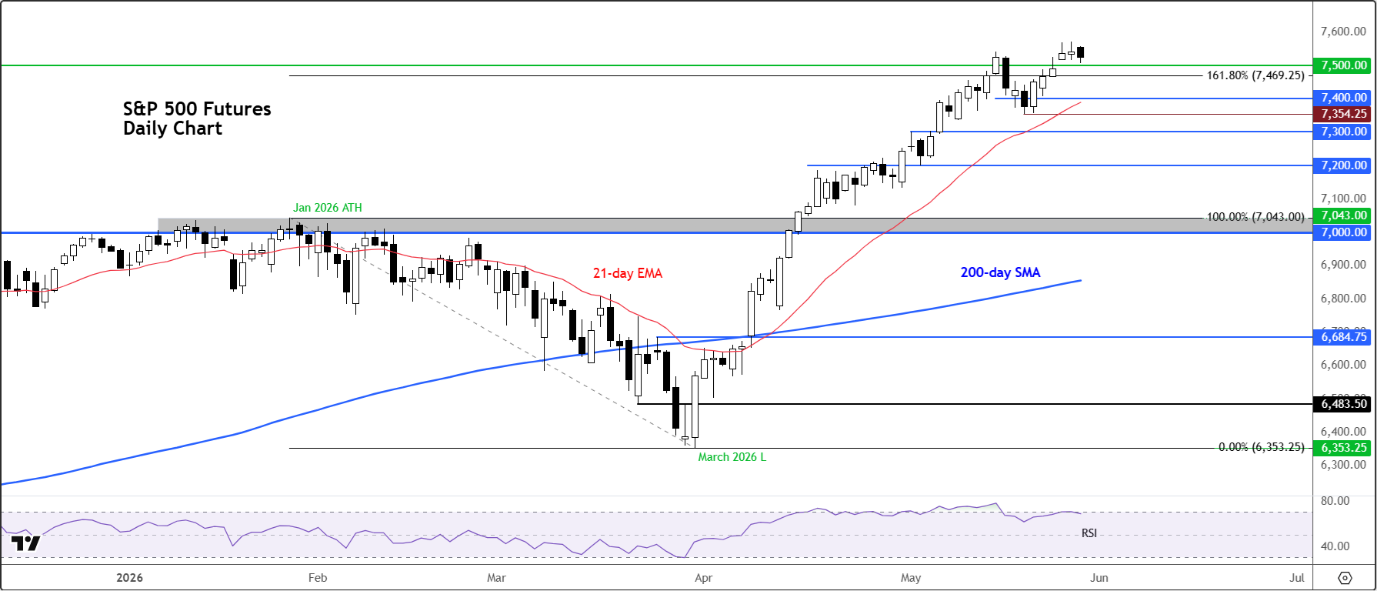
To some extent, that process may already be underway. S&P 500 futures have spent much of the past couple of weeks trading broadly around similar levels before edging to a new all-time high this week. We did see a pause around the 7,500 level as I had anticipated, before the upward trend resumed. The next question is whether this latest move higher develops into a more sustained rally, or whether it quickly fades into to a cooling-off period. Much will depend on the behaviour of oil prices and US Treasury yields, both of which remain closely tied to developments in the Middle East.
Technically, the rally that begun at the end of March has now extended well into territories where profit-taking becomes increasingly understandable.
Key levels to watch on ES
The futures contract has now moved above the 161.8% Fibonacci extension of the sell-off that began in late January and bottomed toward the end of March. That projection lies near the 7,470 area and we have already seen some profit-taking around there in the last couple of weeks. While the index is now above it, and moving past the 7,500, there is not much in the way of fresh stimulus measures to keep the market moving higher. So, I would expect some choppy price action, especially around this time of the year.
For now, though, the market is holding together reasonably well. Initial support sits around the psychologically important 7,500 level, followed by 7,400, an area that has so far absorbed mild selling pressure.
However, a more decisive break lower — particularly beneath the recent trough near 7,354 — could leave the market vulnerable to a deeper retracement towards 7,200 or lower.
Longer term, the more substantial support zone remains much lower, between 7,000 and 7,043 — effectively the area around the previous all-time highs established earlier in the year.
Reaching those levels would likely require a much sharper deterioration in the macro backdrop. In practical terms, that probably means renewed escalation between the US and Iran, accompanied by another leg higher in oil prices and bond yields. Until then, dips may continue to attract buyers given the resilience that has characterised this rally so far.
On the topside, the technical landscape remains relatively open. Beyond this week’s record high, the next round handles like 7,600 and 7,700 should be watched closely.
Meanwhile, the RSI is in a state of negative divergence, making a lower high at overbought levels of around 70, despite the underlying index making a higher high. This divergence points at potentially weakening of the rally.
For now, though, there is little evidence of any material breakdown in trend dynamics. Any near-term weakness may therefore prove relatively shallow unless accompanied by clearer deterioration in broader market momentum and macro conditions.



Comments
Log in or sign up to join the conversation.