


SiTime (SITM) operates in a highly specialized corner of the semiconductor industry: precision timing. Every electronic device, from a digital watch to a massive artificial intelligence server cluster, needs a "heartbeat" to synchronize data transfer.
For over 70 years, quartz crystals provided this heartbeat. SiTime recognized quartz's physical limits and engineered a silicon-based alternative using Micro-Electro-Mechanical Systems (MEMS).
As data speeds increase and devices shrink, the legacy quartz infrastructure is increasingly outdated. SiTime has capitalized on this transition, securing a dominant market share in MEMS timing and cementing its technology in the fastest-growing sectors of the global economy.
SiTime divides its business segments based on end markets:
Communications, Enterprise, and Data Center (CED): The highest-margin segment, covering 5G infrastructure, telecom networking, and high-performance computing.
Automotive, Industrial, and Aerospace: Covering rugged, high-reliability applications like autonomous driving sensors, factory automation, and satellite communications.
Mobile, IoT, and Consumer: Covering smartphones, wearables, and smart home devices. While this is the highest volume segment, it traditionally carries the lowest average selling prices (ASPs).
AI inference deployments require two to four times more timing content than the original AI training systems. When thousands of GPUs are strung together to process a large language model, synchronization must be perfect. If the timing is off by fractions of a nanosecond, data bottlenecks occur, latency spikes, and the expensive GPUs sit idle waiting for data.
To solve this, the industry is transitioning to ultra-high-speed 800G and upcoming 1.6-terabit optical modules. These optical transceivers convert electrical signals into light, moving massive amounts of data across the data center. Pushing data at 1.6 terabits per second requires extreme precision, and SiTime's Elite series products have captured roughly 80% market share in AI data center timing.
The Numbers
SiTime is executing very well and driving solid financial performance for investors. Revenue in the second quarter of 2026 reached $157.4 million, up 127% year over year. Not only is the company growing strongly, but it is also accelerating versus prior quarters.
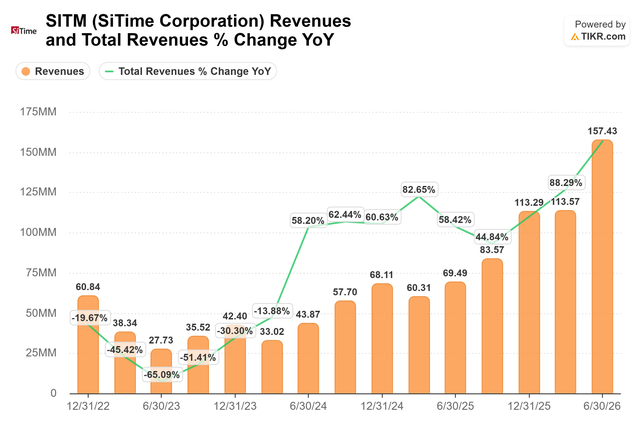
This is not a "growth at all costs" company but rather a solidly profitable business making positive cash flows and even positive earnings on a GAAP basis. Operating income was $53.5 million last quarter, representing 34% of revenue versus an operating margin of 10% of revenue in the same quarter during the prior year.
All of the company's business segments are firing on all cylinders.
Enterprise and Data Center revenue was $101.2 million, up 181% year over year and up 34% sequentially. This is driven by expanding demand for precision timing across AI infrastructure.
Automotive, Industrial, and Aerospace & Defense revenue was $24.8 million, up 51% year over year and 18% sequentially.
Mobile IoT and Consumer revenue was $31.4 million, up 85% year-over-year and 89% sequentially.
Management was decisively bullish on the conference call:
Now that many customers are placing orders 12 to 18 months in advance, our visibility into 2027 continues to improve.
SiTime is also benefiting from strong tailwinds as AI moves beyond data centers and into personal devices, drones, cars, and even humanoid robots. Positional accuracy is crucial for all kinds of autonomous vehicles, including not only cars but also agricultural and heavy equipment in industrial applications.
Key Risks To The Thesis
SiTime is a relatively small company operating in a very dynamic environment, so risk and volatility need to be carefully assessed. SiTime has always had a close relationship with Apple (AAPL); this offers important advantages, but it also makes SiTime vulnerable to any decision Apple makes about sourcing its NEMS components. Diversification into the CED data center is rapidly diluting this risk for SiTime, but it is still an important factor to keep in mind.
The fabless business model is crucial for companies like SiTime for both strategic viability and profitability, but it also creates supply chain risks. If any of the company's suppliers experience a facility outage, geopolitical/military disruptions, or management simply decides to prioritize other customers, this could be problematic for SiTime, at least in the short term until the company can find a workaround.
The semiconductor industry has always been cyclical, and that won't change. At the present time, demand is being driven by exponential growth from the data center buildout, and this trend looks stronger than ever over the coming quarters. However, it is a source of volatility for SiTime and other companies in the industry.
In fact, rising interest rates over recent months have created substantial volatility across the AI ecosystem. This does not affect SiTime too directly from a fundamental point of view, but AI infrastructure companies tend to be positively correlated and often trade in tandem based on macro considerations. In times of market fears about AI, I would fully expect SiTime stock to feel the pressure.
Valuation And Catalysts
SiTime is still a relatively young and undercovered company, with a market capitalization below $15 billion. The valuation levels reflect high-growth expectations, but they are not excessive if the company keeps delivering.
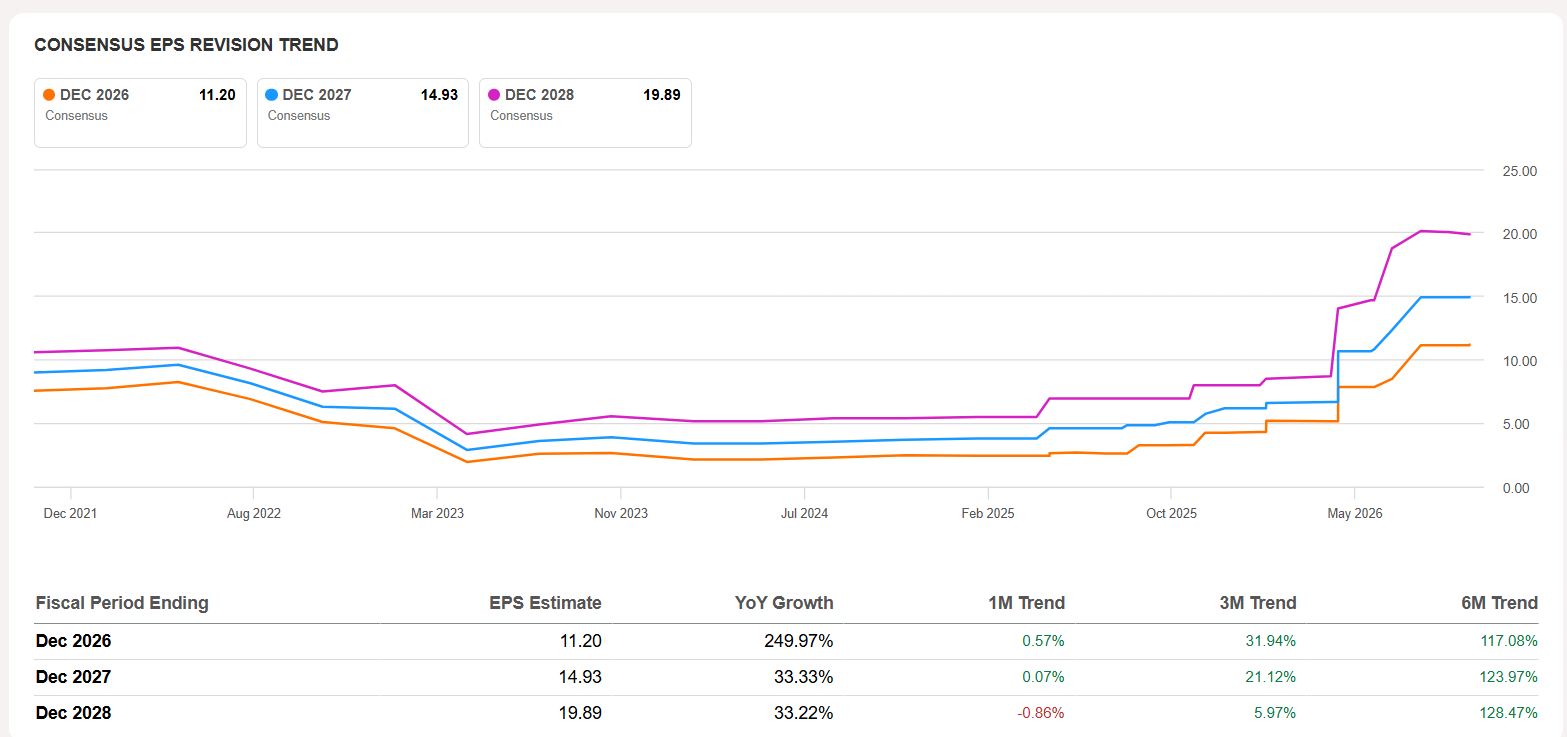
SiTime is currently trading at a forward PE ratio of 33.3 versus earnings expectations in 2027, with earnings per share expected to grow 33.3% next year. A Price to Earnings Growth ratio below 1 is more than reasonable for a company that still has a huge runway for growth ahead of it.
Fiscal Period Ending | EPS Estimate | YoY Growth | Forward PE |
|---|---|---|---|
Dec 2026 | 11.20 | 249.97% | 44.39 |
Dec 2027 | 14.93 | 33.33% | 33.29 |
Dec 2028 | 19.89 | 33.22% | 24.99 |
Data Source: Seeking Alpha
Even more important for a young company like SiTime, earnings estimates for the years ahead are rising as Wall Street analysts adjust projections in response to evidence of both customer demand and management execution. For a young company like SiTime, the trend in earnings revisions can matter more than the price-to-earnings ratio.
Over the long term, the stock price will flow in the same direction as earnings, and a relatively small company with strongly rising earnings growth can deliver particularly vigorous returns for investors over the long term. Especially
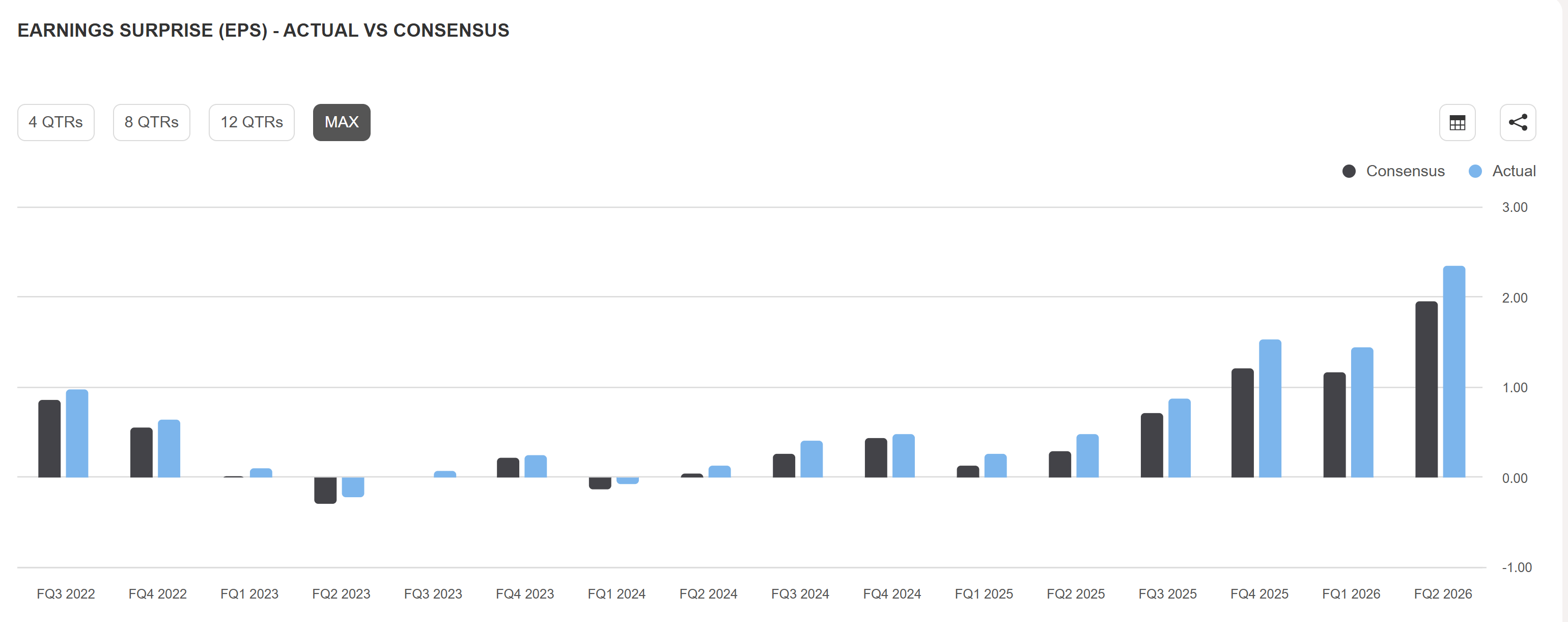
This is even more the case when earnings are not only growing strongly but also outperforming expectations. SiTime has consistently delivered earnings numbers above forecasts, which reflects that management likes to underpromise and overdeliver.
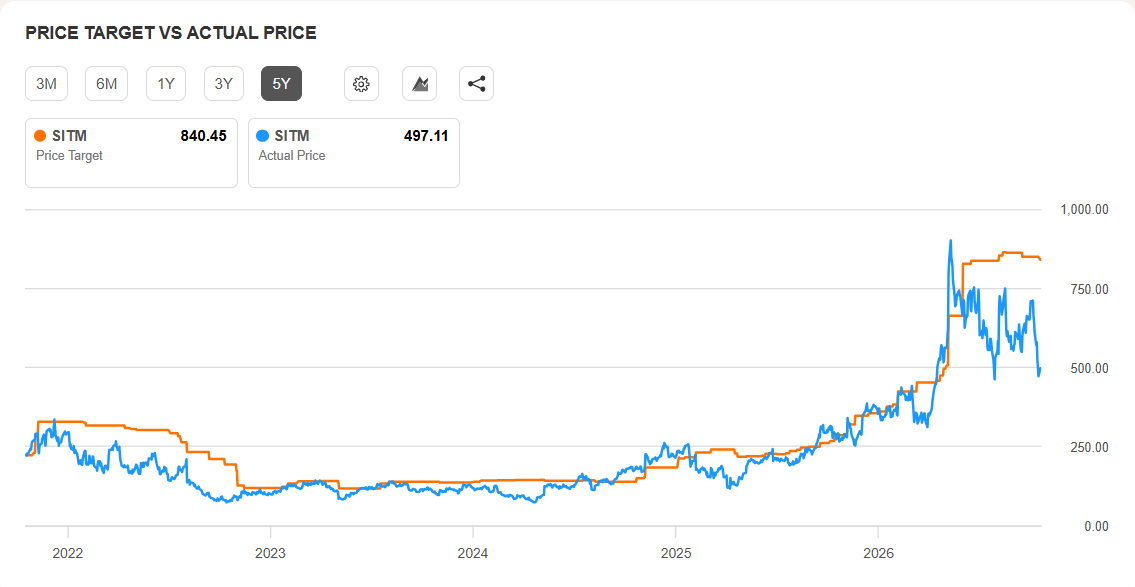
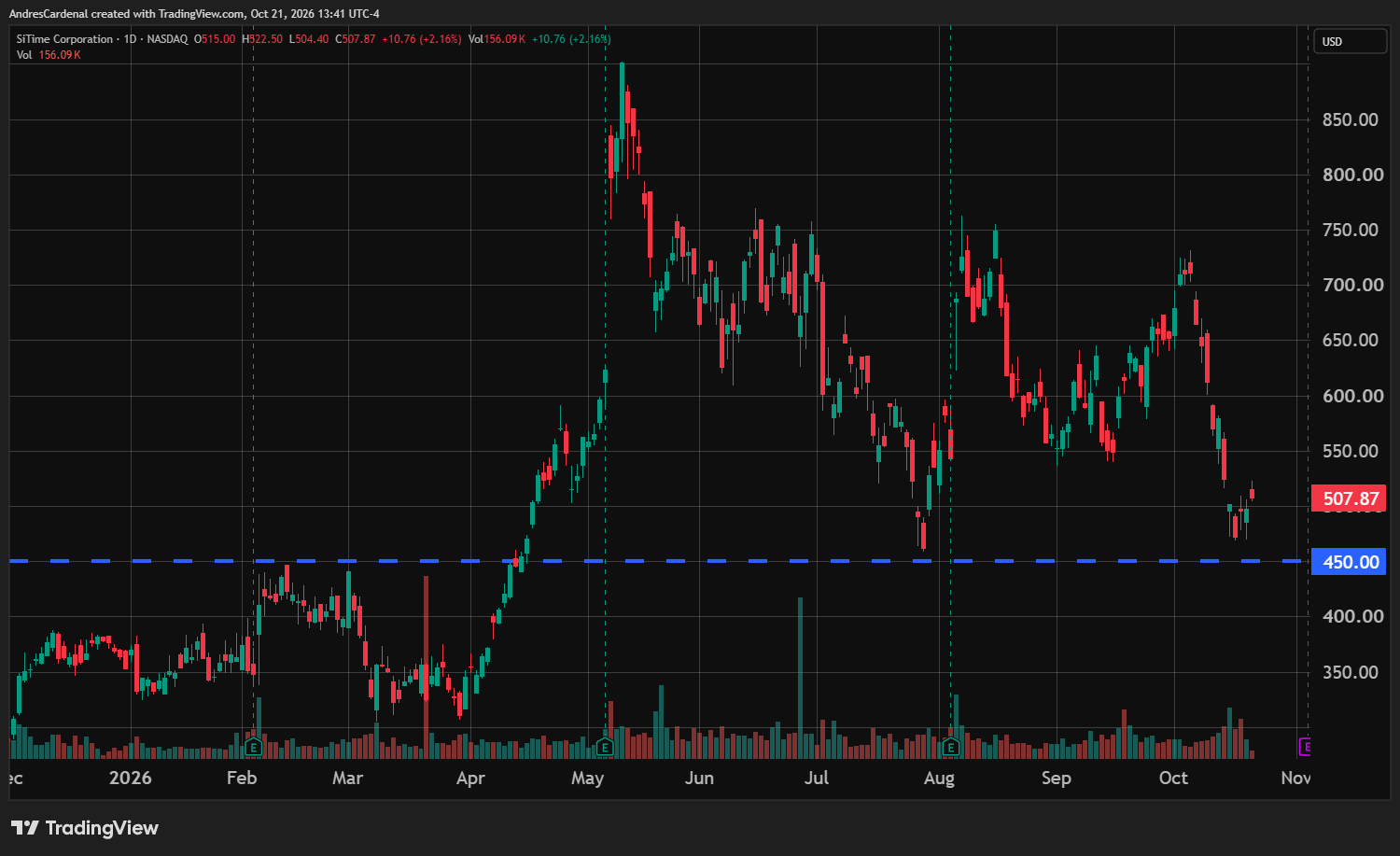
The average Wall Street price target for SiTime stands at $840.45, implying almost 65% upside from the current stock price. Notably, the fundamentally driven valuation target has not changed, but the stock price has pulled back materially in recent weeks. This is a classic example of a stock pulling back in price due to macroeconomic concerns while the business-specific fundamentals remain stronger than ever.
SiTime is scheduled to report earnings on Wednesday, November 4, 2026, and the report should provide some valuable insights for investors trying to assess the main trends in AI and data center demand.
Interestingly, the most recent earnings report from SpaceX (SPCX) provided some notably bullish perspectives on this front. In the words of Elon Musk during the SpaceX conference call:
Our belief is that the value of compute per watt will increase over time, not decrease. And the reason for that, I think it should be obvious to people really, is that as you improve the AI software, as the models get better and better, they're able to -- you get more useful intelligence per watt. And the value of that compute is proportionate to the useful intelligence per watt. And that's why you see things like even old computers like H100s renting for more than they rented when they were new. And I think that's likely to continue.
I think we're going to face a shortage of super intelligence compute. And that shortage is going to remain for a long time.
And also, if you look at, say, how are our short-term contracts renewing? Are they renewing at higher dollars per watt or lower? And we see them renewing at higher dollars per watt, not lower dollars per watt. We are also, frankly, hounded relentlessly by every hyperscaler and by dozens of smaller companies to rent more of our compute. So we could rent out our compute several times over if we said yes to everyone.
Precision timing is absolutely critical for the data center buildout, and SiTime is a leading beneficiary of this opportunity. The main reason why the stock has pulled back in recent months is the general market concerns related to interest rates, credit conditions, and the sustainability of the AI buildout. Looking at the most recent data from SpaceX, however, it looks like the AI infrastructure revolution is still driven by vigorous demand and healthy economics.
From a technical point of view, SiTime seems to be finding support near $450 per share, an area that has also worked as support in July.


Comments
Log in or sign up to join the conversation.