

On November 23, 2026, markets received confirmation of a deal that had been rumored for days: CrowdStrike (CRWD) is acquiring Zscaler (ZS) in an all-stock deal worth nearly $43.9 billion.
Big acquisitions always raise eyebrows among investors, but CrowdStrike has an exceptional track record of integrating acquisitions, and the Zscaler deal makes a lot of strategic sense.
CrowdStrike and Zscaler together will be arguably the strongest cybersecurity company in the world, with over 10 billion in ARR (Annual Recurring Revenue) and covering all security needs with top-level AI capabilities.
The Deal
Zscaler shareholders will receive 1.135 shares of CrowdStrike common stock for each Zscaler share under this agreement. Based on current market prices, that means nearly $260.41 per Zscaler share, valuing the company at approximately $43.9 billion.
That implied price represents a roughly 34% premium to Zscaler’s Friday closing price of $194.82. Once the deal closes, existing CrowdStrike shareholders will own approximately 84.1% of the combined company, while Zscaler shareholders will own 15.9%.
Both boards unanimously approved the deal. Critically, Jay Chaudhry and his affiliates, who hold roughly 34% of Zscaler’s outstanding shares, signed binding voting agreements supporting the transaction.
Rather than walking away with a large wire transfer, Chaudhry is rolling his fortune into CrowdStrike equity, continuing to lead the Zscaler business post-close, and taking a seat on CrowdStrike’s Board of Directors.
Both companies expect the transaction to close in the second half of CrowdStrike’s fiscal year 2028 (which runs from August 2027 through January 2028), pending Zscaler shareholder sign-off and global regulatory clearances.
Financing And Valuation
Investors naturally dislike dilution, which explains why CrowdStrike stock is initially down by 8% after the announcement, as the share count will increase roughly 18% after this deal. However, the capital allocation considerations make a lot of sense on deeper review.
CrowdStrike stock was relatively expensive as the deal was being negotiated. The stock price is booming due to spectacular growth and profitability metrics, with a market capitalization near $216 billion. CrowdStrike stock is up nearly 80% year-to-date, a remarkable outperformance in a tough market for tech stocks.
Zscaler, on the other hand, had been unfairly beaten up, down more than 16% year-to-date, due to market panic over whether AI coding tools would let enterprises cheaply clone traditional SaaS products.
In terms of EV-to-revenue ratio, CrowdStrike stock is aggressively valued at almost 43 times revenue, while Zscaler trades at a much cheaper 9 times revenue.
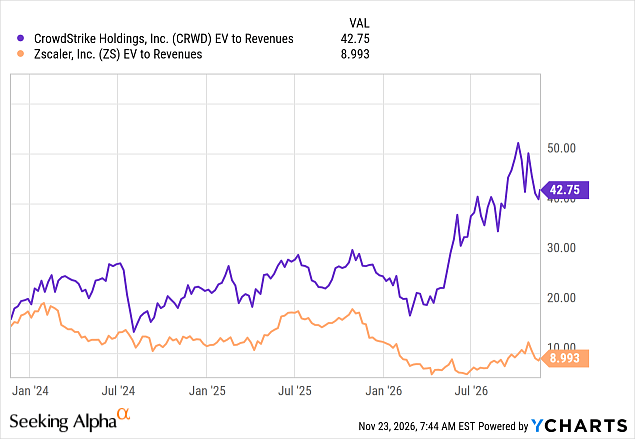
Data by YCharts
When your currency (CrowdStrike stock) trades at a big premium and a premier strategic asset sits in the penalty box, using equity to lock in a transformational acquisition is textbook corporate finance. You are trading expensive shares for undervalued, mission-critical infrastructure.
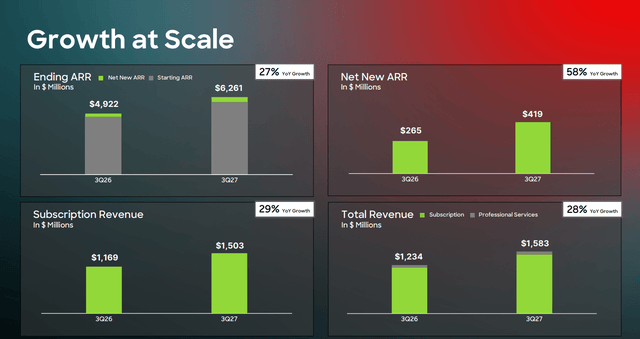
Importantly, this acquisition is being done from a position of strength, as CrowdStrike has just reported excellent numbers for the third quarter of fiscal year 2027, which is the period ended on October 31, 2026 for the company. Both sales and earnings exceeded expectations during the quarter, and fundamental indicators keep moving in the right direction.
Total revenue reached $1.58 billion, growing 28.5% versus the same quarter in the prior year. Net new ARR reached a record $419 million, an increase of 58% and surpassing the company's guidance by more than $70 million. In a display of confidence, management raised the new ARR guidance by 790 basis points, now expecting 45% year-over-year growth for the full year.
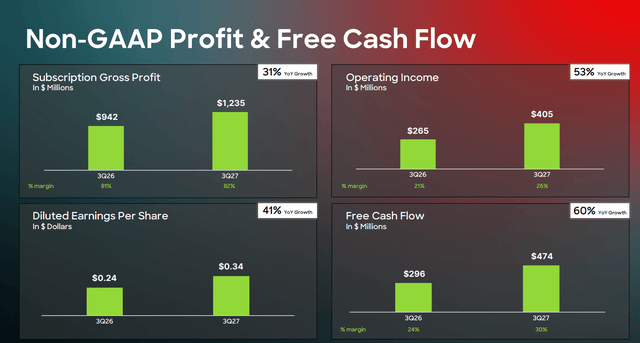
Operating profit margin came in at 26% of revenue, with free cash flow margin above 30%. This combination of vigorous growth and strong profitability at scale is quite remarkable.
Management sees AI agents as the next major frontier in cybersecurity, as these agents are always on and can launch increasingly sophisticated attacks at unprecedented speed. Falcon Guardian, which secures and manages AI agents, is now CrowdStrike's fastest-growing product, recently surpassing $100 million in ARR in less than a year.
Revenue And Cost Synergies
Management estimates this deal could create $1 billion in annualized revenue run-rate synergies in the first 30 months and $500 million in cost savings over the next 18 to 24 months after close. Analysts are always skeptical of these projections, and for good reason, because management teams almost always overpromise and underestimate integration headaches. With this in mind, let's take a look at the numbers behind this guidance.
The press release cites 8,000 non-overlapping Zscaler customers. If we assume CrowdStrike can cross-sell Falcon to just 15% of them, that would bring 1,200 enterprise accounts at an average annual contract value (ACV) of $400,000; that alone would generate $480 million in new ARR.
CrowdStrike also has tens of thousands of customers, including massive Fortune 1000 accounts already spending millions on Falcon Flex, that do not yet use Zscaler. Converting just 600 to 800 of those large Falcon Flex accounts onto Zscaler Zero Trust SASE and AI Protect at an average ACV of $700,000 yields another $420 million to $560 million in ARR.
We can also consider deeper upsells to the more than 2,000 shared customers who now have a powerful financial and operational incentive to consolidate onto Falcon Next-Gen SIEM (streaming Zscaler logs natively at a lower ingestion cost than Splunk or Sentinel).
Based on these numbers, $1 billion in run-rate revenue synergies actually looks achievable, even slightly conservative, provided sales execution stays consistent and disciplined.
On the cost side, CrowdStrike and Zscaler will operate on a combined annual operating expense base well north of $7 billion by 2028-2029. Finding $500 million in run-rate savings represents roughly 6% to 7% of combined operating expenses, which is well within standard benchmarks for mergers in this sector.
Without touching R&D, there is a lot of room to eliminate redundant G&A in areas like audit, legal, IR, finance, and real estate overhead. The go-to-market strategy can also drive efficiencies, since both companies have large enterprise sales forces and marketing budgets targeting the same CISOs at the same conferences. I would also expect some cost savings in areas like cloud infrastructure due to scale and negotiating power after the merger.
Risk Considerations
At $43.9 billion, this is one of the largest software acquisitions in history. Given the deal's size, I think antitrust enforcers at the U.S. Department of Justice, the FTC, the European Commission, and the UK’s CMA may be paying close attention.
The bull case for approval is that CrowdStrike and Zscaler barely compete. Endpoint protection and inline Zero Trust network security are classic complementary markets.
Regulators already set a strong 2026 precedent by clearing Google’s (GOOG) (GOOGL) $32 billion Wiz deal and Palo Alto’s (PANW) $25 billion CyberArk deal. Besides, CrowdStrike can argue it needs this combination to compete effectively against even larger rivals like Palo Alto Networks, Alphabet, and Microsoft (MSFT).
We can expect intense regulatory scrutiny over bundling and tying. To ease these concerns, CrowdStrike may need to make formal interoperability commitments, such as keeping Zscaler’s open APIs working cleanly with Microsoft Defender and SentinelOne, just as Google promised Wiz would remain multicloud. This sounds doable and reasonable.
Deal limbo is another risk. Until the deal closes, CrowdStrike and Zscaler must legally operate as completely independent competitors. They cannot merge sales teams, cannot bundle Falcon Flex + Z-Flex on a single contract, and cannot share confidential pricing. In enterprise software, a 14-month limbo window is prime hunting season for rivals, and the competition will aggressively target Zscaler’s pipeline during 2027.
The good part is that the strategic partnership between CrowdStrike and Zscaler was already in place before the announcement. This means CrowdStrike and Zscaler can legally continue building and marketing their already-announced integrations through the regulatory waiting period.
George Kurtz and Jay Chaudhry are two of the most driven, intensely competitive founder-CEOs in Silicon Valley history. Both built category-defining titans from scratch, and they have strong views on architecture and go-to-market execution.
In practice, integrating a proud former standalone CEO into a subsidiary leadership role almost always creates cultural friction. Avoiding a cultural split between sales and engineering teams will require genuine executive diplomacy from both leaders, and no one can know in advance how this subtle, complex process will go.
Widening The Moat
The widening of the moat is perhaps the most important advantage in this deal. Revenue growth can be bought temporarily; economic moats, on the other hand, are what let a company compound free cash flow at high returns on capital for ten or twenty years without getting commoditized. This is essentially the most important consideration for long-term investors in CrowdStrike.
The data moat is absolutely crucial. In the AI era, foundation models are rapidly commoditizing. Open-weight models and frontier APIs are available to everyone. Proprietary, real-time, labeled operational data is the only AI moat that lasts, and CrowdStrike has just assembled a formidable data engine.
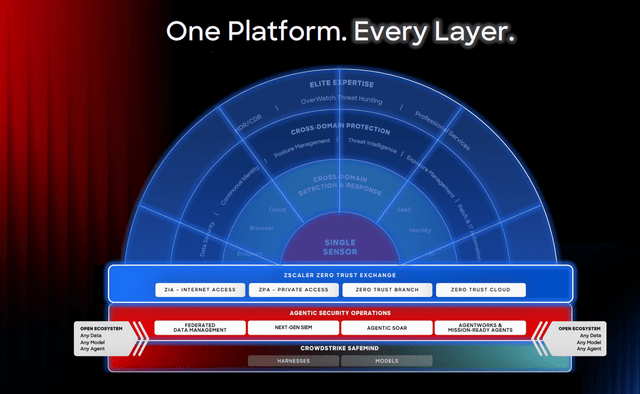
Falcon already generates trillions of security events every day from endpoints, identities, browsers, and cloud workloads worldwide. Zscaler’s Zero Trust Exchange processes more than 750 billion inline network transactions every single day across over 200 global locations.
When SafeMind correlates trillions of endpoint/identity signals with 750 billion daily inline network transactions in real time, it learns adversary patterns that single-domain competitors literally can't see. Better data trains smarter models; smarter models produce superior results. At the same time, higher efficacy attracts more enterprise customers, and more customers generate even more valuable data. That is a classic self-reinforcing AI data flywheel.
Switching costs will add another layer of competitive strength. CrowdStrike and Zscaler already had strong moats in this area before the deal, and they will only get stronger now.
Ripping out CrowdStrike Falcon across 100,000 endpoints, hundreds of cloud clusters, identity directories, and a Next-Gen SIEM packed with years of compliance logs is a multi-quarter operational nightmare and a very risky process to consider undertaking.
Replacing Zscaler’s Zero Trust Exchange, which sits directly in the live traffic path of every employee, branch office, and private application across 185+ countries, is even scarier and more complicated. It means that you are effectively rerouting the corporate nervous system while the patient is awake.
If we consider both companies together, once an enterprise runs its endpoints, identities, browser security, cloud workloads, inline Zero Trust network, and SOC automation on a single unified CRWD+ZS control plane, the switching cost becomes gigantic.
It will be incredibly hard to convince C-level management to take on millions of dollars in migration risk and the associated processes. This gigantic switching cost not only protects the business, but it also creates more opportunities for cross-selling in years to come. If you are not leaving CRWD+ZS, you will probably buy more from them in the future.
The Big Picture
Although big mergers are usually disliked for very good reasons, it is crucial to identify the exceptions to the rule. In this case, CrowdStrike is using its aggressively valued shares to buy a much cheaper business with remarkable strategic advantages. Together, the two companies are building a phenomenal data moat, perhaps the most crucial driver of success in the age of AI.



Comments
Log in or sign up to join the conversation.