

Cerebras Systems (CBRS) is a pure-play AI infrastructure company focused on solving a critical AI bottleneck: the time and energy wasted moving data between processors and memory. Industry dynamics are currently favorable, as Cerebras is particularly well positioned to thrive from inference and agentic AI over the years to come.
The stock has experienced a wild rollercoaster in its short history as a public business. Following the IPO in May 2026, Cerebras went through the classic boom-and-bust cycle of a newly public hyper-growth stock.
The IPO was priced at $185 per share, and the stock exploded to an intraday high of $385 on its first day of trading, pushing its valuation above $86 billion. Since then, shifting investor sentiment toward AI stocks has brought the stock back down to earth, with shares recently trading below $110.
This price-discovery phase offers an interesting entry point for those willing to look beyond the short-term noise in AI infrastructure companies.
The Opportunity
As AI transitions from training to inference, the engineering bottlenecks are evolving too. Generative AI applications like real-time voice assistants, coding agents, and autonomous robots cannot tolerate high latency. Inference speed is no longer just a backend metric; it defines the end-user product experience.
This is where Cerebras plays a key role. The company’s architecture is built for ultra-low-latency processing, delivering inference speeds up to 30 times faster than traditional GPU-based systems.
Cerebras’s competitive advantage comes from a different approach to semiconductor manufacturing. The industry standard has always been to manufacture multiple small chips on a single silicon wafer, slice them up, and then wire them together in sprawling data center clusters. For AI workloads, this approach creates an interconnect bottleneck. Moving data between thousands of individual GPUs requires immense energy and introduces latency.
Cerebras bypassed this bottleneck entirely with the Wafer-Scale Engine (WSE-3), the heart of its CS-3 system. The WSE-3 is roughly 57 times larger than the largest competing GPU die. By keeping all the computing cores and memory on a single, massive piece of silicon, Cerebras utilizes on-wafer, die-to-die communication. Memory sits physically adjacent to the compute cores. This enables pure data-level parallelism, processing matrix and tensor operations simultaneously across the wafer without the lag of off-chip data movement.
Nvidia’s (NVDA) most formidable moat is CUDA, its software ecosystem that creates massive switching costs for developers. Cerebras does not try to fight CUDA across all general-purpose computing tasks. Instead, it provides a turnkey hardware-software stack explicitly designed for the largest AI models. For sovereign entities, military use cases, and hyperscalers trying to consolidate physical data center footprints, CS-3 systems offer a much lower Total Cost of Ownership (TCO).
One of the biggest risks affecting Cerebras has always been customer concentration. In 2025, approximately 86% of the company's revenue came from just two entities linked to the United Arab Emirates. More recently, however, this customer concentration is rapidly changing, which not only validates the technology and opens new growth venues but also improves the risk profile of Cerebras.
The company recently signed a multi-year agreement with OpenAI (OPENAI) for 750 megawatts of AI compute capacity, solidifying its role as a premier infrastructure provider.
Furthermore, during its Q3 2026 earnings call, Cerebras management also announced it had secured new business with tech giants Oracle (ORCL) and Microsoft (MSFT), complementing its existing relationship with Amazon (AMZN) AWS. This expansion from Middle Eastern sovereign projects into the core U.S. hyperscaler ecosystem is a massive de-risking factor for Cerebras.
Building the supply chain to meet this demand is critically important. In that regard, Cerebras is scaling manufacturing with Flex (FLEX) and Sanmina (SANM); management expects to exit 2026 with 10 times the manufacturing capacity it had at the beginning of the year.
The business is performing very well, materially exceeding expectations in Q3 of 2026 with a total increase in revenue of 55%, to $210.8 million. Cloud revenue reached a record $141.9 million, growing 265% versus the same quarter in the prior year. Even better, revenue guidance for Q4 came in at $320 million versus market expectations of $275 million at the time of the report.
Cerebras stock gained 11% after the report was released on November 13, but both the numbers for the quarter and the expanded relationships with hyperscalers arguably deserve an even bigger gain. In other words, the price reaction after the report was perhaps too shy due to all the fears surrounding the AI infrastructure sector these days.
Key Risk Factors
The company’s Q3 2026 core gross margin came in at 41%. While this was a sequential improvement, it remains drastically lower than the margins enjoyed by fabless IP designers like Nvidia, which is well above 70% at the gross margin level.
Because Cerebras sells entire integrated hardware systems, including specialized cooling, power delivery, and memory, its Cost of Goods Sold may be structurally higher than that of other companies in the sector.
Management said in the conference call that the main reason why margins are low today is that the company is ramping up production and doing the final shipments of hardware under special pricing programs to an early customer. The company expects margins to improve over time, with gross margin eventually exceeding 60% as a long-term target. This, however, still remains to be seen, and Cerebras has a lot to prove in this regard.
Investors considering a long position in Cerebras must accept that the company operates a capital-intensive business model, and free cash flow will remain negative at least for one more year.
Competitive risk is also very relevant; Cerebras has a distinct architectural lead in wafer-scale computing, but Nvidia is not standing still. With Nvidia's rapid annual release cadence, which includes the upcoming Vera Rubin architecture, the performance gap between multi-GPU clusters and the WSE-3 will face constant pressure. Cerebras must out-innovate a competitor with a vastly larger R&D budget.
Customer concentration risk is still persistent in Cerebras. While the company is diversifying its customer base, it is intrinsically linked to the AI infrastructure sector. This sector is dominated by a few big whales, and any problem impacting one or multiple customers would undoubtedly hurt Cerebras in a big way.
Valuation And Timing
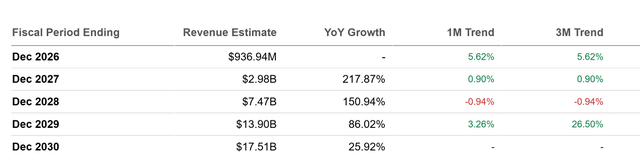
Because the company is not yet optimized for current earnings, we need to rely on revenue multiples to get a quick perspective on relative valuation. Cerebras is growing at an amazing speed, and the company currently trades at 3.5 times revenue estimates for 2028. If management can deliver, and ideally outperform expectations, valuation is not unreasonable at all on a forward-looking basis.
Fiscal Period Ending | Revenue Estimate | YoY Growth | FWD Price/Sales |
|---|---|---|---|
Dec 2026 | 936.94M | - | 28.20 |
Dec 2027 | 2.98B | 217.87% | 8.87 |
Dec 2028 | 7.47B | 150.94% | 3.54 |
Data Source: Seeking Alpha
Revenue estimates are also trending higher, and there is a material chance this trend will continue in the near term after the company delivered such a strong Q3 2026 report.
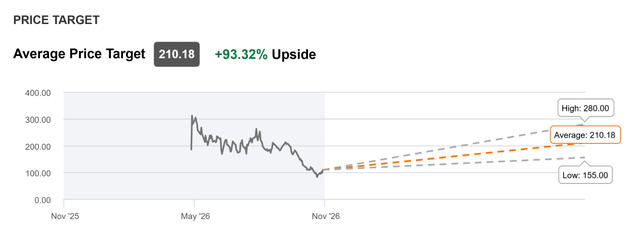
Looking at Wall Street price targets for Cerebras, the average target is above $210, which carries an upside potential of more than 93% versus current prices. Interestingly, the most conservative target is $155, which is still almost 44% above the current stock price. On the bullish side, the most aggressive estimate among Wall Street analysts is $280, or almost 160% above the current price.
The interesting part is that Cerebras had its IPO when demand for AI infrastructure stocks was very strong, and then the stock took a hard landing due to external factors such as inflation, market anxieties, and now all the drama surrounding Jensen Huang, which created fears across the whole sector.
The fundamental drivers, on the other hand, are clearly getting better as the company delivers excellent numbers and guidance while also diversifying its customer base.
The stock had a positive reaction on massive volume after earnings. We still have no evidence of a change in price trends, but such a strong quarter can be a good catalyst if market conditions help.
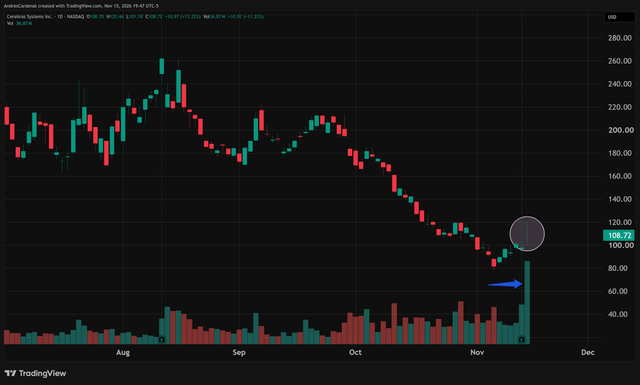
Importantly, the IPO stock lockup releases were fully completed as of November 9th. This makes the timing for a position in Cerebras particularly interesting.
The Big Picture
Cerebras is a hypergrowth pure play in AI infrastructure, with negative free cash flows and facing tough competition. This is a high-risk investment, not suitable for investors looking for stability and predictable returns.
At the same time, the upside potential is huge; the company is solving a crucial AI bottleneck, and the current entry price looks quite attractive for investors who can tolerate the risk of holding a position in Cerebras long-term.



Comments
Log in or sign up to join the conversation.