


Applied Materials, Inc. (AMAT) sits at the epicenter of the AI revolution and is a high-quality business with outstanding profitability, consistent cash flow generation, and a wise strategy of capital allocation and share buybacks over the long term.
Even better, the valuation is now particularly attractive, as AMAT has pulled back almost 50% from its highs of the year and is trading at very reasonable valuation ratios relative to earnings generation.
Fundamental Quality And Growth
When looking at the breathtaking acceleration of artificial intelligence, it's easy to get mesmerized by the dominant chip designers and their vertiginous growth rates. But if we peel back the layers of the digital economy, we will find a physical reality governed by the laws of chemistry and physics.
The chips powering the AI revolution are arguably among the most complex manufactured objects in human history, and Applied Materials plays an indispensable role in this process.
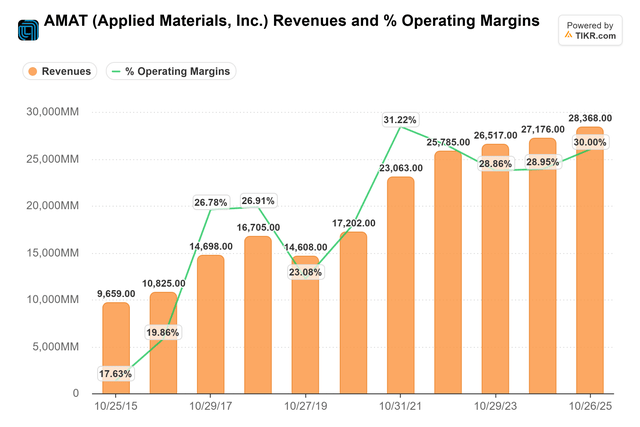
The company has increased revenue from $9.7 billion in fiscal 2015 to $28.4 billion in fiscal 2025 and $34.26 billion projected for fiscal 2026. Applied Materials is also generating this performance while producing operating margins of more than 30% of revenue.
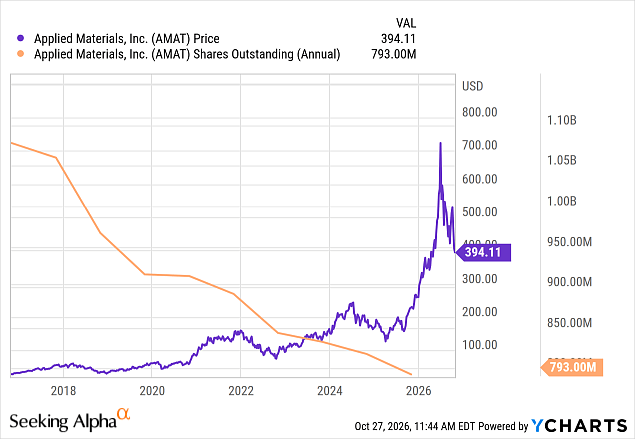
Over the past decade, AMAT has reduced the number of shares outstanding by more than 26% of the total, and the stock has appreciated more than 1200% in that period. In essence, the business generates abundant free cash flow, and this free cash flow is also allocated to an investment with remarkable returns: Applied Materials' own stock.
This means that investors in Applied Materials have been rewarded by two powerful engines at the same time: sustained earnings growth and a steady and consistent reduction in the share count that also increases earnings per share by reducing the denominator in the earnings per share equation.
Financial performance is supported by deep business moats. First, scale makes AMAT more efficient than its competitors because operating leverage spreads fixed costs across a large number of products, reducing per-unit costs. Because of these unparalleled scale advantages, AMAT can surpass the competition in R&D investments, as the company has allocated more than $3.9 billion to these R&D investments over the past 12 months.
Selling the machines is just the first step in a business transaction. These machines run 24/7 in pristine cleanrooms and require constant maintenance, spare parts, and software upgrades. AMAT has an installed base of tens of thousands of tools worldwide. This business segment provides a more stable and predictable revenue stream for AMAT with elevated profitability.
The stability provided by the services segment is particularly appreciated in periods when the semiconductor cycle is declining.
Switching costs provide another key source of moat for AMAT. The company embeds its engineers directly inside the fabs of its customers years before a new semiconductor node goes into mass production.
The switching costs here are enormous. To rip out an AMAT process and replace it with a competitor would require recalibrating an entire multi-billion-dollar manufacturing line, risking disastrous yield losses. Especially since AMAT is world-class in both quality and pricing, this transition rarely makes any sense.
AI And Accelerated Computing
The shift from general-purpose computing (CPUs) to accelerated computing (GPUs and AI accelerators) is a key paradigm shift that offers extraordinary opportunities for Applied Materials. AI is exceptionally hardware-intensive, and it is driving a fundamental change in how chips are built.
For decades, Moore's Law meant shrinking the transistor. But we are hitting the physical limits of how small a transistor can get. To keep increasing computing power for AI models, the industry has shifted to advanced packaging and heterogeneous integration.
Instead of making one massive chip, designers are breaking chips down into smaller chiplets and stitching them together on a single package. High-Bandwidth Memory (HBM) is the crucial memory component that feeds data to AI GPUs, and it relies entirely on advanced packaging techniques.
Applied Materials is the undisputed leader in the tools required for heterogeneous integration. Their tools handle the micro-bumping, through-silicon vias (TSVs), and hybrid bonding that allow these chiplets to communicate at lightning speeds. As AI data centers scale, the volume of advanced packaging required will grow exponentially.
Every time the industry moves to a smaller node, the number of manufacturing steps increases, and more steps mean more tools. Even if the total number of wafers produced globally were to stay flat, AMAT's revenue would grow simply because the complexity of each wafer requires more deposition and etch intensity. AI is accelerating this trend and forcing foundries to adopt GAA transistors much faster to handle the power efficiency demands of massive data centers.
Risks To Consider
Rational optimism requires us to look clearly at the downside. No stock is without risk, and AMAT faces several risk factors to monitor.
To begin with, the semiconductor industry has always been cyclical; while AI has transformed the shape of the demand curve and the duration of the cycle, the cyclicality will never go away. Demand for end devices like smartphones and PCs fluctuates over time, leading to inventory gluts and prompting foundries to cut their CapEx budgets in those periods.
Because AMAT sells the equipment, they sit at the tip of the bullwhip. During a downcycle, revenue can contract sharply. Investors must be mentally prepared to endure 20% to 30% drawdowns in the stock price during cyclical troughs. The key is to recognize that the long-term trend line is moving up and to the right, even if the path is highly volatile.
In the current environment, there is a good chance that emerging trends like agentic AI and robotics will produce new waves of demand, and industry performance could continue to outperform expectations in the near term. That said, the mere perception of a slowdown can always generate volatility for Applied Materials.
Geopolitical risk has grown in importance in recent years. Semiconductors are now a matter of national security. The U.S. government has placed strict export controls on selling advanced semiconductor equipment to China. Historically, China has represented a massive percentage of global WFE spending as they attempt to build domestic capacity. Continued tightening of export restrictions could have a negative impact on Applied Materials.
Customer concentration is also important, as most of the company's revenue comes from just a handful of giants: Taiwan Semiconductor Manufacturing Company Limited (TSM), and Samsung Electronics Co., Ltd. (SSNLF), and Intel Corporation (INTC). Delays, yield issues, or strategic shifts at any of these customers can disproportionately affect results. The same concentration also gives buyers power in negotiations.
On the competitive side, Lam Research Corporation (LRCX) is a challenging rival in etch and some deposition applications; Lam Research has gained share in some periods. Tokyo Electron Ltd - ADR (TELWY) competes across multiple process steps and benefits from its home-market advantage in Japan and Asia. Chinese vendors are trying to compete in less advanced tools and could expand in other areas.
Applied Materials has top-level breadth and scale advantages, but this also means the company has to defend multiple fronts at the same time, which is never easy in such a dynamic industry in which booming demand will always attract competition.
Valuation And Timing
For the fiscal year ending in October 2027, Wall Street analysts are projecting $18.49 in earnings per share. The number represents a year-over-year growth rate of 44.6%. Under this assumption, Applied Materials is trading at a forward PE below 21 and a price-to-earnings growth ratio of 0.47 for fiscal 2027. This valuation is more than attractive when considering fundamental quality and growth potential.
Fiscal Period Ending | EPS Estimate | YoY Growth | Forward PE |
|---|---|---|---|
Oct 2026 | 12.79 | 35.73% | 30.31 |
Oct 2027 | 18.49 | 44.62% | 20.96 |
Oct 2028 | 23.69 | 28.14% | 16.36 |
The average price target among Wall Street analysts stands at $627.83. This number would imply an upside potential of more than 60% versus current price levels for Applied Materials.
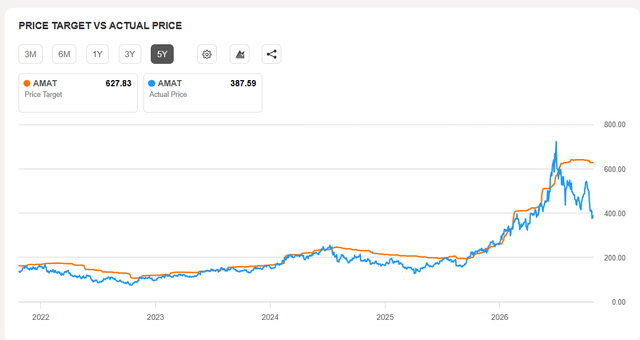
The $627.83 price target would put Applied Materials at a forward price-to-earnings ratio slightly below 30. This is not excessive, given that the company is expected to grow its bottom line by almost 45% in the next fiscal year.
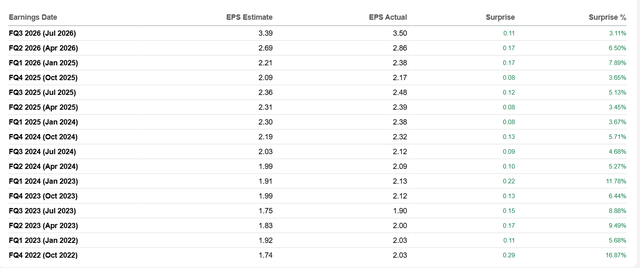
Importantly, Applied Materials tends to consistently beat earnings estimates, so there is a good chance that forward estimates will be surpassed too.
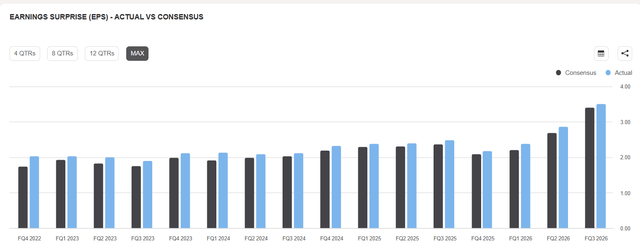
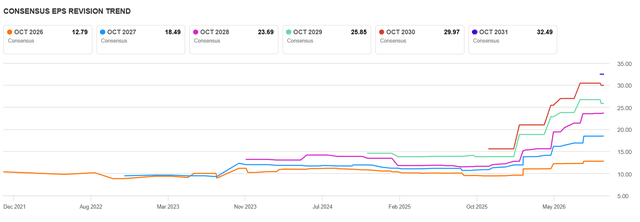
The chart below shows the main trends in earnings revisions, which are clearly moving in the right direction over time. Just as stock prices exhibit momentum, fundamental metrics do, too.
Because channel checks data is encouraging and industry data remains bullish, earnings projections are evolving favorably, reinforcing the bullish case for Applied Materials and making the valuation more attractive than a static look at the numbers could indicate.
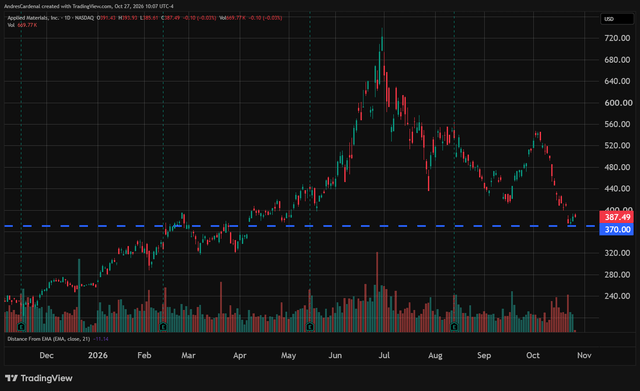
The recent market correction affecting AI infrastructure stocks is creating an interesting entry point in Applied Materials, with the stock down almost 50% from its highs of the year. The area around $370 was quite important for AMAT in the first quarter of 2026, acting first as resistance and then as support.
The stock is once again testing this level, so buying near potential support levels could provide a reasonable entry point for investors.
Note: This article discusses one or more securities that do not trade on a major U.S. exchange. Please be aware of the risks associated with these stocks.



Comments
Log in or sign up to join the conversation.