


Introduction
In the market, there are times when a stock gets placed into one simple bucket, and investors stop looking deeper. I think Sezzle (SEZL) is sitting in that kind of spot right now.
Most investors look at Sezzle and see a buy now, pay later company. That is not wrong, but I think it is incomplete. Sezzle does help shoppers split payments into smaller parts, but the bigger story is that the company may be moving toward something more valuable: an AI-powered consumer credit and payments platform.
That is where the thesis becomes interesting.
Sezzle is not only trying to make payments easier. It is trying to make small credit decisions smarter. Traditional credit cards depend on banks, old credit scores, legacy underwriting systems, and broad customer categories. Sezzle has a different kind of data. It can see how a user shops, how often that user repays, how much they spend, how their behavior changes, and whether their repayment history improves over time.
Now, bring AI into that system, and the opportunity starts to look very different.
AI can help Sezzle use this data to approve more good customers, reject more risky transactions, detect fraud earlier, and scale with better risk control. In a credit business, that is the whole game. If Sezzle can grow while also controlling losses, then the stock should not be looked at as just another BNPL lender.
As of July 24, 2026, the stock was trading around $159 per share, with a market value near $5.6 billion. So, this is not a deep value stock, but it is also cheaper than when I first started looking at the idea. My base-case fair value estimate is around $255-$260 per share, which now implies about 60% upside. In a bull case, if the market starts valuing Sezzle as an AI-powered consumer fintech platform, I think the stock can move beyond $350, or more than 120% above the current price.
Company Overview
Let’s start with the basic business. Sezzle allows customers to split purchases into smaller installments. That makes the product attractive to younger consumers and to people who do not use traditional credit cards very often. It also gives customers a way to manage smaller purchases without going through the full credit card system. But the important point is that Sezzle is no longer only a checkout button.
With Sezzle Anywhere, virtual card functionality, and subscription-based access, the company is moving closer to the consumer. Earlier, Sezzle needed merchants to integrate its service. A merchant added Sezzle at checkout, and then the customer could use it. That model is useful, but it also limits the company because Sezzle depends on merchant adoption. The newer model is more interesting. If customers can use Sezzle through the app and virtual card at more locations, then Sezzle becomes less dependent on waiting for every merchant to add it directly. The customer can bring Sezzle to more places. That changes the direction of the business.
Sezzle is trying to build a direct relationship with the consumer. If that relationship becomes stronger, Sezzle can become more than a payment option. It can become part of how users shop, borrow, repay, and manage small purchases. In simple words, Sezzle can become a shopping, credit, and payments habit.
That is the part of the story I think the market may be missing.
Why AI Is The Explosive Element
The entire thesis, in my view, comes down to one question: can AI make Sezzle better at credit and risk management? I think the answer is yes. Sezzle already uses AI and machine learning for fraud detection and credit risk assessment. That matters because every transaction on the platform creates data. Every repayment creates data. Every missed payment creates data. Every repeat purchase creates data. Over time, Sezzle can build a much clearer picture of user behavior than a simple credit score can show.

Figure 1. Sezzle discloses its use of AI/ML for fraud detection and credit risk analysis - Source: Sezzle 2025 Form 10-K / SEC filing.
This is where AI becomes powerful. AI can help Sezzle judge risk in real time. It can help decide the right spending limit for each user. It can help find fraud before the loss happens. It can help personalize offers. It can also help approve customers who may look weak under traditional credit models but are actually good repayment risks. That last point is very important. Traditional credit often leaves people out because the model is too narrow. If a person has a thin credit file, limited credit history, or does not use normal credit cards, the system may treat that person as risky. But Sezzle may be able to use repayment behavior and shopping data to make a better decision. This is where the disruption comes from. Sezzle is not only giving consumers more time to pay. It may be building a better system for small credit decisions.
Credit is usually a trade-off. If a lender approves more people, growth can rise, but losses can also rise. If a lender becomes stricter, losses can fall, but growth slows. AI gives Sezzle a chance to improve both sides at the same time. It can approve more of the right customers and reject more of the wrong transactions. That is why AI is the explosive part of this thesis. It can help Sezzle approve more, lose less, personalize better, and increase repeat usage.
The Consumer Flywheel
The best way to understand Sezzle is through its flywheel. More users create more transactions. More transactions create more data. More data improves the risk engine. A better risk engine improves approvals. Better approvals increase GMV and revenue. If losses stay controlled, higher revenue can flow through to earnings. The latest reported numbers show that this flywheel is already working.
In the first quarter of 2026, Sezzle’s GMV grew 37.3% year over year to $1.1 billion. Revenue increased 29.2% to $135.5 million. Net income rose 41.9% to $51.3 million. Adjusted EBITDA margin was 52.5%. Average purchase frequency reached 7.1 times, up from 6.1 times in Q1 2025.

Figure 2. Q1 2026 results show strong GMV, revenue, net income, adjusted EBITDA margin, and raised guidance - Source: Sezzle Q1 2026 Results / SEC Exhibit 99.1.
That purchase frequency number is one of the most important numbers in the whole thesis. A low-frequency BNPL company is just a checkout tool. A high-frequency BNPL company can become a consumer finance habit. If customers keep coming back, then Sezzle owns more of the consumer relationship. That makes the business more valuable. The subscription angle makes this even more interesting.
Sezzle’s Monthly On-Demand and Subscribers increased 34.8% year over year to 887,000 in Q1 2026. Active Subscribers also grew 48.4% year over year. This shows that some users are willing to pay for broader access, added flexibility, and more utility.
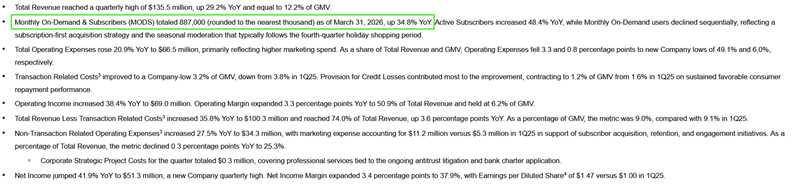
Figure 3. MODS and Active Subscriber growth support the repeat-usage and subscription angle - Source: Sezzle Q1 2026 Results / SEC Exhibit 99.1.
This matters because it can make Sezzle less dependent on one-time transaction economics. If more users subscribe or pay for added access, the business becomes more repeatable. It also becomes easier to see Sezzle as a consumer fintech platform rather than only as a lender.
Why The Market May Be Missing The Story
The market may be making one simple mistake. It may be valuing Sezzle like a small BNPL lender, when the company may be turning into a wider consumer credit platform. That difference matters.
A lender usually gets a lower multiple because investors worry about credit losses, regulation, funding costs, and the consumer cycle. Those risks are real. But a consumer fintech platform can deserve a higher multiple if it has repeat users, proprietary data, strong engagement, high margins, and growing subscription revenue. I am not saying Sezzle is already a major payment network. That would be too aggressive. But the direction of travel is important. Sezzle has the app. It has the customer relationship. It has repayment data. It has virtual card functionality. It has subscription products. It has AI-driven risk tools. When those pieces are put together, the business looks more interesting than a simple pay-in-four product.
This is the underappreciated part of the bull case. If Sezzle can use AI to improve underwriting, grow repeat usage, and expand customer lifetime value, then the company can scale in a way that looks different from a traditional lender. That is why I think the stock can still re-rate, even after a strong move.
Valuation
Sezzle is not a deep value play. At around $159 per share, the stock still reflects growth expectations. So, the valuation question is simple: how much can earnings grow, and what multiple should the market give those earnings?
The company has raised its 2026 adjusted EPS guidance to $5.10. I use three simple scenarios.
Case | EPS | P/E | Target Price | Upside / Downside |
Bear | $5.10 | 25x | $128 | -20% |
Base | $6.75 | 38x | $257 | +62% |
Bull | $8.50 | 42x | $357 | +125% |
In the bear case, I use the company’s 2026 adjusted EPS guidance of $5.10 and a 25x multiple. That gives a target price of about $128, or roughly 20% downside from the latest price. This is the case where the market treats Sezzle more like a risky BNPL lender.
In the base case, I assume EPS reaches $6.75 and the market gives Sezzle a 38x multiple. That gives a target price of about $257, or roughly 62% upside. This is the case where Sezzle keeps growing earnings, controls losses, and stays highly profitable.
In the bull case, I use $8.50 of EPS and a 42x multiple. That gives a target price of about $357, or roughly 125% upside. This case requires the market to see Sezzle not just as a lender, but as an AI-driven consumer fintech platform with strong repeat usage. To me, that is the real debate. If Sezzle is only BNPL, the stock can be expensive. If Sezzle becomes an AI-powered consumer credit platform, the valuation can still move higher.
A simple 3-5 year earnings-based check gives even more room, but I would treat that as long-term optionality rather than a near-term price target. If 2026 adjusted EPS of $5.10 compounds at 25% per year for five years and the stock exits at 32x earnings, the share price can approach $500. From around $159, that would be more than 200% upside. In a stronger case, with 32% EPS growth and a 38x exit multiple, the stock could approach $775, which is close to 390% upside. I would not present that as guaranteed, but it shows how powerful earnings compounding can become if the AI and repeat-usage thesis keeps working.
Risks
There are real risks here, and they should not be ignored.
The biggest risk is credit loss. If consumers weaken, Sezzle can lose more money on repayments. In a business like this, growth is only good if losses are controlled.
The second risk is regulation. BNPL and consumer credit are already getting more attention from regulators. If rules become tougher, Sezzle’s growth or margins could be affected.
The third risk is competition. Affirm (AFRM), Klarna, PayPal (PYPL), Apple (AAPL), banks, and credit card companies are all trying to own the consumer payments relationship. Sezzle is not competing in an easy market.
The fourth risk is valuation. This is not a cheap stock. If revenue growth slows, earnings disappoint, or credit losses rise, the multiple can fall quickly.
So, this is not a risk-free idea. AI is the reason the stock can re-rate, but AI does not remove credit-cycle risk.
Conclusion
The way I see it, Sezzle is more interesting than the market’s simple BNPL label suggests. The company is building a data-driven consumer credit and payments platform. AI is the important part because it can improve the most critical function in the business: deciding who can safely borrow, how much they can spend, and how often they can use the platform. If Sezzle can use AI to approve more good customers, reduce fraud, control losses, and increase repeat usage, then the company can keep growing while staying profitable. That is why the risk/reward looks attractive to me.
The bear case carries around 20% downside, but the bull case offers more than 120% upside on my simple valuation framework. That gives the stock an attractive asymmetry. If I look further out using a simple 3-5 year earnings-based framework, the upside can look even larger, especially if earnings keep compounding and the market values Sezzle as a stronger fintech platform.
That is not guaranteed, and investors should respect the risks. But as an industry disruptor idea, Sezzle has the pieces I want to see: a simple product, a large market, real AI use, strong growth, high margins, repeat customers, and a business model that may be much bigger than the market currently believes.



Comments
Log in or sign up to join the conversation.