

Gold’s high sensitivity to falling real interest rates suggests that a powerful driver of its upward trend will continue. In our previous study, we highlighted this strong correlation between gold and real interest rates over the medium term.
This sensitivity is primarily due to the dominant role of investment demand in determining the price of gold. Unlike industrial metals, the gold market depends largely on investors’ trade-offs between different asset classes. When real interest rates fall, the opportunity cost of holding an asset such as gold decreases, which enhances its appeal.
However, U.S. real interest rates currently remain at levels not seen in nearly twenty years. In this context, could a sustained decline in these rates fuel a new phase of appreciation for the yellow metal?
The impact of real interest rates on the price of gold
The real interest rate is the return on an investment after taking expected inflation into account. For 10-year U.S. Treasury bonds, it is generally approximated by the difference between the nominal yield on the 10-year Treasury and the 10-year inflation expectation:
10-year real rate = 10-year Treasury yield − 10-year inflation expectation
Expected inflation is itself estimated using the 10-Year Breakeven Inflation Rate, which is calculated by comparing the yield on a conventional Treasury bond with that of an inflation-indexed bond (Treasury Inflation-Protected Securities, or TIPS) with the same maturity:
Breakeven inflation = 10-year Treasury yield − 10-year TIPS yield
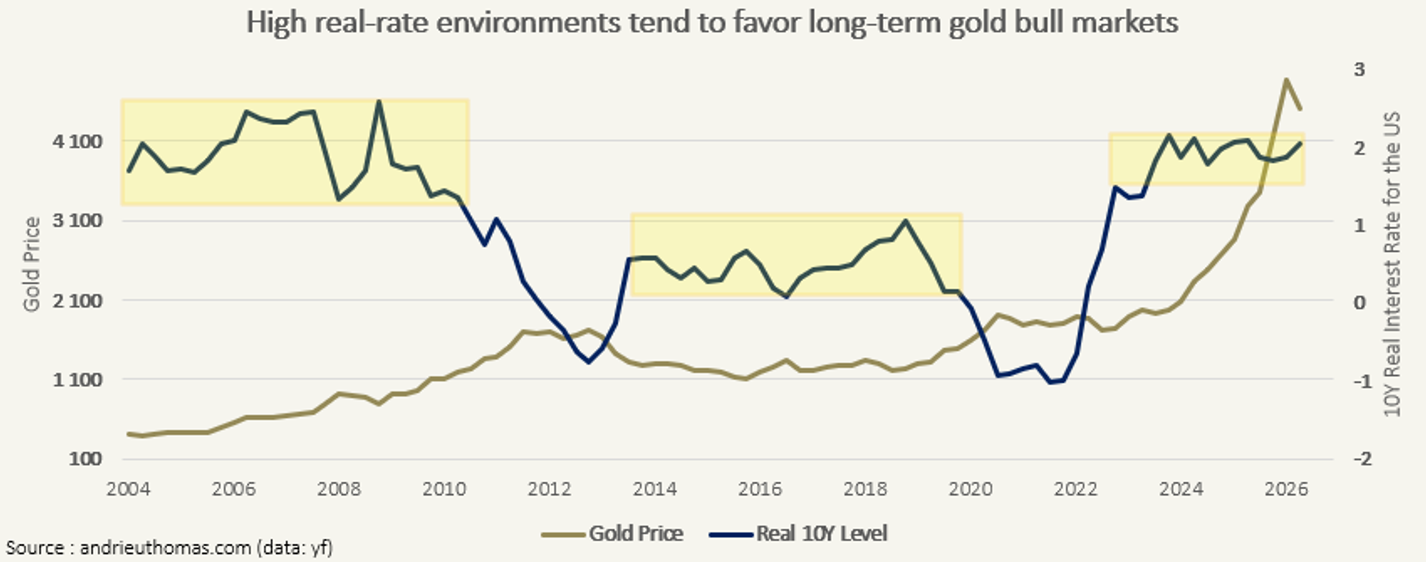
Unlike actual observed inflation, this measure reflects investors’ expectations for the next ten years. Its trend is therefore more steady and can deviate significantly from actual inflation when the economic outlook changes rapidly. The resulting real interest rates thus influence investors’ decisions, particularly in the gold market.
The graph above clearly illustrates this relationship. Periods of falling real interest rates generally coincide with phases of strong gains in the price of gold, while rising real interest rates tend to weigh on the precious metal. Even more interestingly, experience shows that real interest rates do not always need to fall sharply. Simply stabilizing after a period of rise can be enough to trigger a new uptrend in the gold market. Conversely, a decline in real interest rates often signals that this uptrend is nearing its end.
What is the true relationship between gold and real interest rates?
However, the strong sensitivity of investment demand to the expected real yield on 10-year sovereign bonds deserves to be qualified.
Since 2005, changes in real interest rates have accounted for up to 25% of quarterly fluctuations in the price of gold. This relationship is therefore far from insignificant. Nevertheless, its strength varies significantly depending on whether real interest rates are trending downward or upward.
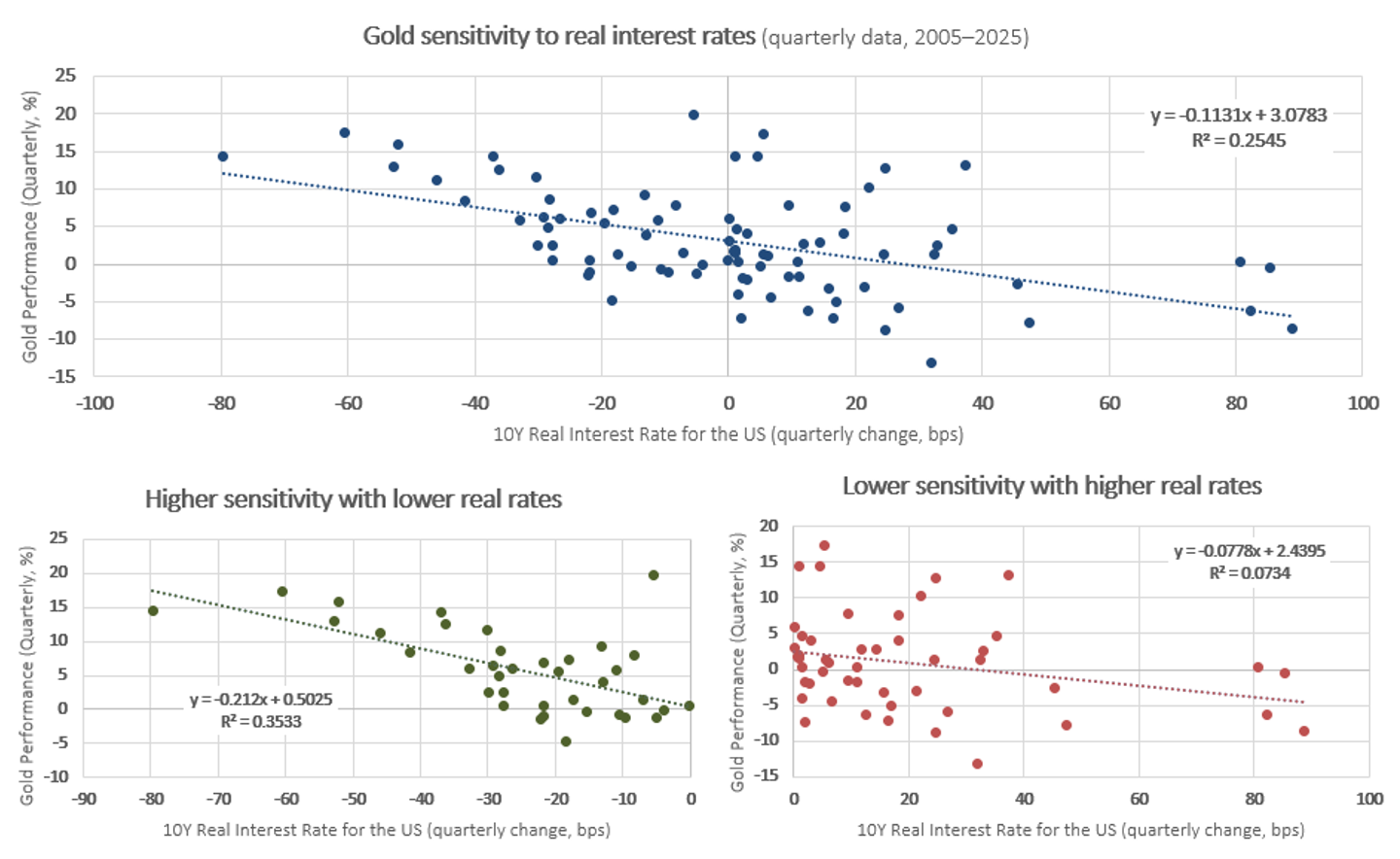
Graphic: Thomas Andrieu (Data source: yf)
When real interest rates decline (bottom-left graphic) the relationship appears particularly robust. Nearly 35% of the quarterly variations in gold’s performance would then be explained by movements in real interest rates. In other words, a decline in real interest rates is one of the main drivers of periods of appreciation for the precious metal.
Estimates indicate that a 10-basis-point (bps) decline in real interest rates is accompanied, on average, by an increase of more than two percentage points in gold’s quarterly performance. At current market levels, this corresponds to a gain of approximately $90 for a decline of about 10 bps in real interest rates.
Conversely, the relationship is significantly weaker when real rates rise. A rise in real rates therefore does not automatically lead to a decline in gold prices, and its explanatory power becomes much more limited.
It thus seems ill-advised to anticipate a correction in the price of the yellow metal based solely on an expected rise in real rates.
What could upset this balance?
The current level of real interest rates — which remains particularly high despite the sharp rise in the price of gold over the past two years — could thus suggest the potential for the bull market to continue.
However, several factors are likely to limit the impact of a potential decline in real interest rates on the price of gold:
First, central banks could keep key interest rates high for longer than expected, or even implement further monetary tightening if inflationary pressures persist.
Second, investment demand may have plateaued. In 2025, it reached a historically high level. A decline in real interest rates would therefore not necessarily guarantee an increase in demand.
Third, a sharp slowdown in inflation — caused, for example, by a weakening economic outlook — could reduce inflation expectations if monetary policy remained unchanged. In such a scenario, the decline in real interest rates would be more limited than expected.
Finally, other factors can influence the gold market independently of real interest rates. Central bank purchases, geopolitical tensions, exchange rate movements, and momentum effects can amplify or limit the impact of monetary conditions.
The rise in energy prices caused by the war in Iran fueled a spike in observed inflation. However, this episode had relatively little impact on 10-year inflation expectations, as investors viewed it primarily as a temporary shock. Real interest rates thus remained relatively stable.
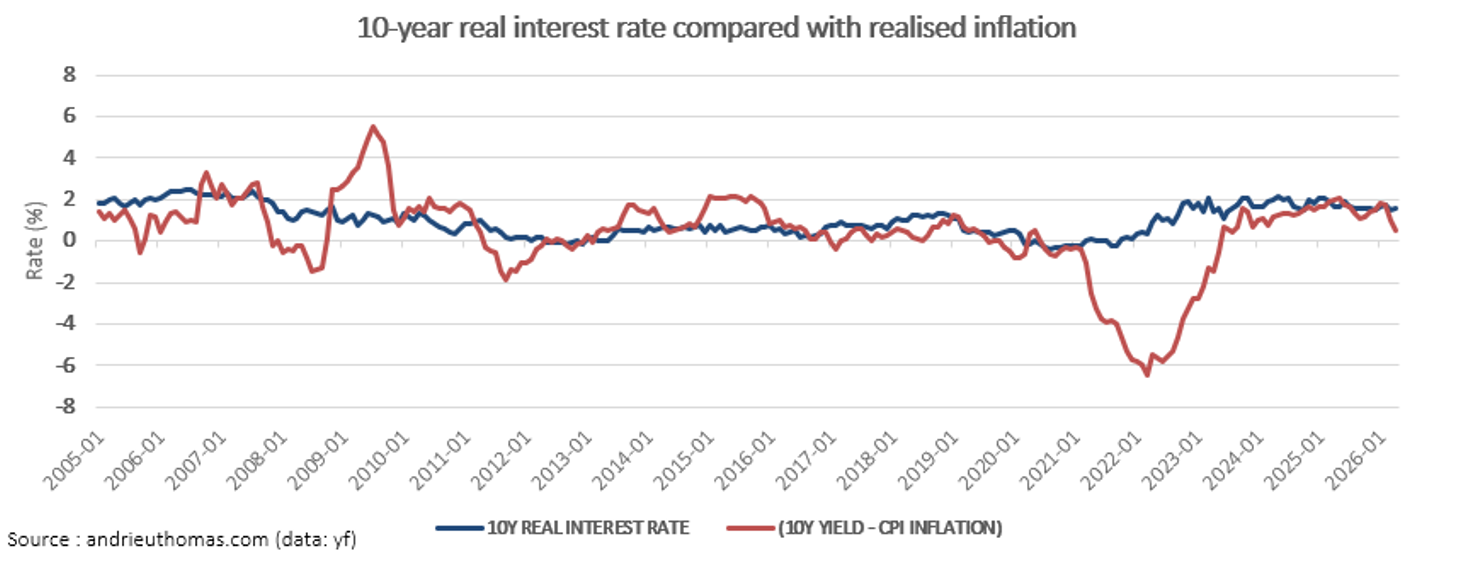
Over the longer term, the real interest rate calculated based on observed inflation generally tends to converge toward the one based on inflation expectations. This convergence, however, can occur in either direction. When inflation remains persistently high or low, investors’ expectations eventually adjust, gradually bringing the two measures of the real interest rate closer together.
While we can currently expect inflation to decline, it is unlikely that inflation expectations will fall by the same amount. On the other hand, interest rates could remain stable or decrease, which could ultimately lead to a moderate decline in real interest rates over the coming quarters.
At this stage, a gradual decline in inflation appears to be the most likely scenario. However, there is no indication that inflation expectations will decline by the same degree. If, at the same time, long-term bond yields stabilize or trend slightly lower as a result of monetary easing, real interest rates could decline moderately over the coming quarters.
Such a development would provide a favorable environment for gold’s upward trend to continue.
Forecasts for real interest rates
In our previous publications, we have shown that gold generally follows bull cycles lasting about a dozen years, driven by a variety of factors.
However, despite the magnitude of the rise already recorded, the gold market does not appear to have completed its bull cycle. This hypothesis is based, in particular, on the prospect of a decline in real interest rates.
In reality, a structural decline in real interest rates could only result from a gradual deterioration in economic conditions. With year-over-year growth of 2.7%, the United States is still experiencing robust economic activity, exceeding its potential growth rate, which is fueling inflationary pressures and, at this stage, limiting the scope for a decline in real interest rates.
For now, there is no evidence to predict with certainty a sharp slowdown or the onset of a recession, even though historical data calls for caution. It appears, however, that a new phase of acceleration in the gold bull market would likely be preceded by a shift in the economic outlook, which could lead to a sustained decline in real interest rates.
Derivatives markets are “holding up”
While investor activity is a key indicator of the gold market’s vitality, data from the derivatives markets also provide important insights.
Open interest, which measures the number of outstanding derivatives contracts by market participant category, reflects both the intensity of activity and the level of interest in the market. Historically, major lows in the price of gold are generally accompanied by low levels of open interest, while major highs most often occur after a bearish divergence in open interest.
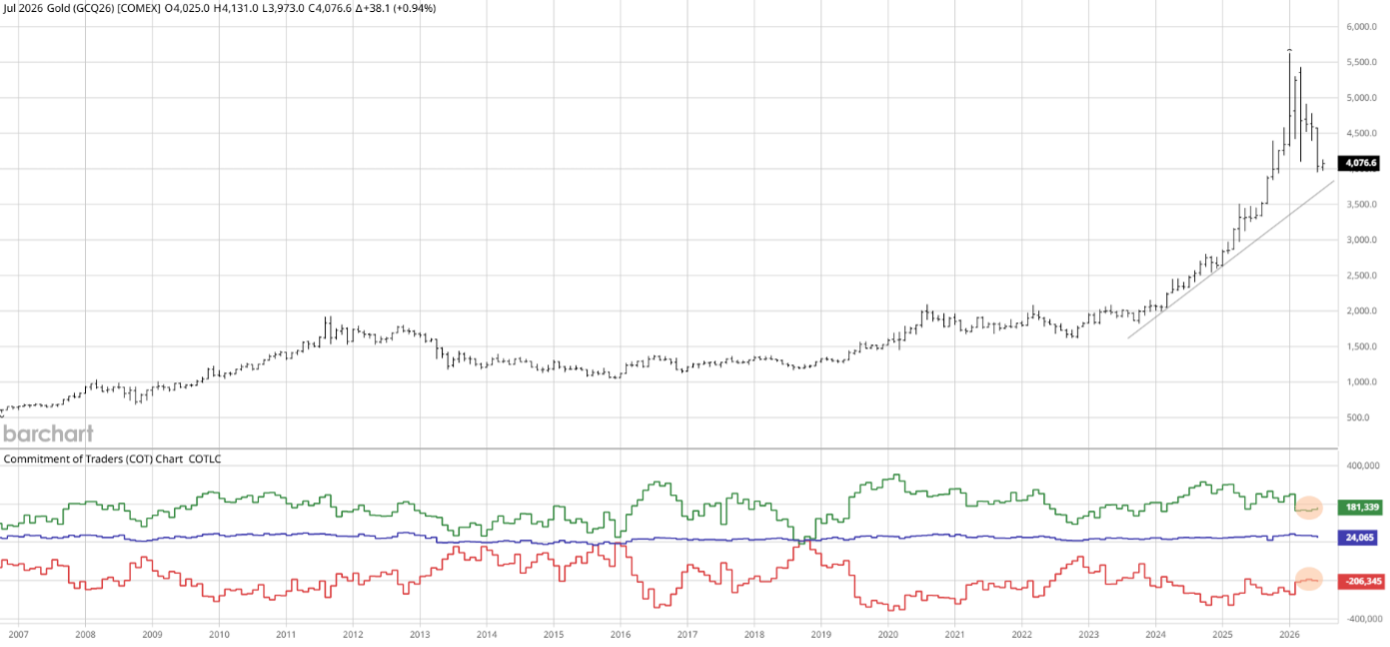
Source: Barchart
In this context, the recent peak in the gold price fits a classic pattern of bearish divergence in open interest. However, unlike previous major peaks, this phase was not accompanied by new records in open interest.
The recent correction was, as expected, accompanied by a decline in open interest. This decline remains particularly limited, however, and, in fact, open interest has remained flat for most of the price decline. This development suggests that the decline in gold prices has not been fully confirmed by the derivatives markets.
This plateau in open interest thus leaves open the possibility of a rebound in the gold price. Three scenarios can be considered:
A moderate, short-term rebound, comparable to those seen in 2012 or 2022, with a recovery in open interest without exceeding previous highs.
A rapid and powerful rebound, driven by a still relatively moderate level of open interest, which could push the price of gold to new all-time highs. This scenario would, however, require additional signals to be confirmed.
A breakdown of this plateau, with a more pronounced decline in open interest accompanying a significant drop in the price of gold, paving the way for a new downtrend. At this stage, the available data does not seem to point in that direction.
The objectives of major banks
Despite recent events, J.P. Morgan is maintaining its price targets, with a target of $6,000 per ounce by the end of 2026, and even $6,300 in 2027. According to the bank, demand from central banks is expected to remain strong, while the geopolitical landscape continues to favor gold.
In particular, China continues to buy gold at a steady pace:
“In response, China appears to be systematically building gold reserves as part of a long-term project to establish the renminbi as a credible reserve currency alternative.”
Nevertheless, the bank does not rule out a less favorable scenario for the price of gold:
“The most significant bearish risk to our view is a macro scenario where U.S. growth and employment remain buoyant but inflation continues to accelerate, solidifying a Fed hiking cycle this year.”
For its part, Goldman Sachs maintains a price target of close to $4,900 per ounce, representing a return to the price range corresponding to the previous peak.
Conclusion
We have demonstrated the decisive role of real interest rates in determining the price of gold. Their influence is exerted primarily through investment demand, which remains one of the market’s main drivers.
In the United States, real interest rates are currently hovering around 2 percent, a particularly high level. This situation can be explained in part by long-term inflation expectations that have remained relatively stable despite the recent inflationary shock.
Historically, periods of high real interest rates have often coincided with periods of accumulation or appreciation in the price of gold. Conversely, lows in real interest rates tend to accompany major peaks in the price of the precious metal.
However, while a decline in real interest rates generally provides strong support for gold, the opposite effect is much less consistent. Many investors were thus misled by this misconception in 2022.
In this context, the persistently high level of real interest rates suggests potential for easing that could naturally fuel the continuation of gold’s bull market.
The most favorable scenario for gold would be a sharp slowdown in the U.S. economy, leading to monetary policy easing.
The major banks, however, remain slightly more cautious and, on the whole, expect the price of gold to return to its previous highs — or even exceed them — in the medium term.

Comments
Log in or sign up to join the conversation.