Pricing Wendy's Without A Buyout Floor

Wendy's shares plummeted after Trian Fund Management dropped its buyout bid, refocusing investors on weak fundamentals.

Source: DepositPhotos

For months, Wendy's (WEN) investors had a possible safety net. Reports that Trian Fund Management was exploring a buyout provided support for the stock price even as the core business struggled. That support just disappeared. Reuters reported that Trian currently has no plans to make a take private bid, although sources said it is keeping its future options open. The market must now focus much more heavily on the burger chain's standalone math. Right now, that math includes plunging traffic, a dividend cut, and losing the number two spot in US burger chain sales to Burger King. The central question is whether Bob Wright's turnaround plan can fix the menu and operations before weak franchisee economics deteriorate further, or if the stock has further to fall without its deal premium.

Main Note

The Rumored Buyout Premium Collapses

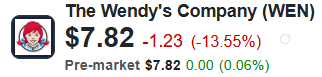
Wendy's (WEN) Quote

Verdict: The evaporation of the rumored take private premium puts severe fundamental deterioration back at the center of the story, forcing investors to price the stock mainly on standalone metrics that currently feature falling US sales, shrinking market share, and plunging traffic.

What happened

Reuters reported Wednesday evening that Nelson Peltz's Trian Fund Management currently has no plans to make a take private bid for Wendy's. That is different from an official withdrawal because no formal offer was ever announced. Reuters said sources familiar with the matter cited concerns about Wendy's performance, valuation, and strategic direction, while also saying Trian is keeping an open mind about its future intentions. Shares fell roughly 13.5% on Thursday to about $7.82, wiping out most of the premium that followed the August 12 bid report.

The standalone reality is bleak. US traffic fell 12.5% in the second quarter, while US same restaurant sales declined 7.0%. Management withdrew its full year 2026 outlook and cut the quarterly dividend from $0.14 to $0.07 per share to create more flexibility to fund the turnaround.

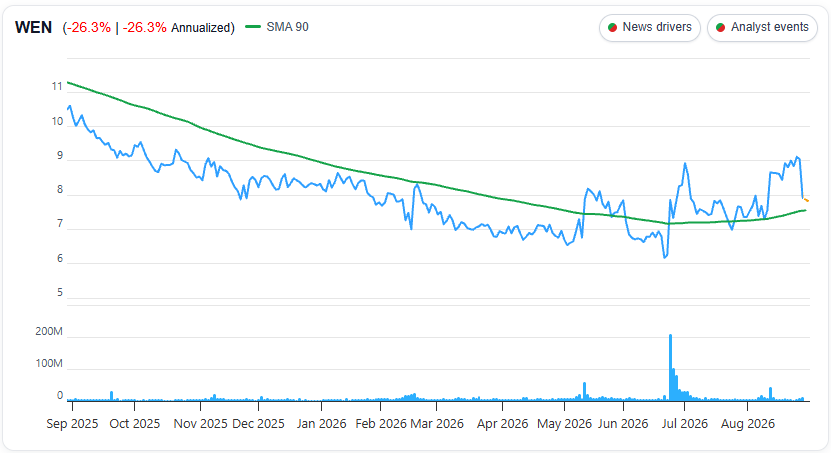
Wendys (WEN) 1 Year Chart

Wendy's 1 Year Chart

Why it matters

When a stock loses an active takeover narrative, the market pivots from deal speculation to a classic turnaround story. Wendy's also cut its annualized dividend from $0.56 to $0.28 per share, reducing the indicated yield to roughly 3.6% at Thursday's closing price. That weakens the income case at the same time the reported deal premium has disappeared, leaving fewer reasons for short term holders to stay.

What changed in the thesis

The bet has shifted from hoping for a possible buyout to trusting new Chief Executive Officer Bob Wright and his five point turnaround plan. Buyers must now believe the company can rebuild a quality menu at compelling value, improve marketing and operations, increase digital frequency, and use its restaurant base as an engine for growth, all while franchisee economics remain under pressure from weak traffic and rising costs.

What the market may be missing

Wendy's still generated $120.3 million of free cash flow during the first half of 2026, up 9.9% from a year earlier, which gives the company some room to fund the turnaround. But that improvement came from lower cash taxes, capital spending, and franchise development investments rather than stronger earnings. At the same time, the US restaurant base shrank by a net 81 locations in the second quarter and 245 through the first half. The cash flow buys time, but it does not prove the business has stabilized.

Valuation and expectations

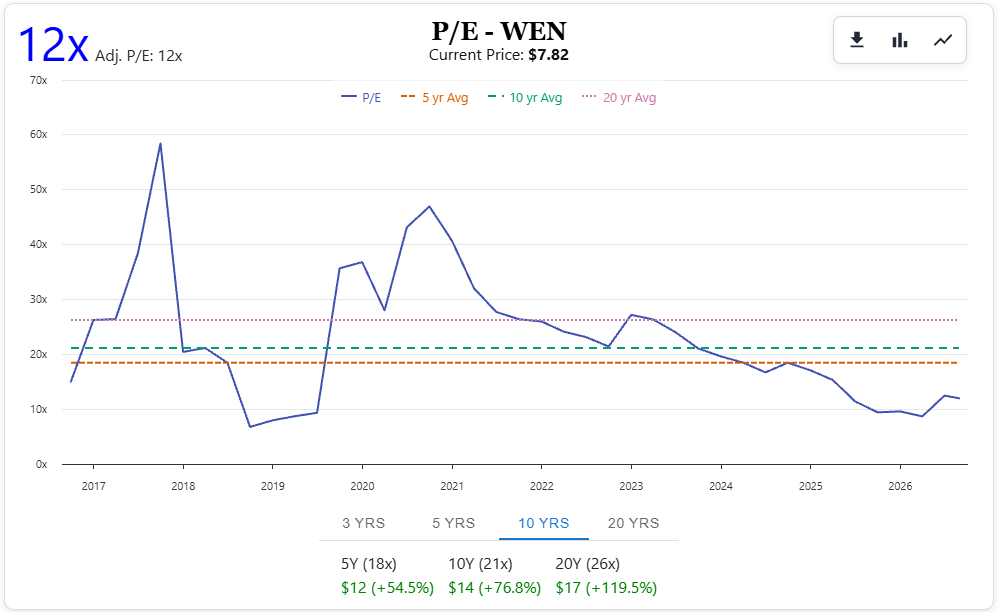
At Thursday's close, Wendy's traded at roughly 12 times trailing GAAP earnings. That looks cheap beside larger franchised peers, but the price to earnings ratio does not capture the balance sheet risk. Wendy's ended the second quarter with about $2.75 billion of long term debt, including current maturities, against $341 million of cash, while first half net interest expense rose about 9%. Management has also acknowledged that cost cutting weakened food quality, and second quarter operating profit fell 24%. If the turnaround requires heavier spending or lower restaurant margins to fix the core product, earnings estimates could still move lower.

Wendys (WEN) PE Ratio

Wendy's (WEN) PE Ratio

Bottom line

A cheap multiple is only a bargain if the underlying business can stabilize. Until third quarter traffic and same restaurant sales show real improvement, Wendy's lacks operational momentum, while the reported buyout premium should not be treated as a dependable floor.

Pre Market Pulse

  • US equity futures are mixed ahead of Federal Reserve Chair Kevin Warsh's Jackson Hole remarks at 10:00 a.m, Dow futures are up about 0.2%, S&P 500 futures are near flat, and Nasdaq futures are down about 0.3%.

  • The yield on the US ten year Treasury note is near 4.68%.

Why it matters this morning

Interest rate signals directly affect the cost of capital and consumer spending power. For heavily franchised consumer discretionary stocks, a higher cost of capital makes funding restaurant upgrades more expensive and keeps pressure on the lower income consumer base.

Peer Read Through

Restaurant Brands International (QSR)

Burger King has taken the number two position in US burger chain sales from Wendy's as its domestic turnaround gains traction. Burger King US comparable sales rose 8.5% in the second quarter. QSR trades at roughly 21.0 times trailing GAAP earnings with an indicated dividend yield near 3.3%.

McDonald's (MCD)

The dominant market leader continues to command the largest share of the US burger market and trades at roughly 21.1 times trailing GAAP earnings.

Yum Brands (YUM)

The globally diversified parent of Taco Bell remains a useful comparison for a heavily franchised restaurant model and trades at roughly 19.0 times trailing GAAP earnings.

Group takeaway

The quick service sector is splitting into clear winners and losers. Brands with positive sales momentum and healthy franchisee economics still command higher multiples, while companies losing traffic and market share are being valued like turnarounds.

What to Watch

  • Third quarter traffic and same restaurant sales to see whether the customer bleed has slowed.

  • Any new Schedule 13D amendments from Trian that signal a change in its ownership or intentions.

  • Early signs that new Chief Marketing and Customer Growth Officer Tariq Hassan is improving Wendy's value message, digital engagement, and customer frequency.

  • Updates on franchisee health and restaurant closure rates amid higher commodity and labor costs.

Bottom line

The immediate focus shifts from boardroom drama to store level execution. If the new value menu and new marketing leadership fail to bring customers back over the next few quarters, weak franchisee economics and continued restaurant closures could become a larger problem.

STOCKS IN THIS ARTICLE

Also Mentions:

Comments